A Play of Passion

Colin_Ainsworth_Headshot2Tenor Colin Ainsworth and pianist Stephen Ralls today presented three song cycles written for them by Derek Holman.  The first, The Death of Orpheus (2004) sets two translations of Ovid by Arthur Golding; on the subject of Orpheus in the underworld sandwiching Shakespeare’s Sonnet XVIII.  The parts form an interesting contrast.  In the Ovid, Golding chose to write in rhyming iambic heptameters but Holman’s setting completely ignores that, breaking and reshaping the lines very freely.  The piano line too is spare and more a commentary on the vocal line than a support.  In contrast the Shakespeare is set much more “faithfully”; piano and vocal line both reflecting more closely the metre of the verse.  Holman also rarely repeats a phrase of the text) it happens maybe five times in the eleven songs in today’s programme) which puts quite a burden on the listener given the allusive complexity of Ovid/Golding’s verse. Continue reading

Why productions succeed in one place but not another?

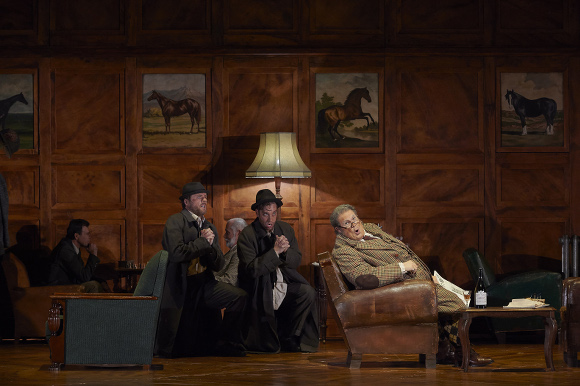
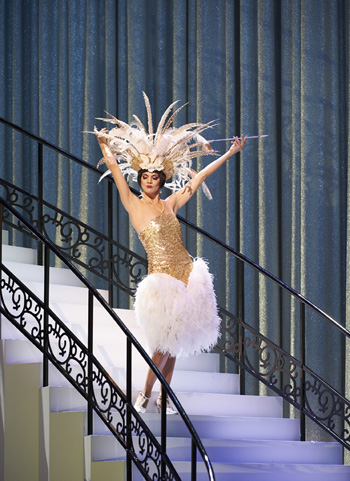
12-13-02-b-MC-D-3024In an age of co-productions many opera productions are seen in multiple houses.  Some of them we get to see in multiple guises.  For example I’ve seen Tcherniakov’s Don Giovanni on DVD and will be seeing it live later this season in Toronto.  Spmething that’s been fermenting in my brain for a while now is why the same production can get a drastically different reception in different places.  The piece that first made me think about this was Chris Alden’s Die Fledermaus.  This was generally well received in Toronto (more perhaps by my friends and acquaintances than the print media but that’s par for the course) but universally panned in London when it played at ENO.  Bryan’s interesting comments about the Carsen Falstaff kicked off the train of thought again and made me want to put some tentative thoughts into writing.

Continue reading

The Revengers’ Comedy

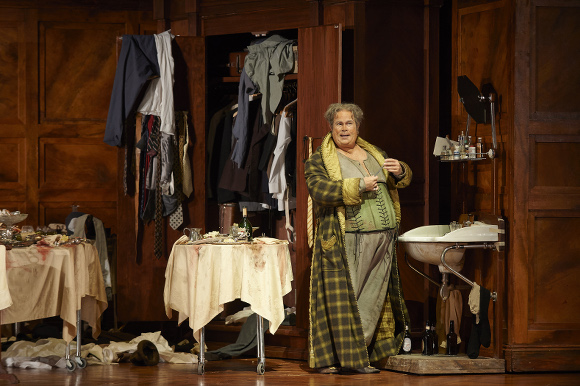
Last night, the COC opened its 2014/15 season with Verdi’s Falstaff; a work I was not familiar with and one that turned out to be a bit of a surprise.  It’s not your usual Verdi.  It’s his last opera, composed when he was 80, and is not at all typical of his earlier work.  There are hardly any “big tunes” or even conventional arias.  The odd chorus harks back to an earlier style but much of the music is quite dark; heavy use in places of the lower pitched instruments, especially for a “comedy”.  Don’t take that as a criticism though.  It’s a musically and dramatically tight, even compact, work that is both incredibly funny and also something more disturbing.  Perhaps it’s as much about mortality as love.

Falstaff-MC-1533 Continue reading

Moving into October

October is the month things usually really get going again in Toronto and this year is no exception.  The calendar for the first third of the month is very busy.  Highlights include three free concerts in the Richard Bradshaw Amphitheatre, the opening of two productions at the Canadian Opera Company and Nuit Blanche events at the Canadian Music Centre and the UoT Music Department.

fall101308_6 Continue reading

That elusive new audience

tumblr_m6l1rgQ65g1ra9bpvo7_1280The other night I was chatting to some folks at a performance by Loose TEA Theatre and a comment was made to the effect that it was companies like Loose TEA and Against the Grain who were creating the future audience for opera.  I didn’t think about it much of the time but it turned into a sort of brainworm that wouldn’t go away.  I don’t think the idea was that somehow innovative “pop up” type companies would replace the likes of the COC; at least not this side of nuclear war or total economic collapse (neither of which seems impossible it has to be said).  So the hypothesis has to be that this sort of endeavour makes a significant contribution to replacing the aging “big house” audience.  As I began to mull that over and further stimulated by yet another fact free piece in The Guardian on “opera snobs” (courtesy of Schmopera) I started to develop a number of lines of enquiry that aren’t exactly tangential to the original hypothesis but rather seem more like a set of eigenvectors defining the problem space.  Which is a mathematician’s way of saying that what follows is kind of all over the place.

Continue reading

This season’s free concerts in the RBA

rbaThe Canadian Opera Company has just announced the 14/15 line up for the free lunchtime (mostly) concerts in the very beautiful Richard Bradshaw Amphitheatre at the Four Seasons Centre.  Highlights, from my point of view, include recitals by Jane Archibald, Krisztina Szabó, Lauren Segal, Colin Ainsworth, Joshua Hopkins, Robert Gleadow, Barbara Hannigan and Ekaterina Gubanova.  There will also be ten concerts by the Ensemble Studio plus the Quilico competition.  The Canadian Art Song Project will showcase Allyson McHardy in a new song cycle by Marjan Mozetich.  There’s also a themed series of concerts  to commemorate anniversaries of the First and Second World Wars, and the fall of the Berlin Wall. This will comprise six concerts drawn from the Vocal, Chamber Music and Piano Virtuoso programs.

That’s just the tip of the iceberg.  There are vocal, chamber, piano, dance, jazz and world music programs to suit a very wide range of tastes.  And it’s all free.  Full details at http://www.coc.ca/PerformancesAndTickets/FreeConcertSeries.aspx

Mixed news on subscriptions from the COC

scalpers_322A recent press release from the COC states that they have (so far) sold 9870 subscriptions for next season with 1368 of those being new subscribers.  The renewal rate is apparently 79%.  A quick bit of arithmetic suggests that this season there were 10762 (or very close to) subscribers and that therefore 2260 of them did not renew.  So new subscribers are lagging drop outs by around 900.  We can assume that subscribers who intend to renew have already done so as the deadline for keeping one’s seats was April 30th.  There’s still plenty of time to close part of that gap of course but it does suggest a decline in the subscription base that’s consistent with experience everywhere else that uses the subscription model.

Continue reading

More “oy vey” than “¡Olé!”

First a disclaimer, I’m not a huge Massenet fan and even among his works Don Quichotte would rate pretty low with its cheesy melodies and faux Spanoiserie.  However, a good production has the potential to liven it up and a stellar cast is always a plus.  The run that opened at the Canadian Opera Company last night certainly had the latter in Ferruccio Furlanetto, Quinn Kelsey and Anita Rachvelishvili.  Unfortunately Linda Brovsky’s production looked and felt like one of Mr. Peter Gelb’s attempts to get the Broadway audience into the Met.  It was cluttered, unfocussed, pretty much devoid of ideas and didn’t even really make best use of the acting talents of the principals though Rashvelishvili did her best to inject some life into it.  It’s exactly what I feared when I heard they were going to use a real horse and donkey (later replaced by a mule in one of the more recent of the season’s casting problems at COC).  For me, one of those productions almost best listened to with eyes closed.

13-14-07-MC-D-0300 Continue reading

Lend me a tenor

ramirezThe saga of “Where in the world is Roberto Devereux?” at the COC continues.  Originally Giuseppe Filianoti was slated to sing the title role in the seven show run that began April 25th.  At some point, some while ago, it was announced that Leonardo Capalbo would sing the first three performances; which he did to some acclaim.  During the week the rumour mill started grinding with news that cover Edgar Ernesto Ramírez would sing tomorrow night’s show and, a bit later, that Filianoti was out completely.  All this has now been confirmed.  Mexican born Toronto resident Ramirez will sing tomorrow and then Spanish tenor José Bros will complete the run (or at least that’s the plan).  It’s a great break for Ramírez and we wish him luck.