The Merchant of Venice

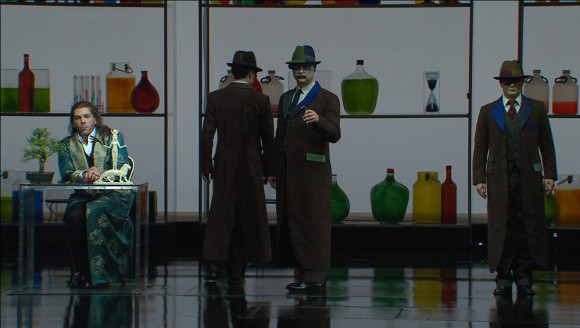
André Tchaikowsky’s The Merchant of Venice was written in the years leading up to his premature death in 1982 but, despite interest from ENO in the 1980s, it did not get a full performance until David Pountney decided to stage it at the the 2013 Bregenz Festival with Keith Warner directing.  It’s hard to explain the neglect though Pountney ascribes it some degree as the fate of the emigré  (the composer being a Polish Jew domiciled in the UK).  The Merchant of Venice is a really solid piece.  It’s got all the elements; a strong story, a really interesting but not overly intimidating score and really good writing for voice (it really is singable).  It’s the right length at around two and a half hours and it doesn’t call for unreasonable orchestral or vocal forces.  John O’Brien’s libretto even manages to overcome some of the objections to staging Shakespeare’s play.  While one might consider the Shakespeare piece to be antisemitic, O’Brien’s libretto is much more clearly about anti-semitism.  There’s also a clear homoerotic element in the Antonio – Bassanio relationship and perhaps too in Portia – Nerissa.

mov1

Continue reading

A weirdly eclectic Fidelio

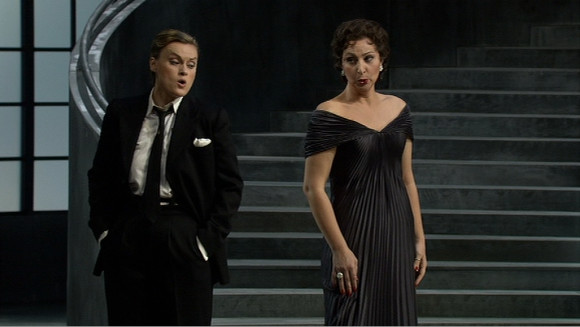
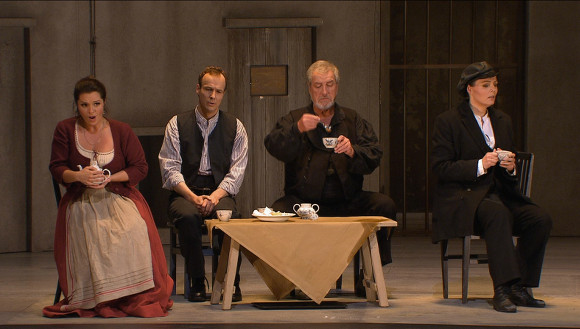
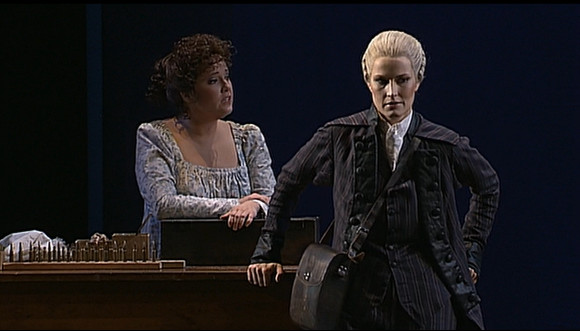
I’m really not sure what to make of Jürgen Flimm’s 2004 production of Fidelio for the Zürich Opera House.  It’s not offensive and it doesn’t really get in the way of the story but it seems quite devoid of originality beyond mixing styles in a way one might describe as anachronistic if one could figure out when synchronistic would be.  Rocco wears a sort of frock coat with, apparently, goatskin pants, Marzellina’s dress looks probably 20th century, bolt action magazine fed rifles are apparently muzzle loaded and metal cartridge cases filled by hand.  Then to cap it off when Don Fernando shows up he looks like he’s stepped straight out of a Zeffirelli production of Der Rosenkavalier.  So “nul points” for coherence.  For once one rather appreciates that so much of the action takes place in the dark.

1.marzfid Continue reading

Starkly beautiful Carmen

Matthias Hartmann’s staging of Carmen for the Opernhaus Zürich recorded in 2008 is starkly simple but very beautiful and provides a perfect vehicle for the considerable talents of Vesselina Kasarova and Jonas Kaufmann.  The set consists of a plain backdrop and a raised elliptical disk, reminiscent of a bull ring.  A few, very few, props are added as needed.  A dog lies asleep at the front of the set (replaced by a cattle skull in the final act).

1.set Continue reading

Spuren der Verirrten

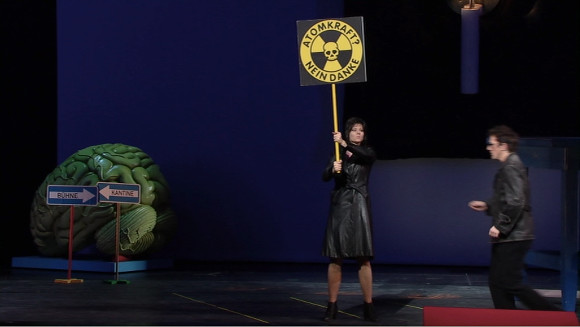
Spuren der Verirrten (The Lost) is described on the box as an opera by Philip Glass.  That’s pretty misleading.  It’s more a theatre piece/ballet by David Pountney and Amin Hosseinpour with a soundtrack by Philip Glass.  It was created for the opening of the new Landestheater Linz at the instigation of Artistic Director Rainer Mennicken (carefully trimmed beard, wire rimmed glasses) who wanted a piece that would encapsulate all the various theatrical forms the new building would stage, as well as show off its technical capabilities.  Mennicken also wrote the “libretto” based on a highly abstract play by Peter Handke which seems to deal with the hopelessness of the human condition in some sort of post apocalyptic world.  There’s no plot as such and the work unfolds in a series of scenes.  For example there’s a ballerina point shoeing across the stage followed by a “spectator” in the auditorium commenting on the action followed by dancers with roadsigns followed by a Gumby like couple sitting under a table followed by more narration.  Then come more dancers in Hosseinpour’s signature “jerky” style followed by a woman with an anti-nuclear sign having a row with her boyfriend in front of a giant green brain.  And that’s just the first ten minutes of a piece that goes on for nearly two hours.  Along the way we get a reality TV show in which the characters discuss whether a serial killer is worse than a goalkeeper who lets in a soft goal, a confrontation between the patriarch Abraham and a giant rabbit and a scene where a naked woman cuddles a human head while two dancers do the fish slapping dance around her.  The piece concludes with the orchestra on stage and the chorus in the pit miming playing instruments and singing “blah, blah, blah” which actually fits the music pretty well.

1.atomkraft Continue reading

For pity’s sake

I’ve been involved in a lot of on-line discussions about various productions; live and DVD, of La clemenza di Tito.  Oddly perhaps, none of them have ever referenced the 2005 Zürich recording with Jonas Kaufmann in the title role.  Today I think I found out why.  Basically it’s rather dull, except where it’s unintentionally funny.

1.sestovitellia Continue reading

Pelléas for dummies

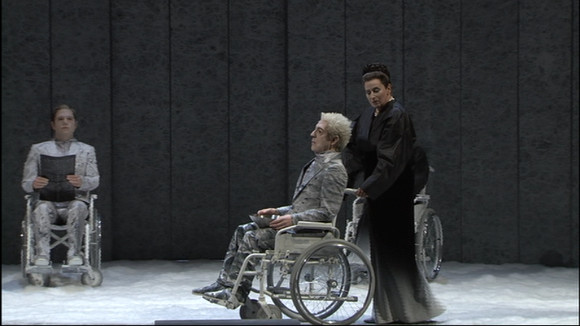
The most obvious feature of Sven-Eric Bechtolf’s Pelléas et Mélisande is the use of dummies to double up the characters.  Much of the time these doubles are lying around or being pushed around the set wheelchairs by the singers.  Most of the time the singers address themselves to one of the dummies even when the “real” version of the person they are addressing is on stage.  I guess it’s designed to create a kind of emotional distancing or dehumanising that does seem in keeping with the piece and, when the convention is broken, ie; characters interact directly, that seems to heighten the drama at that point.

1.wheelchairs Continue reading

O namenlose Freude

Katharina Thalbach sets her Fidelio, filmed at Zürich in 2008, somewhere in the early 20th century.  Most of the costuming suggests very early but Don Pizzaro’s suit suggests 20s/30s gangster.  Maybe he’s just fashion forward. The story telling is fairly straightforward and there’s no big concept.  There are a few, smallish, touches.  For example, the prisoners seem to be playing basketball with Don Pizarro’s head in the conclusion.  The sets are literal but evocatively lit and rather effective.

1.quartet Continue reading

Allons enfants de la Patrie

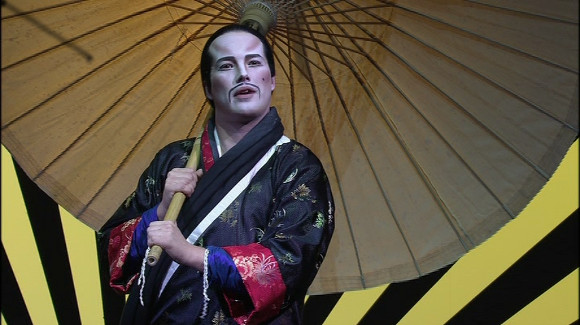
There can’t be many French Revolutionary propaganda comedies but Cherubini’s Koukourgi is one of them.  Written in the crisis year of 1792 and intended for the Théatre Feydeau it never actually made it onto the stage and remained unperformed until it was staged by the Stadttheater Klagenfurt in 2010.  By then the dialogues, the overture and the finale had been lost but music director Peter Marschik found a couple of bits from other Cherubini operas to fill the musical gaps and director Josef E. Köpplinger supplied rather arch German dialogue to link the musical numbers (sung in French).

1.koukourgi Continue reading

Orlando in Craiglockhart

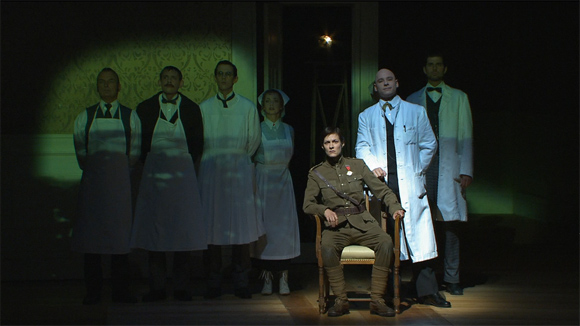
Handel’s Orlando is pretty classic opera seria stuff.  It’s based on an episode in Ariosto’s Orlando Furioso.  Orlando, a great soldier in Charlemagne’s army has lost his ardour for military glory because he has fallen desperately in love with the pagan princess Angelica, who is in turn in love with another man, Medoro. Orlando cannot accept this and he is driven to madness, prevented from causing absolute carnage only by the magician Zoroastro (who eventually restores his sanity).  There’s also a shepherdess, Dorinda, who is also in love with Medoro, but comes to accept her lot.  It’s all a bit daft and screams for a strong production concept.  In his 2008 Zürich production Jens-Daniel Herzog finds one.  He relocates the action to a military psychiatric hospital during, or just after, WW1.  Orlando is suffering from battle fatigue or PTSD and Zoroastro is a psychiatrist.  Angelica is still a princess but Dorinda has become a nurse.  It all works rather well.

Continue reading