 To Redeemer Lutheran Church last night for the first of two Friday evening concerts in the West End Micro Music Festival. This one was an exploration of baroque music and its derivatives though to quote co-curator Brad Cherwin, “What is baroque music? I don’t even know anymore”. Amen to that.
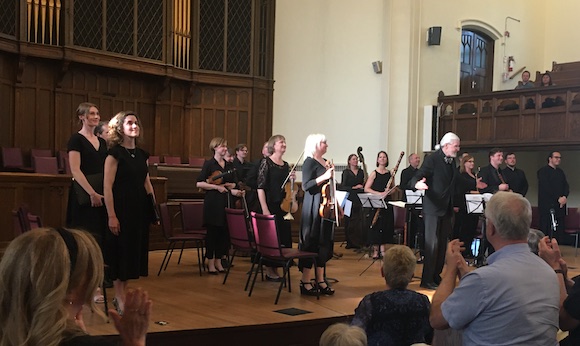
The first section of the programme consisted of three pieces for strings and harpsichord conducted by Simon Rivard run together as one. I found Linda Catlin Smith’s Sinfonia a bit formless and hard to get into especially when contrasted with the “attack” of the Vivaldi pieces (Sinfonia RV 169 and Concerto for Four Violins RV 580). Excellent playing though and I did like the Vivaldi.
Nahre Sol claims that all her music derives from the baroque; Bach, Vivaldi, Rameau. Who am I to argue? I can hear those influences but also others. Minimalism for sure, but where is that not an influence today? Also jazz, but not, as perhaps more typical, “the blues”. It’s more a cool jazz, sort of like John Dankworth. It flirts with schmaltz but recoils (in horror?) just when you think the saccharometer is going to go off the scale. It was interesting to hear it come together especially in the pieces scored for keyboards (variously piano, electronics, harpsichord with Sol often playing two at once), bass (both double and electric played by Ben Finley), with John Lee on Korean percussion. This section consisted of five pieces; three by Sol, one by Finley, one a collaboration. Tides (Sol) and Unexpected Turn (Finley) set the tone but it was the collab; Leaping Lightly and Sol’s Roundabout Bach that caught my attention most. They both use percussion in quite a visceral way with echoes of military march and tribal dance spiking the jazz/baroque soundscape to dramatic effect.
Continue reading →

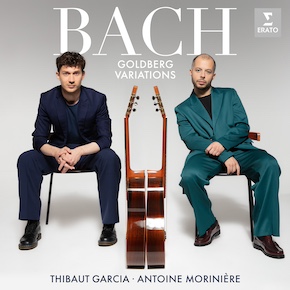 One tree, two guitars, one sound. This was the creative mission for Hugo Cuvilliez, guitar-maker and wood-whisperer from the Drôme region of south-eastern France: to honour the essence of a partnership with the sonic unity of one and the same instrument.
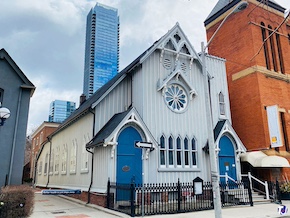 The final programme of Confluence Concerts season took place at Heliconian Hall on Wednesday night. It was billed as The Confluence Songbook and, if there was a theme, it was about doing live versions of music that had been streamed during the Plague. But really by the time we saw it it had outgrown that. For, in addition to the full line up of Confluence artistic associates there was a raft of guests which resulted in a fairly lengthy and very eclectic programme.
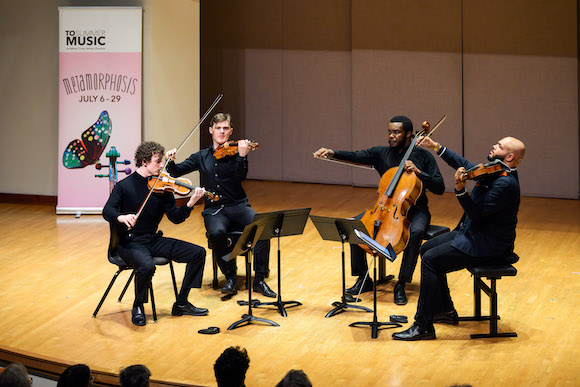
  The second concert in this year’s West End Micro Music Festival took place at Redeemer Lutheran Church on Friday night. Titled Alchemical Processes it featured a mix of early and modern works written or arranged for some combination of string quartet (Jennifer Murphy, Madlen Breckbill – violins, Laila Zakzook – viola, Philip Bergman – cello), harpsichord (Alexander Malikov) and clarinet or bass clarinet (Brad Cherwin).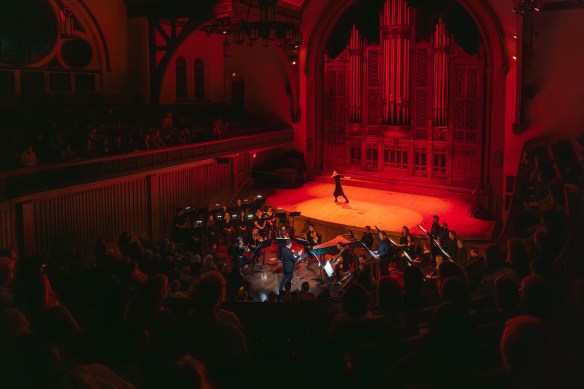

 To 918 Bathurst last night to hear the Happenstancers’ latest offering Hypersuite. The concept was to take movements from Bach suites and partitas for solo instrument and combine them into sets with (mostly) contemporary music of like form. The one exception was some Telemann but we’ll come to that.
 The second set had a lot in common with it. Brad Cherwin on clarinet played Augusta R. Thomas’ d(i)agon(als) followed by the sarabande from Bach’s Partita BWV 1013 (usually played on flute). This segued into Telemann’s fantasie 8 played on English horn by Aleh Remezau. Completely different from the first set; more melodic and dance like, these three pieces also had much in common.
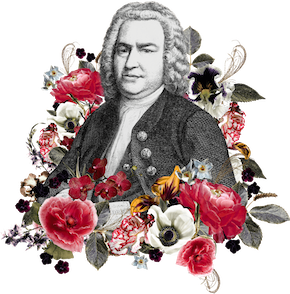 So to Eastminster United last night for the opening concert of the Toronto Bach Festival. We got three concerti bookended by (I think) a sinfonia from one of the cantatas; an excuse to show off the trumpets and timpani recruited for Sunday’s oratorios, and an arrangement of the Air on the G String. Festival director John Abberger contributed a scholarly programme note on the general issue of Bach concerti. Bottom line, there aren’t very many of them but they can be rearranged for a pretty wide range of instrumental options. Last night we got the Concerto for Oboe BWV1056, Concerto for Flute, Violin and Harpsichord BWV 1044 and the much better known Brandenburg Concerto No. 1 BWV 1046.
 operaramblings