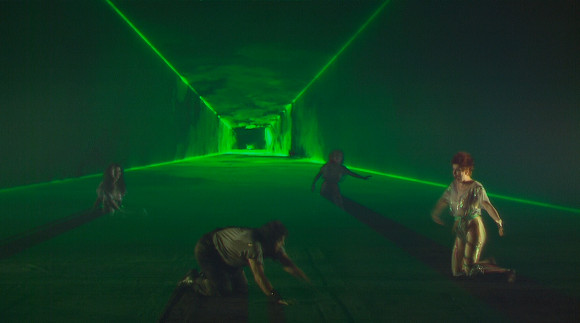
Chabrier’s one act opera Une Éducation Manquée has possibly the most implausible plot in all of opera. It concerns a young aristocratic French couple on their wedding night. The whole plot turns on them having no idea what they are supposed to do. Not only are they French but they rejoice in the names of Gontran de Boismassif and Hélène de la Cerisaie. Titter ye not! Fortunately it only takes them 47 minutes to figure things out because a Wagner work on this theme would be quite intolerable. I’m not sure why anybody would bother with this piece of fluff but it made it onto DVD in a performance recorded in Compiègne in 1994. It’s probably the most amusing thing out of there since someone faked up a video of Hitler dancing in front of a train carriage. Which isn’t saying a lot.
Albert Herring
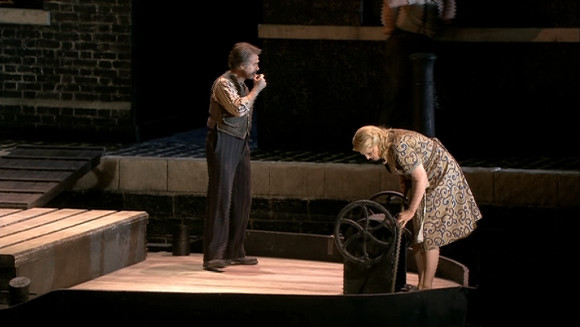
Britten’s Albert Herring is mysteriously under represented in the DVD catalogue. The work is performed quite often being relatively inexpensive to mount and suitable for smaller venues but the many productions haven’t led to many recordings. I have only been able to find one and that dates back to 1985 when it was recorded at Glyndebourne. That’s appropriate enough as that’s the house the piece premiered in in 1947. At least it’s a fair and effective representation of the work. Peter Hall’s production takes few liberties with the libretto and is a rather literal and effective, if necessarily somewhat caricatured, representation of life in a Suffolk village. The sets and costumes are evocative; especially the hall of Lady Billows’ house which really evokes a 17th century Great Hall and, as the view through the window tells us, is set in or close to the village, not in an isolated park. There’s quite a lot of that kind of attention to detail in this production.
You think this is funny, Beauty?
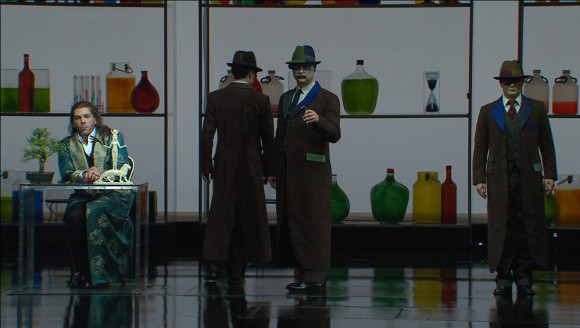
The DVD version of Michael Sturminger’s Giacomo Variations was recorded at the Ronacker Theater in Vienna in 2011. With the exception of Florian Boesch in the baritone role it’s the same line up as the performance in Toronto that I reviewed earlier this year. Watching the DVD didn’t change my views about the piece or the performances materially. It still feels a bit undercooked and schematic. I did like the quote on the DVD box about Malkovich’s singing from the Kürier “closer to Tom Waits than to Fritz Wunderlich”. I wish I’d said that.
Tapestry Briefs
Tapestry Briefs is the product of the Composer-Librettist Workshop run annually by Tapestry. Four composers and four librettists come up with sixteen ideas for a new opera and work up a scene from each. Last night twelve scenes from the most recent workshop were presented in a fully staged format with piano accompaniment in Ernest Balmer Studio and adjacent Distillery spaces. The quartet of singers for the evening was made up of some of Toronto’s top singer/actors; Carla Huhtanen, Krisztina Szabó, Keith Klassen and Peter McGillivray. Piano accompaniment was from Gregory Oh and Jennifer Tung.
Songs of Life and Love
Last night saw the launch of the first triennial Maureen Forrester Memorial Prize tour. Sponsored by Jeunesses Musicales Canada, soprano Simone Osborne and pianist Anne Larlee will tour some forty cities across Canada over the next two years performing material on the theme “Songs of Life and Love”. Each recital will include a new work; Birefringence, by Brian Current, commissioned by the Canadian Art Song Project. Continue reading
A feast of a Belshazzar
Handel’s Belshazzar, written as an oratorio, was staged at the Aix-en-Provence festival in 2008. It works really well as a stage work. The plot is straightforward but dramatic. Impious Babylonian king Belshazzar is being besieged by the virtuous Cyrus of Persia. Babylon is impregnable but a combination of Babylonian impiety and divine intervention on behalf of Cyrus(*) leads to Cyrus’ capture of the city, the death of Belshazzar and, almost incidentally, the liberation of the Jews.
Staging Handel’s oratorios
I’ve been watching a few staged versions of Handel oratorios recently and I’ve come to the conclusion that, in general, I prefer them to his Italian operas. It’s not just that they have really good plots they are also musically much more interesting than the operas. For the stage Handel stuck pretty firmly to the conventions of opera seria. Da capo aria succeeds da capo aria and only occasionally does a chorus or a duet break out and that bit is often the musical highlight of the piece, to my mind at least. Think of Io t’abbraccio in Rodelinda; surely the highlight of the whole work. In the oratorios Handel seems to feel much freer to use multiple forms and, of course, he writes magnificent choruses. Continue reading
Fear and loathing in Corinth
Cherubini’s 1797 opéra comique Médée was one of the first to use the form for serious drama. Krzysztof Warlikowski’s 2011 production filmed at La Monnaie in Brussels is certainly that. Jason, Medea and the rest are very contemporary characters though we often see them against a backdrop of 1960s style home movies and the chorus too, which tends to remain in the background also seems to be from the same period.The meaning of this juxtaposirtion isn’t clear and there is nothing on the disks or in the documentation to help. We are also told that the libretto was adapted by Warlikowski and dramaturge Christian Longchamp but nothing more than that. This is definitely a production where the director’s notes would be a major plus.
Jealousy, rage, love and fear
It’s a curious thing how some works get over recorded and others are almost entirely neglected. For example, there’s only one video recording of Weill’s Die Dreigroschenoper and that a 1931 film that omits huge chunks of the stage work. It’s inspiration fares little better. There’s only one video recording of The Beggar’s Opera by Johann Pepusch and John Gay. It’s a 1963 BBC TV production of Benjamin Britten’s reworking of the piece for the English Opera Group based on a stage production by Colin Graham. [ETA: There are actually two other versions; a 1953 movie version with Lawrence Olivier and a 1980s version with Roger Daltrey and John Eliot Gardiner].
Opera Five gala
So Toronto’s weather took a weird twist pushing the Humidex into the 40s just in time for the Opera Five movie themed fundraiser at Atelier Rosemarie Umetsu last night. And some people still managed to wear suits and ties and stuff. Made of sterner stuff than me I tell you. And even more props to the ladies who were sporting Rosemarie’s creations. They looked great but some of them must have been hell in the heat.
It was an interesting format with seven singers and two pianists appearing in various combinations and guests having an opportunity to sponsor a singer to sing their “feature” aria. It was fun and there were some fine singers on display. Two I’ve seen and enjoyed in the past were baritone Geoffrey Sirett and coloratura soprano Teiya Kasahara. Both were on good form with some fine Escamillo from Geoffrey and the mad scene from Lucia from Teiya in a rather good arrangement for voice, flute and piano. The other five were new to me but I’d happily go see any of them. Favourite moments for me would be some fine Carmen from the unpronounceable Olenka Harasymowycz (who looks disturbingly like Maria Ewing), a very cute “Poor Wandering One” from Caitlin Wood and a very fine “Ebben…” (from Catalani’s La Wally) from Calgary’s Krista de Silva. Accompaniment was from music director Mai Nash and Jo Greenaway on piano with flautist Amelia Lyon.
So, a fun event which seemed to be raising quite a bit of much needed cash. The first show it will be helping fund is In Pace Requiescat; a trio of one act operas based on Edgar Allen Poe stories. There will be The Cask of Amontillado by Daniel Pinkham, La Chute de la Maison d’Usher by Claude Debussy and the world première of The Masque of the Red Death by Cecilia Livingston. Performances will be at the Arts and letters Club on Elm Street on the 27th, 30th and 31st of October. Tickets are available from 05inpace.eventbrite.ca and are $30 ($25 concessions).