La tragédie de Carmen

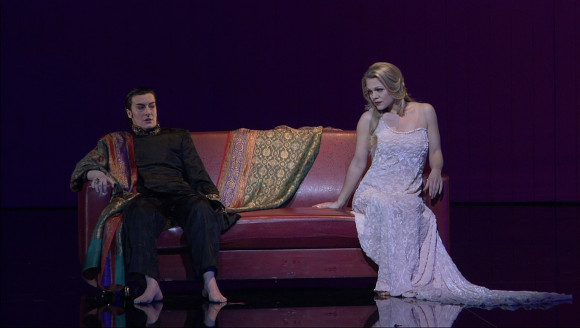
warnerLa tragédie de Carmen is a stripped down version of Bizet’s opera originally created by Peter Brook some thirty years ago.  It dispenses with the chorus and most of the minor characters to focus in on the central drama of Carmen, Micaëla, Don José and Escamillo with some support from Zuniga and Lillas Pastia.  In Loose TEA Theatre’s version the action is transferred to New York in the 1920s and given a night club/mob setting which stretches the libretto but allows the rather striking Cassandra Warner to appear in some quite stunning outfits.

The piece is very condensed.  It runs maybe 80 minutes.  Presented in a small space like Buddies in bad times it becomes almost unbearably intense, especially when presented by fine actors as it was here.  Central to the whole thing is Warner’s stunning Carmen.  She is very good looking in a rather angular 1920s sort of way.  She can act and she has a really good voice.  The tone is genuine mezzo but she seems quite comfortable well up into soprano territory.  The overall effect was extremely sexy.

Continue reading

More season announcements

suzieleblancToronto Masque Theatre has announced the line up for the 2013/14 season.  There are three main stage productions.  First up is Patrick Garland’s now classic play Brief Lives, based on John Aubrey with song and music from 17th century London. Second is a revival of Tears of a Clown, under a new title, Arlecchino Allegro. Finally, there is a reinterpreted classic from the world canon teamed up with a contemporary interpretation in the Myth of Europa.  Details for the shows are as follows:

Continue reading

Can Bayreuth really tackle Meistersinger?

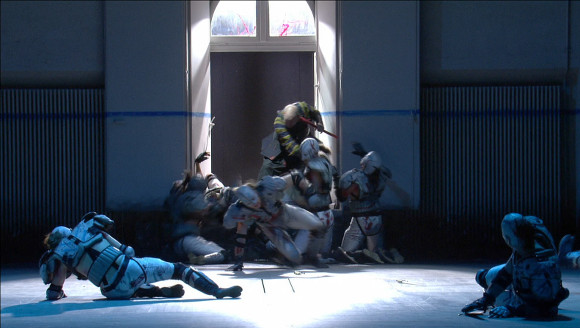
Die Meistersinger is a problematic opera, particularly for Bayreuth.  It has rather disturbing elements of German nationalism and a performance tradition at the festival of those being used for ends that most people would rather be able to forget.  No surprise then that Katharina Wagner’s production, recorded in 2008, tries to deal with both.  It’s a bold effort.  Like Robert Carsen’s Tannhäuser it tries to use visual art as a metaphor for music and art in general.

1.walther Continue reading

Brünnhilde lives

The concluding instalment of Kasper Holten’s Copenhagen Ring really does wrap it up as Brünnhilde’s story.  It’s very effective in so doing too.  Holten states that the central problem in interpreting the Ring is the ending and he points out that Wagner struggled with it for years before resorting to what Holten sees as a cop out; the tired, patriarchal device of wrapping things up by having the heroine sacrifice herself for her man.  Holten rejects this and instead offers us a living Brünnhilde as a symbol of hope and renewal at the end of a century of terrible strife.  I wish I were as optimistic.

1.norns Continue reading

Lotfi Mansouri

So two “obituaries” on the trot.  Now Lotfi Mansouri is gone.  He was an interesting, larger than life, character.  Arguably he was born in the wrong age.  He would have been perfect in the days of entrepreneurial opera company owner/directors.  17th century Venice, London in Handel’s day or the US of the turn of the century would all have been natural homes.  His ability to cut a deal, to charm money out of the rich, to persuade legendary singers to perform in opera backwaters and to create spectacle while counting the pennies were amazing.  Was he so well suited for an age of complex artistic cultural politics and changing trends in opera production?  Perhaps not.

Tannenbaum_Opera_Centre_2009 Continue reading

Heaneygone

Saddened by the news of the death of the great Seamus Heaney, I took some time out from opera last night to listen to the man reading his translation of Beowulf.  Some scholars may disparage the freedom of the translation but I love it.  I own, I think, four different translations of Beowulf and the Heaney is much my favourite.

This is a shot of the Folio Society bilingual edition (original poem, Heaney translation).  It's a glorious thing. Continue reading

Meyerbeer in the museum

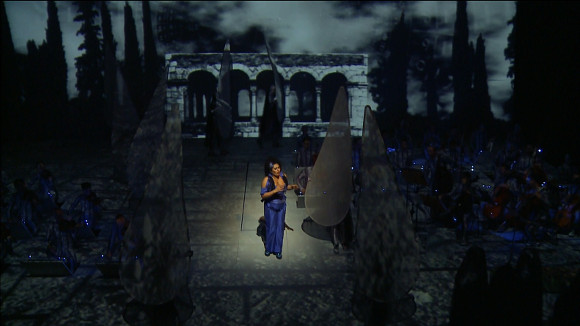
Meyerbeer’s L’Africaine was a huge hit in Paris, London and New York when it premiered in 1865.  I’m not sure why.  It has all of the things that make Meyerbeer seem very dated and not as much of the good stuff as Les Huguenots, or even Dinorah.  It’s ostensibly about Vasco de Gama but that’s just a peg to pin a love triangle and a bunch of exoticism on.  Are we actually supposed to believe that the Portugese wanted to find a way around the Cape to find out what was there?  It would have been a lot easier to get hold of a copy of Herodotus.  It’s also long.  Even with cuts it runs well over three hours in the version recorded at San Francisco Opera in 1988.

1.room Continue reading

The price is right

simoneThe best bargain of the Toronto music season is the free lunchtime concert series at the Four Seasons Centre.  The 2013/14 line up was announced today.  Opera and vocal highlights include recitals by Sir Thomas Allen (Songs of the Sea, which sounds rather excellent), Simone Osborne, Robert Pomakov with The Gryphon Trio, Tracey Dahl, Russell Braun and Paul Appleby.  Somewhat off the beaten track, there will be a performance of Gagliano’s La Dafne by Capella Intima and the Toronto Continuo Collective and the Canadian Art Song project will be premiering a new commission by a Canadian composer.  There will also be the usual (and very popular) sessions from the COC Ensemble Studio (including two Britten themed concerts), the students of the University of Toronto opera division and the young artists of the Atelier lyrique de l’Opéra de Montréal.

For the less vocally inclined there is also a full line up of piano, chamber music, world music, jazz and dance.  Here’s the full PDF brochure.

Ponnelle’s Ulisse

Il ritorno d’Ulisse in Patria is the third of the Ponnelle/Harnoncourt Monteverdi collaborations and perhaps the best.  Itseems to stick closer to the original Zürich staging and be less obviously a film though it was recorded in the studio and lip synched.  The orchestra and conductor are visible and, in Act 3, Irus descends into the pit throws himself all over Harnoncourt.  It’s the conductor too who gives him the knife he kills himself with.  Is this the first (of many) times when Harnoncourt has been drawn into the theatrical action?

1.penelope Continue reading