Distant Light

distantlightRenée Fleming’s new CD Distant Light is quite unusual for a “diva disc”.  It’s definitely not “Opera’s Greatest Hits” territory.  Rather, it’s in three quite contrasting parts though all are linked by the idea of “emotional landscapes”.  It starts off with Samuel Barber’s Knoxville: Summer of 1915, follows it with settings of Mark Strand poems by Anders Hillborg and finishes up with arrangements of Björk songs.  She’s accompanied throughout by the Royal Stockholm Philharmonic Orchestra with Sakari Oramo conducting.

The Barber piece sets a text by James Agee which is quite fragmentary and not obviously singable.  Barber gives it a setting that varies quite a lot in mood and is full of melodic and rhythmic invention.  It’s very Barber actually.  Fleming is good here.  Her voice is true and clean with no harshness in the upper register and her diction is excellent.  It’s not often that the text in a high soprano setting is this comprehensible.
Continue reading

Like the 504 streetcar

Season announcements, it seems, are like the King Street streetcar(1).  You wait for ages then three come along at once.  This time it’s Opera Atelier announcing the 2017/18 season.  As ever there are two productions.  A remount of Mozart’s The Marriage of Figaro runs October 26th to November 4th. The cast icludes Douglas Williams, making his Opera Atelier debut, in the title role, with Mireille Asselin (Susanna), Stephen Hegedus (Count Almaviva), Peggy Kriha Dye (Countess Almaviva), Mireille Lebel (Cherubino), Laura Pudwell (Marcellina), Gustav Andreassen (Bartolo), Christopher Enns (Basilio/Don Curzio), Olivier Laquerre (Antonio), and Grace Lee (Barbarina).  This one will be sung in English.

oafigaro

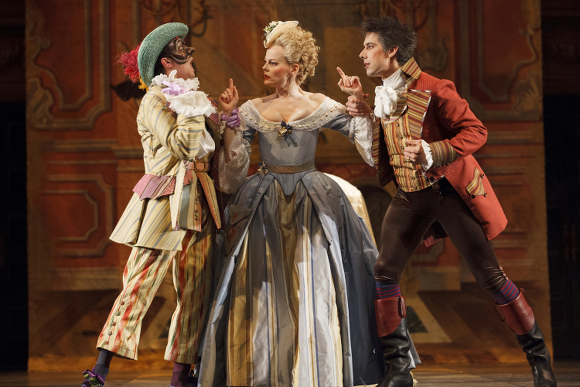
Patrick Jang, Carla Huhtanen and Phillip Addis in “The Marriage of Figaro” (2010).  Photo by Bruce Zinger.

Continue reading

And now, the TSO

tso-music-director-peter-oundjian-photo-credit-sian-richardsHot on the heels of the RCM, the Toronto Symphony has announced its 2017/18 season, whih will be Peter Oundjian’s last as Music Director.  There’s lots of sesquicentennial stuff of course but here’s a summary of the interesting vocal stuff (rock and roll and other children’s music omitted).
September 27,28 and 30, 2017: Brahm’s German Requiem with Erin Wall and Russell Braun.

October 19 and 20, 2017: Mahler’s Das Lied von der Erde with Susan Platts and Michael Schade.  This is billed as a Maureen Forrester commemoration.

November 9 and 11, 2017: Jeffrey Ryan’s Afghanistan:Requiem for a Generation with Measha Brueggergosman, Alysson McHardy, Colin Ainsworth and Brett Polegato.

December 16, 19, 20, 22 and 23, 2017: Handel’s Messiah with Karina Gauvin, Kristina Szabó, Frédéric Antoun and Joshua Hopkins.

April 26 and 28, 2018: A concert performance of Bernstein’s Candide with Tracy Dahl, Judith Forst, Nicholas Phan and Richard Suart.

June 2 and 3, 2018: A concert called Water Music with Leslie Ann Bradley singing Dvorak, Schubert and Mozart.

June 28 and 29, 2018:  Peter Oundjian signs off with a Beethoven 9.  Soloists tba.

Full details here.


Lost in a Russian Forest

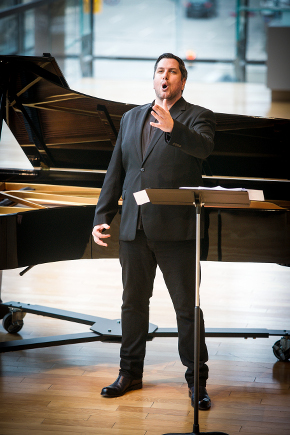
SONY DSCCroatian bass Goran Jurić is currently making his North American debut as Sarastro in the COC’s Magic Flute.  Today he gave a lunchtime recital with Anne Larlee in the RBA.  It was an all Russian programme; Tchaikovsky, Rachmaninov and Sviridov.  I don’t want to do a blow by blow review because I don’t know the rep well enough and it seems a bit pointless.  Instead let’s talk about Jurić as an artist, as shown by his performance here (and not surprisingly as Sarastro).  He’s a genuine bass, no messing.  The low notes are all there and the timbre is rich and dark when he wants it to be.  But he’s also extremely lyrical.  He can lighten up without ever stopping sounding like a bass.  It’s a most pleasant combination.  He’s also a terrific storyteller.  This seems like an odd thing to say about a recital where not a word was spoken and all the songs were in a language I scarcely understand at all, yet I felt he was communicating the essence of the text with great clarity as a good lieder singer must.  Anne was great as an accompanist too.  There was quite a lot of range in the piano parts from quite delicate and playful in some of the Sviridov to cranking the pedals up to 11 in some of the Rachmaninov.  A very good way to spend one’s lunch break.

Besides, it was great to see Anne Larlee back at the Four Seasons Centre and to discover a young bass who I want to hear a lot more of.  Fortunately he’s back next season as Osmin in Entführung.

Photo credit: Karen E. Reeves

Royal Conservatory 2017/18 Koerner Hall season

wallis-giunta-photo-dario-acostaThe Royal Conservatory has just announced its Koerner Hall line up for the 2017/18 season.  There are 23 classical and 6 jazz concerts.  This doesn’t include the Glenn Gould School or concerts in the RCM’s other halls.  Highlights from a vocal point of view are as follows:

November 10th 2017 at 8pm:  Barbara Hannigan with Reinbert de Leeuw in a mainly Second Vienna School programme.  Not to be missed if that’s your thing and it’s certainly mine.

February 14th 2018 at 8pm:  Ian Bostridge with Julius Drake in an all Schubert programme.

April 6th 2018 at 8pm:  Bernstein@100; a tribute to Lenny featuring, among others, Wallis Giunta.

April 22nd 2018 at 3pm:  Gerald Finley with Julius Drake in a varied program of art and folk songs.

April 27th 2018 at 8pm:  The Amici Ensemble with Isabel Bayrakdarian and the winners of the GGS chamber music competition.  The vocal part of the programme is all Bernstein.

May 10th 2018 at 8pm:  Not typical Opera Ramblings fare but worth a mention; Jodi Sarvall, Hespèrion XXI and Galician pipes specialist Carlos Núñez in a program of pipe music from around the western fringes of Europe.

The PDF with the full line up is here

Next week (mostly) in the RBA

woodley

Things are still a bit quiet on the vocal music front (the lull before the storm judging by my agenda) but there are a couple of free concerts of interest at noon in the RBA next week.  On Tuesday, bass Goran Jurić, currently singing Sarastro at the COC, is teaming up with Anne Larlee in an all Russian program featuring works by Rachmaninov, Tchaikovsky and Spiridov.  Then on Thursday there’s a concert in the chamber music series featuring the members of the COC orchestra academy.  But once again, the chamber series deceives because half of the program (at least) features soprano Jaqueline Woodley in a series of Handel arias.  Later, at 7pm at The Fifth Pubhouse, the COC is hosting Opera Trivia Night with trivia master Russell Harder.  It’s free but ticketed.  Tisckets from coc.ca or the Four Seasons box office.  The COC’s Magic Flute continues with the first chance to see the alternative cast on Sunday afternoon (29th) at the Four Seasons Centre, which is pretty close to sold out.  No doubt the matinee show will be a lot of kids’ first opera.

Magic Flute revived at COC

Last night saw the first performance of this season’s run of Mozart’s Die Zauberflöte at the COC.  It’s a revival of the Diane Paulus 2011 production with Ashlie Corcoran as revival director.  It has a “theatre within a theatre” overlay in Act 1; it’s supposed to be an aristocratic birthday party for Pamina where the guests perform the opera, which mysteriously disappears in Act 2 though it makes an odd reprise right at the end where all the characters appear to perform a country dance.  Strip that element out and it’s a workmanlike Flute with nothing much to say but some pretty visuals.  The animals are cute and the trials scene is rather well done.  There is one notable change from 2011.  Pamina’s lurid pink Disney princess outfit is gone, replaced by something Regencyish and far less jarring.

priests

Continue reading

Workshopping The Harvester again

stacie_3005bThis time last year I attended a workshop performance of a work in progress; Aaron Gervais’ The Harvester.  That time it was in piano score but semi staged.  Last night it was presented, at Gallery 345, in concert format but with chamber orchestra.  I’m not going to recap the plot etc because it’s all in last time’s review.  Let’s start by saying it’s coming along and I really look forward to seeing a fully staged version.

So, back to last night.  The concept is of a double bill of Schoenberg’s Erwartung in a chamber reduction followed by The Harvester so last night we started with half the Schoenberg (up to the discovery of her lover’s body).  The chamber reduction (by Aaron Gervais) for piano, three woodwinds, strings, horn and percussion works remarkably well.  The effect is similar (ironically) to Schoenberg’s chamber versions of Mahler’s songs.  Textures are clearer, if less lush, and the singer is less pushed for sheer volume which allows for a bit more subtlety.  It’s different but it works.  On this scale it’s a good fit for Stacie Dunlop; one of those singers who is an excellent musician and interpreter but is not a huge voice.

Continue reading

Cav and Pag

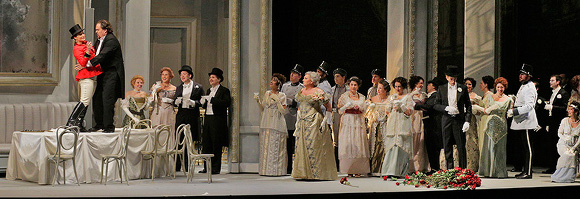
Mascagni’s Cavalleria Rusticana and Leoncavallo’s Pagliacci are not only a commonly coupled pair of operas but pretty much define the genre we call verismo.  It’s a curious genre in a lot of ways.  Musically it defines a style, brought to its highest state by Puccini, that is a sort of Fukuyama-esque “end of opera” after which everything is, for a section of the opera audience, modern, inaccessible and frightening.  It’s also dramatically an attempt to get away from stories from myth and history and root the drama in “stories of everyday folk”.  Which is fine, I suppose, if one believes the only things “everyday folk” care about are female constancy and the more pagan end of Catholicism for these stories tend to be a touch unsubtle; “she done him wrong so he killed her” (and her dog and he probably crashed her truck too).  It’s actually quite ironic that Puccini, held up as the arch exponent of verismo, rarely actually goes down this path.  Il Tabarro perhaps, maybe Suor Angelica, at a stretch Tosca but in large part his material is drawn from the usual well of opera plots.  So Cav and Pag is interesting as almost pure verismo.

cav1

Continue reading

COC 2017/18

Last night the Canadian Opera Company announced the line up for the 2017/18 season.  It was all pretty much as predicted.  My predictions post got five out of six right and Dylan was right on the money down to timing.  So what do we get?

The fall season features, finally, Tim Albery’s production of Strauss’ Arabella first seen at Santa Fe.  Erin Wall, as expected, takes the title role while Jane Archibald, in one of three season appearances, sings Zdenka.  The Mandryka will be one of the few high profile imports, Tomasz Konieczny.  There are welcome appearances for David Pomery as Matteo and Claire de Sevigné as Flakermilli.  It’s a season full of Ensemble Studio graduates.  Patrick Lange conducts.  Partnering Arabella is Donizetti’s L’elisir d’amore in a production by James Robinson adapted to set the piece in pre WW1 Niagara on the Lake.  Simone Osborne and Andrew Haji play Adina and Nemorino with Gordon Bintner as Belcore.  This is, I think, the first time I’ve seen husband and wife as soloists at the COC though the Pomeroys have been seen on stage together quite a few times.  Brit Andrew Shore rounds things out as Dulcemara.  Yves Abel makes his COC debut in the pit.

arabella

Continue reading