Mélodies of the Heart

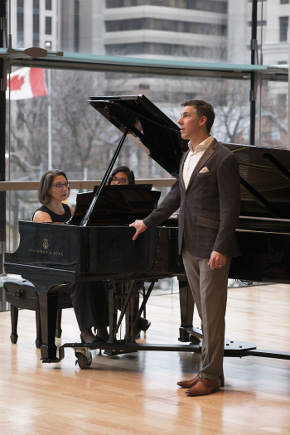
Yesterday’s concert in the RBA was dedicated to the late Stuart Hamilton, founding director of the COC’s Ensemble Studio.  Current members, mezzo Emily D’Angelo and baritone Bruno Roy, each gave us two sets of French songs accompanied respectively by Hyejin Kwon and Stéphane Mayer.  Ms. D’Angelo gave us Débussy’s Chansons de Bilitis and the curiously Débussy like Trois Mélodies by Messiaen.  Both sets are quite meditative and impressionistic and Ms. D’Angelo’s very beautiful voice suited them well.  There’s more there than beauty of tone.  She’s showing some interesting, very mezzoish, colours in the voice now and there’s clearly plenty of power in reserve as she showed on a couple of occasions.  It’s so easy to forget how young she is when a performance is this accomplished.  Ms. Kwon was a sympathetic accompanist.

And so to the boys who gave us Poulenc’s La fraîcheur et le feu and Ravel’s Don Quichotte à Dulcinée.  The Poulenc piece rather races along with the piano part, impressively played by Mayer, often much more interesting than the vocal line.  Roy was at his best in the more hectic passages where his diction and command of French were at a premium.  When the music became more expansive he didn’t quite seem able to expand with it; the voice lacking bloom in both upper and lower registers and with no real sense of some underlying power.  This was more of a handicap in the Don Quichotte songs.  Roy managed some decent physical and vocal acting, especially in the drinking song, but there just wasn’t enough heft to put in the swagger required in these pieces.

Prior to the  performances, the COC’s Janet Stubbs made a short speech in memory of Stuart which managed, in a very brief span, to convey both the impact he had on the Canadian and wider opera scene and a sense of his more endearing eccentricities.

Photos if and when.
Glenn Gould School Vocal Showcase

lillianbrooks

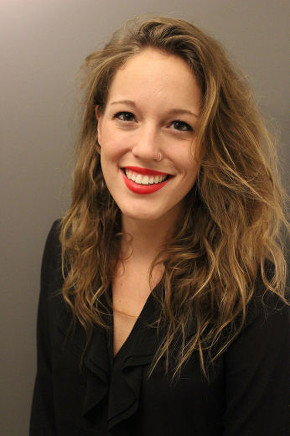
Lillian Brooks

The GGS Vocal Showcase is an opportunity to take a look at the vocal talent on offer at the Royal Conservatory.  It’s a tricky exercise as the students range from the equivalent of first year undergrad to second year masters so one is constantly recalibrating expectations.  We got to hear one bass, two baritones, three tenors, one mezzo soprano and fourteen sopranos in a variety of arias, art songs and ensemble numbers.

So, in no particular order my favourites and “ones to watch”.  Lets start with the obvious.  Gabriel Sanchez-Ortega is a genuine bass.  We only heard him in some Haydn trios last night but he seems to have heft and genuine low notes and quite a wide range.  He’s also still quite young.  Singing with him was soprano Joanna Burt who also gave us an aria from La Cecchina.  She has real potential as a dramatic soprano which is the one part of the tweeter market that isn’t flooded.  She has some nice dark colours as well as weight.  The trios were rounded out by tenor Zachary Rioux.  He held his own with two pretty big voices so we’ll see.

Continue reading

The week in prospect

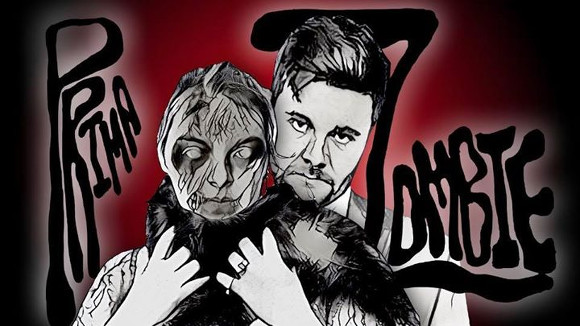
Tomorrow (Sunday) is a busy day.  There’s a matinée of Götterdämmerung at the COC with a few tickets still available.  UoT Opera is doing their annual student composer piece.  This year it’s called Prima Zombie and it’s based on the premise that a cabal of disgruntled music critics, disenchanted with the current state of opera, unearth and electrify the corpse of the celebrated 19th century diva Nellie Melba.  Mayhem ensues.  This one is in the MacMillan Theatre at 2.30 pm and it’s free.

3e4a80caf6

Continue reading

Magic Flute – the other cast

Last night I saw the alternate cast of the COC’s Magic Flute.  Owen McCausland swaps First Armed Man for Tamino with Andrew Haji, Kirsten MacKinnon comes in as Pamina, Phillip Addis is Papageno and Matt Boehler is Sarastro.  The changes don’t really affect things much at all.  All the new faces are very good.  MacKinnon is a very perky Pamina which works well with Addis who has maybe a bit more of the “cheeky chappy” than Hopkins.  Fans of Owen McCausland and Andrew Haji will see exactly the differences in timbre and vocal technique one would expect but the interpretation is pretty much the same.  Overall, I would say that someone not very familiar with these singers would scarcely notice any differences.  What I did notice is how much better this production looks from Ring 3 than from the Orchestra.  Getting something of a “plan view” makes the antics during the overture look less cluttered and frantic and the trials scene is much more effective.  And the sound is better too.

Photos by Michael Cooper under the fold. Continue reading

Twilight

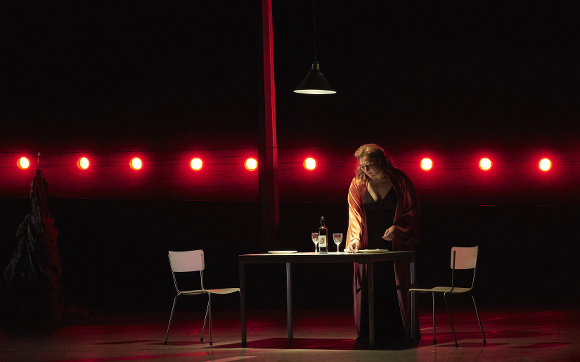
Last night the COC began its run of Götterdämmerung, the last and longest opera in Wagner’s epic tetralogy at The Four Seasons Centre.  It’s very different from Die Walküre and Siegfried.  The visual elements that tied them together; tottering Valhalla, disintegrating world ash, gantries, dancers, heaps of corpses are mostly gone.  In Tim Albery’s production the visuals are spare almost to abstraction.  The Gibichung Hall is a CEO suite with computer monitors and red couches, both Brünnhilde’s rock and the Rhinemaidens’ hang out look improvised, almost like squatters’ camps.  Costuming, apart from an occasional flashback, as in Waltraute’s scene, is severely modern business; grey suits, black dresses.  Only Siegfried himself in tee shirt and leather jacket stands out from the corporate crowd.  Dancing flames are replaced by red lights.  Everything that can be understated is and the world ends not with an overflowing Rhine and collapsing Valhalla but a stately pas de quatre between Brünnhilde and the Rhinemaidens.

gotterdammerung-mc-0646

Continue reading

The Killing Flower

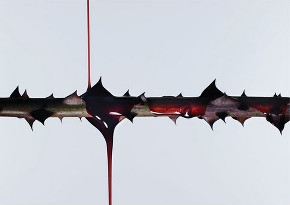
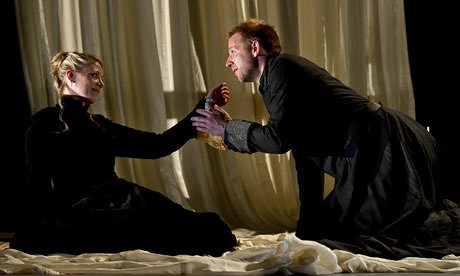
hqdefaultThe Killing Flower is an opera by Salvatore Sciarrino.  Both Italian and English versions exist and it was the latter that was given, in semistaged form, at Walter Hall as part of the Toronto New Music Festival last night.  It’s a very distinctive work and not easy to form a full appreciation of on a single hearing.  The plot is straightforward enough.  There’s a duke and duchess.  She falls in love with a guest.  They are betrayed by a servant.  He kills the guest and then her.  But all this happens in a highly abstracted way (made even more abstract by not being fully staged).  As the composer puts it:
My theatre is ‘post cinema’ theatre, beginning with the way the scenes are laid out – they proceed by dry blocks that ‘subtract’ in order to get the point across.

Got that?  Nor me but what I saw was a succession of scenes in which two characters exchanged fragments of text repeated multiple times.  This was actually quite useful as there were no surtitles and it made it easier to grasp what the (very few) words actually were.

Continue reading

Phillip Addis in the RBA

2017-01-31-fcs-addis-021Phillip Addis, currently one of two Papagenos at the COC, together with pianist Emily Hamper, gave yesterday’s lunchtime recital in the RBA.  First up were Ravel’s settings of Jules Rénard’s Histoires Naturelles.  These are quirky, fun pieces with sometimes quite complex, impressionistic piano lines.  They seemed well suited to Addis’ full, characterful baritone and his obvious zest for comedy. The text twists and turns both linguistically and as narrative calling for acute timing in places, which Addis delivered.
The second set was Waypoints; four songs by Erik Ross to texts by Zachariah Wells (both of whom were present).  The first piece, Broken was being given for the first time.  The texts are interesting and bear rereading.  The settings, often repeating phrases over an over, I found a bit uneven.  They are essentially conventional and tonal ranging from the rather fierce setting of the second song, I, to almost Broadwayish in the final number, Waypoints.  They are pleasant enough pieces and they got a sympathetic treatment from Addis and Hamper but I’ve heard a lot more interesting Canadian art song.

The performance finished up with an arrangement by Hamper of the lullabye, The Rainbow Connection.  Again pleasant but not very substantial.  Which, I suppose, was my overall reaction to the concert.

Photo credit: Chris Hutcheson.

Historic Der Freischütz

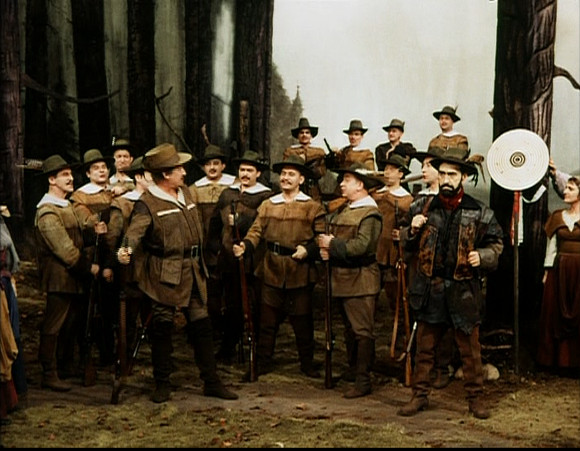
In the late 1960s and early 1970s the Hamburg State Opera cooperated with Polyphon and NDR to make a series of thirteen films for television of assorted operas.  They are all available as a boxed set called Cult Operas of the 1970s but one or two of them are also available separately.  One such is a 1968 recording of Weber’s Der Freischütz.  It was directed for film/TV by Rolf Liebermann and recorded in the studio using the HSO’s stage production.  I think the action is lip synched to a pre-recorded soundtrack (normal practice at the time) but I’m not sure.

1-men

Continue reading

Getting busier

We are moving into busy season for the next two or three weeks.  Next week, Tuesday sees a lunchtime recital in the RBA by Phillip Addis with song cycles by Maurice Ravel and Erik Ross.  Wednesday sees a concert staging of Salvatore Sciarrino’s The Killing Flower (Luci mie traditrici).  It tells the story of Carlos Gesualdo’s murder of his wife and lover.  Performers include Shannon Mercer, Geoffrey Sirett, Scott Belluz and Keith Klassen.  It’s at Walter Hall at 7.30pm with a pre-show with the composer at 6.30pm.  Sciarrino is involved in other events connected with the New Music Festival all week.  Thursday is opening night for the COC’s Götterdämmerung at the Four Seasons Centre with an early kick off time of 6pm.  Alternatively the TSO are doing the Fauré Requiem with Karina Gauvin and Russell Braun on both Wednesday and Thursday evenings.

the-killing-flower-sciarr-008

Music Theatre Wales’s touring production of The Killing Flower at Buxton Festival. Photograph: Clive Barda

Continue reading

Meet the Academy

The COC Orchestra Academy program is a mentorship scheme for young orchestral musicians providing a bridge between student and professional life somewhat akin to the Ensemble Studio  for singers and pianists.  Today at noon in the RBA we gort the chance to see the current crop in action in all baroque program featuring Jacqueline Woodley as soprano soloist.

Continue reading