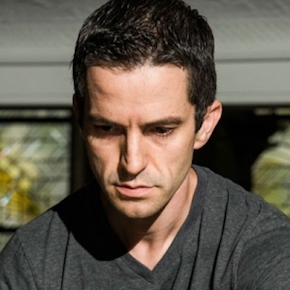
1001 Nights with Miriam Khalil

Yesterday’s lunchtime concert in the RBA was a song recital with an Oriental(ist) theme by polyglot soprano Miriam Khalil and pianist Topher Mokrzewski.  It kicked off with the two Suleika songs by Schubert to texts by Marianne von Willimer.  For my taste Miriam’s voice and treatment of the songs was decidedly on the dramatic side.  It was interesting and there’s no doubting the commitment but it’s not my favourite way to hear Schubert.  It was all uphill from there though.  Ravel’s Shéherazade; Debussy inspired music to texts by Tristan Klingsor, was given an equally dramatic treatment, and Miriam is very dramatic in both voice and body language,  but here it worked for me, especially the passionate invocation of the invented East in Asie.

SONY DSC

Continue reading

Creepy Wozzeck

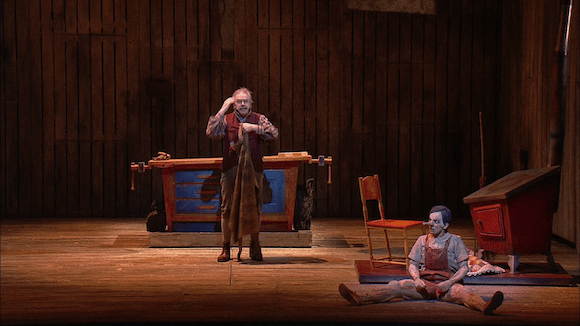
Alban Berg’s Wozzeck seems to attract just about every possible treatment from directors other than a straightforwardly literal one.  Krzysof Warlikowski’s approach, seen at Dutch National Opera in 2017, is to go back to the original story on which the Büchner play, in its turn the source for the opera, is based.  Wrapped around that are several interesting ideas which I can’t fully unpack but which make for a rather creepy but compelling production.  Alas, the disk package has nothing to say about the production so, interpretively, one is on one’s own.

1.dancers

Continue reading

Fourth Annual Toronto Bach Festival

bachtbfThe fourth annual Toronto Bach Festival runs May 24th to 26th.  There are four concerts and a lecture.  Here’s the line up:

Friday, May 24th at 8pm – Brandenburg Five

The program includes two cantatas: the early Tritt auf die Glaubensbahn, and Du wahrer Gott und Davids Sohn, plus Julia Wedman as soloist in Bach’s Concerto in A minor for violin. A brilliant night of illuminating music.  Soloists for the cantatas are Hélène Brunet, Daniel Taylor, Nick Veltmeyer and Joel Allison.  John Abberger directs the Toronto Bach Festival Orchestra.

Continue reading

Is Iago a nihilist?

I managed to catch the fourth performance of the COC’s current run of Verdi’s Otello last night.  It’s a David Alden production that first aired at ENO and it’s a very dark take on an already dark story.  It’s set maybe circa 1900 and the sets are stark but the lighting is dramatic with lots of contrasts and giant moving shadows.  The overall Zeitgeist seems to be of a society that has seen too much war; a sort of collective PTSD.  This comes over in a number of ways.  The scenes that usually lighten things up a bit; the victory celebrations in Act 1, the children and flowers in Act 2, don’t here.  In fact they are downright creepy.  There’s also a female dancer, used rather as Christopher Alden used Monterone’s daughter in Rigoletto, who clearly doesn’t expect good things from returning soldiers.

18-19-06-MC-D-0086

Continue reading

Opera for Toronto

Last night at the COC there was a special performance of Puccini’s La Bohème.  The cast was made up, for the most part, of current and past Ensemble Studio members and tickets had been made available free to a variety of community groups.  It was billed as “Opera for Toronto”.  There had also been a small number of tickets available on line on a first come basis and, by the looks of things , a fair number of comps for the cast.

LBES6

Afarin Mansouri giving an introductory talk in Farsi – Credit: Gaetz Photography

Continue reading

A Few of Liz Upchurch’s Favourite Things

Liz Upchurch has now been head of the COC Ensemble Studio for twenty years.  To put that in perspective, Alain Coulombe was an Ensemble Studio member back then.  So Liz has deeply influenced a whole generation of Canadian singers and it was fitting that there should be a concert in her honour in the Richard Bradshaw Amphitheatre.  It’s named for the man who brought her to the COC and it’s been the venue for countless concerts by the Mama Bear’s cubs.

2019-05-07-FCS-Upchurch-34324

Continue reading

Dolce la morte

655646189239_cover_smallSuzanne Farrin’s Dolce la morte sets poems by Michelangelo inspired by his relationship with Tommaso de’ Cavalieri dealing with the joy and complexity of desire and spiritual fulfillment.  They are really intense poems and Farrin has scored them for counter tenor and seven piece chamber ensemble.  The music is complex and intriguing.  The vocal line consists mainly of long, high legato lines that play around with pitch in a variety of ways.  The instrumental accompaniment is often also quite high and somewhat drone like with percussive insertions and places where the strings sound uncannily like another voice.  It’s haunting and quite disturbing and definitely the sort of music one doesn’t fully “get” on first hearing but which makes one want to come back to it.

Continue reading

Dido and Belinda

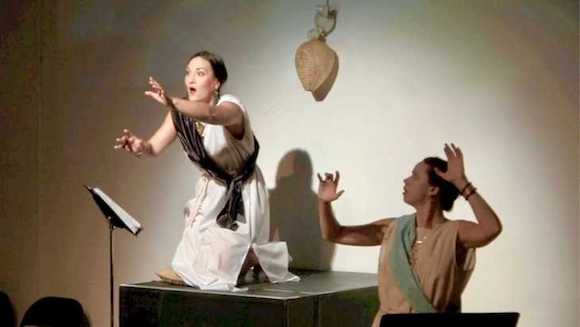
Dido and Belinda is the first show from Opera Q and Cor Unum Ensemble.  It’s a reimagining of Purcell’s Dido and Aeneas from Belinda’s perspective and with a decidedly gender fluid twist.  Nathum Tate’s libretto is extended by spoken passages which give Belinda’s take on the story and make it very much  a story of the two sisters.  The back story is Dido’s flight from Tyre rather than Aeneas’ flight from Troy.  The future is about Belinda as Queen of Carthage not Aeneas’ “promised Empire”.  It works pretty well though I have reservations about interpolating text in the final scene.  I think Belinda’s accession as Dido’s successor could have been conveyed without interrupting some of the most sublime music ever composed.  That’s a minor quibble though in a story concept that works.

Dido_1

Continue reading

How can I sing to descendants I will never have?

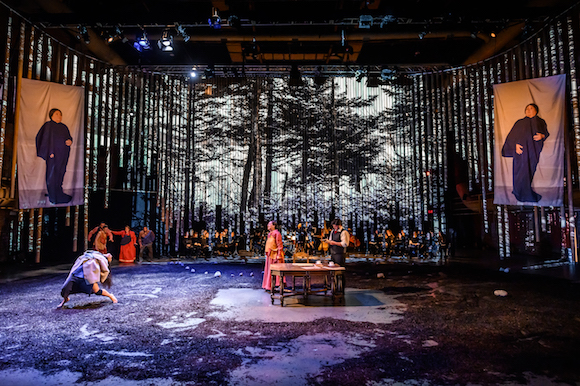
The header is a line from Yvette Nolan’s libretto for Shanawdithit; the work she is creating with composer Dean Burry for Tapestry Opera and Opera on the Avalon, which tells the story of the last survivor of the Beothuk people.  I sat down with them on Friday to talk about how the work has progressed since I saw an incomplete version in workshop last October.  The line really does get to the heart of the creative process that addresses the issues I raised in my review of the workshop (i.e. how we remember and tell stories) and this line, and it’s accompanying music, have become a kind of leitmotiv for the emerging work.

mn_shanawdithit

Continue reading