Here’s a summary of what’s been cancelled as I understand it at time of writing:
- The Canadian Opera Company (including the free concert series), Tafelmusik, Opera Atelier, Soundstreams and the Toronto Symphony have all cancelled the remainder of their 2019/20 seasons.
- The Women’s Musical Club of Toronto has cancelled through May 7th.
- Voicebox’ Adriana Lecouvreur and Against the Grain’s Bound have been postponed until further notice.
- Opera Pub April and May editions are off.
- Most RCM/Koerner Hall events have been cancelled but last I heard they were still discussing some future events.
- UoT Music cancelled through April 3rd but I imagine that will be extended.
At this point I haven’t heard anything definite about TOT’s Northern Lights or Tapestry’s Rocking Horse Winner.


 Isabel Bayrakdarian’s latest CD is rather odd. The material is obscure. It’s all taken from 18th century operas about the Armenian king Tigranes and his daughter Cleopatra. The plots are basically the same. Tigranes wants Cleopatra to make a marriage of state but she is in love with Tigranes’ enemy Mithridates. The outcomes are predictable. Apparently, these operas are Bayrakdarian’s academic specialty and she has chosen excerpts from Cleopatra’s part in versions by Hasse, Vivaldi and Gluck.

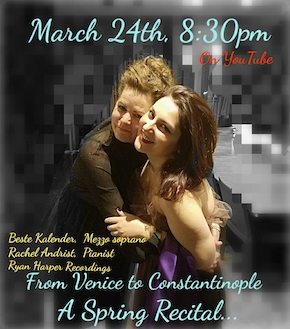 Mezzo-soprano Beste Kalender and pianist Rachel Andrist are performing on line on Tuesday evening (March 24th) at 8.30pm (Toronto time). The recital is titled A Spring Recital: From Venice to Constantinople and will feature music by
 Carlisle Floyd’s Prince of Players was originally written for the Opera Studio in Houston as a chamber work. It was subsequently reworked as a full scale piece and taken up by Milwaukee’s Florentine Opera where it was performed and recorded in 2018. It’s a two act piece with a libretto by the composer that deals with the transition from men playing women on stage to the roles being taken by women for the first time in the reign of Charles II. It’s framed by the final scene of Shakespeare’s Othello. First time around Desdemona is played by noted actor Ned Kynaston to rapturous applause and praise from the king. The rest of the first act is the story of how Charles; influenced by his mistress and aspiring actor Nell Gwynn and the much more talented Meg Hughes who, to complicate matters, is Kynaston’s dresser and secretly in love with him, decides that times must change and women must play women on the stage. The act culminates in a confrontation between the king and Kynaston where the latter accuses the former of destroying his art and livelihood and the theatre with it. The king is unrelenting. This act is tight and well crafted with quite a lot of humour as well as some pathos.
 The following just in from Tapestry concerning Saturday night’s livestream of Songbook X.