Lost in a Russian Forest

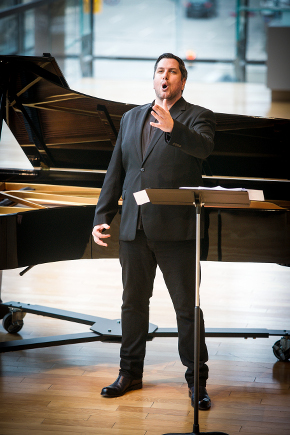
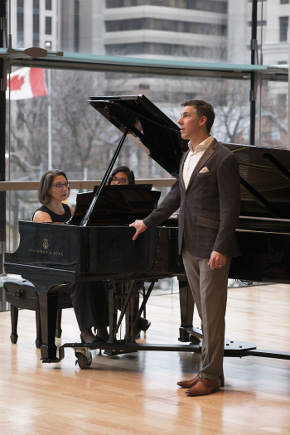
SONY DSCCroatian bass Goran Jurić is currently making his North American debut as Sarastro in the COC’s Magic Flute.  Today he gave a lunchtime recital with Anne Larlee in the RBA.  It was an all Russian programme; Tchaikovsky, Rachmaninov and Sviridov.  I don’t want to do a blow by blow review because I don’t know the rep well enough and it seems a bit pointless.  Instead let’s talk about Jurić as an artist, as shown by his performance here (and not surprisingly as Sarastro).  He’s a genuine bass, no messing.  The low notes are all there and the timbre is rich and dark when he wants it to be.  But he’s also extremely lyrical.  He can lighten up without ever stopping sounding like a bass.  It’s a most pleasant combination.  He’s also a terrific storyteller.  This seems like an odd thing to say about a recital where not a word was spoken and all the songs were in a language I scarcely understand at all, yet I felt he was communicating the essence of the text with great clarity as a good lieder singer must.  Anne was great as an accompanist too.  There was quite a lot of range in the piano parts from quite delicate and playful in some of the Sviridov to cranking the pedals up to 11 in some of the Rachmaninov.  A very good way to spend one’s lunch break.

Besides, it was great to see Anne Larlee back at the Four Seasons Centre and to discover a young bass who I want to hear a lot more of.  Fortunately he’s back next season as Osmin in Entführung.

Photo credit: Karen E. Reeves

Across the Channel

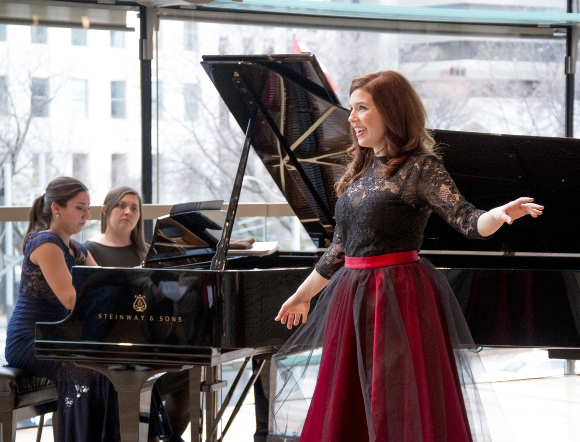
Having been tipped off that yesterday’s RBA noon concert was to be a vocal recital rather than, as previously billed, a chamber concert I made the trip through the snow to catch it.  Three of the Royal Conservatory’s Rebanks fellows were singing with Helen Becqué at the piano and assorted staff and alumni added for the final number.  Attendance was a bit sparse perhaps unsurprisingly given the weather and the evident confusion.  That was a shame because it was an interesting, varied and well presented concert combining well known works with some much less well known fare.

channel1

Continue reading

Reconciliation

Yesterday’s free concert in the RBA featured mezzo Marion Newman with pianist Adam Sherkin and violinist Kathleen Kajioka in a programme of contemporary Canadian works (all the composers were in the room!) mostly connected in some way with Canada’s First Nations and Inuit peoples.  First up was Ian Cusson’s setting of E. Pauline Johnson‘s A Cry from an Indian Wife.  It’s a long, highly emotional but not, I think, especially well crafted, text about an Indian woman sending her husband off to war (the language reflects the usage of its day) and the words are not easy to set or sing.  Cusson’s setting is appropriately intense with a blistering piano part and a tough vocal line.  It’s deeply affecting but hardly comfortable especially when sung in a manner that clearly (and rightly) privileged text and emotion over beauty of sound.

newman1

Continue reading

Chelsea Rus in the RBA

Chelsea Rus is a recent graduate of the Schulich Scool of Music at McGill University and winner of the Wirth Vocal prize.  Today, along with pianist Marie-Ève Scarfone, she gave a recital in the Richard Bradshaw Amphitheatre.  I like that it was all song bar the opening number; “Je veux vivre” from Gounod’s Roméo et Juliette.  Hearing young singers belt out the same few Mozart and bel canto standards gets a bit tedious.  Anyway this was one of those recitals that started quite well and just got better as things progressed.  Poulenc’s Fiançailles pour rire are, I suppose, a bit of fluff but they allowed Chelsea to show off a rather lovely middle voice and good French diction, though the registers are still not fully integrated.  Even better was Liszt’s Oh! quand je dors.  Here she showed just how expressive she can be.

fcsdecember1rba5

Continue reading

UoT Opera season opener

As has become the norm, UoT Opera opened their concert season with a free “preview” of their spring show in the RBA at noon today.  It was a series of Mozart scenes which were given semi-staged today but will, in the fullness of time, form a staged and costumed performance.  It’s always an interesting event because it’s so early in the academic year.  It’s the first chance to try and talent spot and see how things develop over the rest of the cycle.  As such, it’s often a bit rough but today really wasn’t.  It was a surprisingly high quality across the board effort which augurs well.  That said, it was all ensembles and nobody was asked to pull out vocal fireworks so maybe not the sternest test imaginable which makes star picking that bit trickier.

uoft-opera-c-tanner-davies Continue reading

Quartet for the End of Time

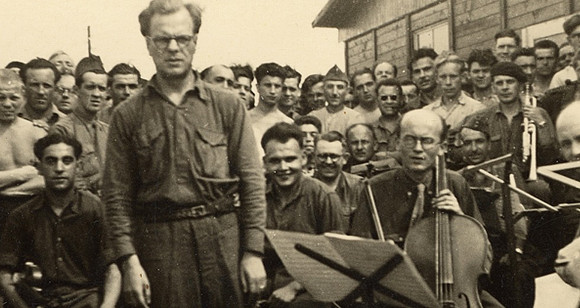
Messiaen’s Quartet for the End of Time is a work of astonishing power and unique provenance.  It was written after Messiaen’s capture in June 1940 at the POW camp Stalag VIII-A in Görlitz in what is now Poland.  First performed for POWs and guards in 1941 it is, most unusually, scored for piano, clarinet, cello and violin because that’s what the professional musicians among the POWs played.  What always strikes me about this work, familiar since my early teens, is how it combines Messiaen’s transcendent and deeply optimistic faith with a kind of passionate statement about the state of the world rooted in Revelations.  The contrasts are there throughout the work’s eight movements but nowhere more clearly than at the end when the power and even fury of Danse de la fureur pour les sept trompettes and the Fouillis des arcs-en-ciel, pour l’Ange qui annonce la fin du Temps dissolve into the lyrical serenity of Louange à l’immortalité de Jésus.  And, of course, there is birdsong in the haunting clarinet movement Abime des oiseaux.

quartet_end_time-980x520

Continue reading

Here we go again

The tenth season at the Four Seasons Centre opened with the, by now traditional, lunchtime concert by the COC’s Ensemble Studio.  Six of the eight singers and one of the two pianists are new recruits which is unusual and more of a chance to level set than see how anyone has developed.

2016-09-27-fcs-ensemble-092

Continue reading

Season’s end

The final concert of the year involving members of the Ensemble Studio took place yesterday in the RBA.  First up were Charles Sy and Hyejin Kwon with Britten’s Les Illuminations.  This is a formidable challenge for both singer and pianist and we were treated to a performance of real intensity and maturity.  Charles seemed to be sufficiently in technical command of the material to let himself go a bit and have some fun with the more ironic bits of Rimbaud’s rather extraordinary text.  His French diction was more than good enough for this, even in the places where the notes pretty much fall over themselves.  There were some very pretty sounds where needed and real intensity, particularly in Parade.  Hyejin was excellent too.  The piano part is no mere support in this piece.  It’s challenging and demands real partnership with the singer.  All in all, it was a performance that made one forget that these two have only been in the program for a year.

KLP160517-_DSF4437

Continue reading

CASP 2016

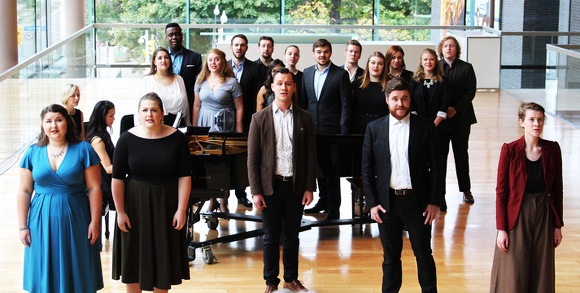
It’s been four years since the initial Canadian Art Song Project concert in the RBA.  Since then they’ve commissioned a number of works and started a recital series that has included innovative presentations such as the performance of Brian Harman’s Sewing the Earthworm given in November.  A work premiered that night; Erik Ross’ The Living Spectacle formed the conclusion to yesterday’s concert but first came a series of works performed by students from the University of Toronto.

casp16-1

Continue reading

Georgian Romance

Hearing Anita Rachvelishvili sing Carmen on the main stage of the Four Seasons Centre, it was obvious that she had a huge voice with really interesting colours.  The full scope only became apparent to me hearing her in recital in the RBA today.  It’s an extraordinary instrument that can go from a very delicate pianissimo to very loud indeed  without any obvious change in quality.  There’s no steeliness or squalliness as the volume ramps up.  Just the same colours and rich tone.  A blow by blow account of a concert that included music in Georgian by Tabidze, Russian by Rachmaninov, French by Fauré and Spanish by de Falla seems superfluous.  There was delicacy.  There was drama.  There was humour.  There was playfulness.  All in less than an hour.  And to cap it off there were encores; Mon cœur s’ouvre à ta voix from Samson et Delilah and, perhaps inevitably, the Seguidilla from Carmen.  Stephen Hargreaves was at the piano.  One wonders if he actually lives at the hall.  He covered a wide range of material from the delicate to the impressively percussive with his customary skill.

May03RBA8 copy

Photo credit: Lara Hintelmann