Marriage of Figaro preview

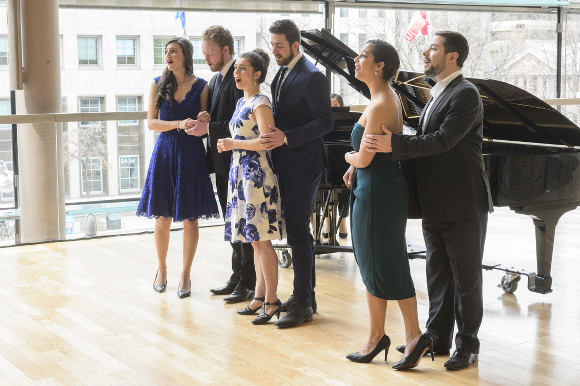
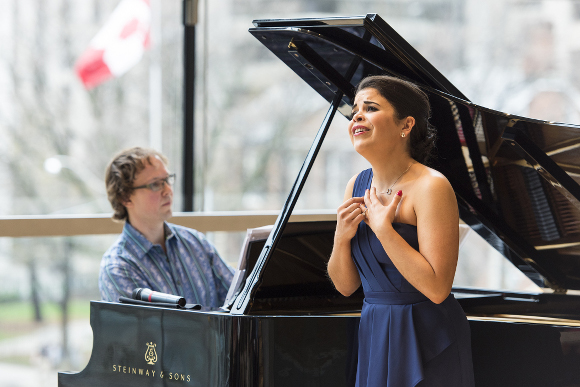
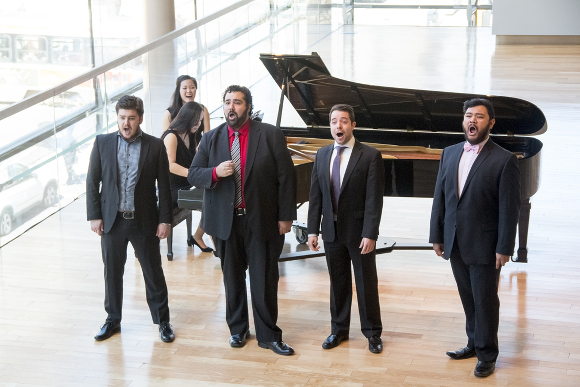
Today’s lunchtime concert in the RBA involved members of the cast of the Ensemble Studio performance of Marriage of Figaro in a semi-staged series of excerpts from the opera.  The Ensemble Studio annual stage performance is always worth seeing and this year I think it’s going to be a real treat.  Highlights today included Gordon Bintner’s Count.  The guy can sing but here there was a swagger that should be just perfect for the Guth production.  Jacquie Woodley’s Cherubino was utterly brilliant.  Aviva Fortunata nailed Porgi amor, so often a disappointment I find.  And I really liked Karine Boucher’s Susanna.  She’s not always been a favourite of mine but her slightly dark for a soprano tone seemed really well suited to this music and blended especially well with Aviva.  Ian MacNeil impressed too as Figaro, though it’s a role that’s a bit downplayed by this production, and I shall be curious to see what he does with it in the full version.  Megan Latham, Jean-Philippe Fortier-Lazure and Aaron Sheppard rounded out today’s cast with the indefatigable Hyejin Kwon on piano.  If you don’t yet have tickets for the performance on the 22nd I strongly suggest getting some.  They are only $22 or $55 for the best seats.  As Claire Morley said in her introduction this could be an event that’s talked of for years to come.

Christopher Purves in the RBA

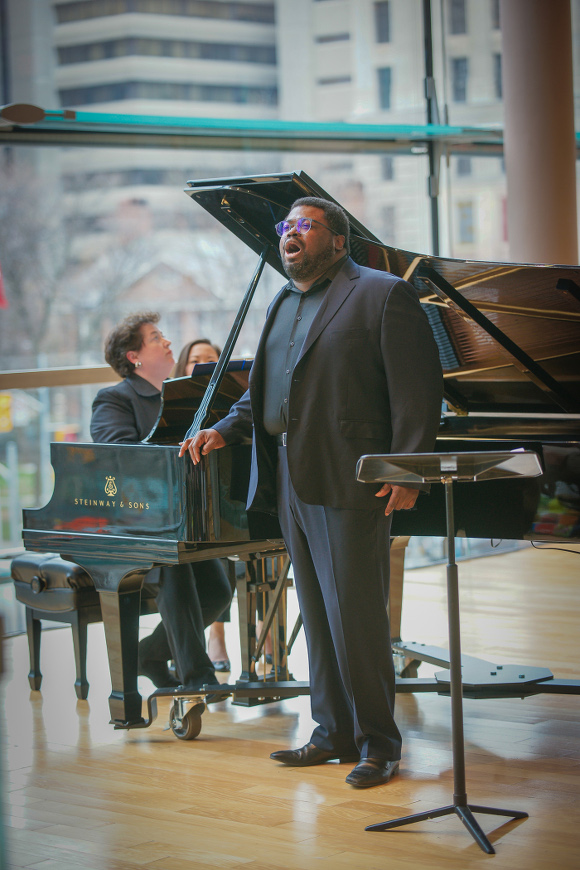
British baritone Christopher Purves was the lunch special at the Four Seasons Centre today.  Along with the amazing Liz Upchurch he gave us a most enjoyable program of Handel, Duparc and Mussorgsky.  The two Handel arias were drawn from Handel’s two very different takes on Ovid’s Acis and Galatea.  The first from the later (1718) English version “I rage, I melt, I burn!… O ruddier than the cherry tree” is a mostly comic furioso recitative and aria sung with great drama and not a little comedy by Chris but it was rather eclipsed by the next number taken from the earlier (1708) Aci, Galatea e Polifemo.  Polyphemus’ aria “Fra l’ombre e gl’orrori” is just nuts but very beautiful.  It ranges from the D below the bass staff to the A above it and is a continuous series of insane intervals accompanied by a really simple and very beautiful piano part.  It’s amazing anybody can sing it all let alone as well as it was done here.

purves

Continue reading

Classics Reimagined

I’ve seen Robert Pomakov and the Gryphon Trio perform together a few times now and it’s always interesting.  Today’s lunchtime concert in the RBA was no exception.  Four of Mozart’s concert arias for bass and orchestra, arranged for string trio by Bohdana Frolyak, were interspersed with movements of Heather Schmidt’s Lunar Reflections; a 2008 piece commissioned by the Gryphons inspired by the moon in different seasons of the year.  It was stimulating.  The concert arias (K.432, K.513, K.512 and K.612) all showcase the bass voice with tectonic low notes and plenty of opportunity for virtuosity.  I think they suited Robert pretty well.  He’s perhaps not the most subtle of singers but he’s exciting (and loud!) and the trio accompaniment provided so much more than piano alone could.

The Schmidt piece was also enjoyable.  It’s fairly approachable and the five movements are quite varied.  The first two; Blue Moon and Pink Moon, are quite lyrical, even lush in a slightly post romantic sort of way then comes Wolf Moon which is in an altogether darker place; slower, louder and more dissonant with lots of work for the low notes on the cello.  Snow Moon continues in a slower, somewhat dissonant vein but is much lighter textured and the piece concludes quite violently with the aggressive and abrasive Thunder Moon which puts serious demands on all three players but especially the piano.  Unsurprisingly, I feel I’ve probably not done this piece justice.  I find I need to hear work of this kind more than once to fully appreciate it.

Où dort la fantaisie

Yesterday’s lunchtime concert in the RBA featured two members of the Ensemble Studio.  Andrew Haji, standing in for an indisposed Charles Sy, and Jennifer Szeto performed Liszt’s Tre Sonetti di Petrarca.  These songs were unfamiliar to me and came as a pleasant surprise.  They are very Italianate and very operatic and have a pretty involved piano part (unsurprisingly).  Haji displayed his uncanny ability to find exactly the right idiom for the music and sang with beauty and expression as well as nailing the three high D flats.  Szeto was a most accomplished accompanist. Great dress too!  New Yorkers can catch these two in the Marilyn Horne Song Celebration at Carnegie Hall on Saturday where they will perform the same music.

Jan19RBA4

Continue reading

Quinn Kelsey singing from the heart

KLP151027-_DSC7440Baritone Quinn Kelsey, currently singing Germont père in La Traviata at the COC stepped down off the big stage today to give a recital, with Rachel Andrist at the piano, in the more intimate RBA.  As befits the venue, he gave us a more intimate program.  Ralph Vaughan Williams Songs of Travel and the less frequently heard Gerald Finzi cycle, Let Us Garlands Bring sandwiched three songs by Brahms.

The Vaughan Williams is a pretty well known work, almost a recital warhorse.  Kelsey showed considerable sensitivity in, mostly, dialling his big voice back for it.  He is extremely expressive, occasionally I thought maybe just a touch too much so, and he has a surprisingly wide range of colours at his disposal.  The contrast between the light, bright tone he used for The Roadside Fire and the much darker (and louder) approach to Youth and Love was quite striking.  And that’s just an arbitrary comparison of two songs that follow one another.  The rest of the set was equally varied.  This guy is a lot more than “just” a big, Italianate Verdi baritone!  And Rachel Andrist is so much more than “just” an accompanist.  She brings a complimentary personality to every song with some real detail in the piano part that makes it seem quite fresh.

Continue reading

Diva, diva, diva

Danika Loren

Danika Loren

Today’s lunchtime concert in the RBA featured the assembled students of UoT Opera in a staged programme called The Art of the Prima Donna.  It was a sequence of mostly ensemble numbers drawn from the core 19th century rep.  Verdi, Tchaikovsky, Puccini, Donizetti, Bellini, Bizet and Rossini all featured with works made famous by the great divas of the era’ Patti, Pasta, Malibran etc.  Linking narrative, which skipped over who slept with Rossini, was provided by Michael Albano who directed the staging with Anna Theodosakis.  Sandra Horst headed up the musical side and accompanied with help from Sue Black, Kate Carver and Ivan Jovanovic. Continue reading

Array Ensemble in the RBA

Yesterday was slightly bizarre in that I was at two concerts of contemporary, or at least very modern, music.  The first was at lunchtime in The RBA where the Array Ensemble presented two works by female Canadian composers; Linda Catlin Smith’s Hieroglyphs and Barbara Monk Feldman’s Love Shards of Sappho, both for soprano and chamber ensemble. Continue reading

And so it begins

Yesterday saw the first free concert of the season in the Richard Bradshaw Amphitheatre.  It was a chance to see the 2015/16 Ensemble Studio; two new singers, one new pianist and six singers and a pianist from last year.  The format was one aria per singer with few surprises.  We also got to hear the core quartet casting for the Ensemble Studio performance of Le Nozze di Figaro later in the season.  No surprises there either; Il Conte – Gordon Bintner, Iain MacNeil – Figaro, La Contessa – Aviva Fortunata, Susanna – Karine Boucher.  That leaves four tenors for the other roles…

2015-09-22-COC-Ensemblegrp-043

Continue reading

Doundou tchil

Today’s lunchtime concert in the RBA was a preview of Against the Grain’s upcoming show Death and Desire.  It’s a staged mash up of Schubert’s Die Schöne Müllerin and Messiaen’s Harawi: Chant d’amour et de mort; a settong of texts, rather weird ones at that, by the composer.  As director Joel Ivany said, mixing Messiaen and Schubert might seem “a bit bizarre” but these two texts seem to work together remarkably well and the juxtaposition seems almost inspired.  I’m glad too that the original intention of performing the two pieces back-to-back has been replaced by a mash up.  Today we got to see and hear the first half of the show.

Continue reading

The Diary of The One Who Didn’t Disappear

The on/off saga of the Ensemble Studio’s promised Janáček’s The Diary of One Who Disappeared came to an apparent conclusion yesterday.  It had been postponed at least once and even this morning the COC website is advertising a complete performance with two soloists and a small chorus.

cocIt didn’t happen.  What we got was a recital by Owen McAusland singing some excerpts from the Janáček plus Vaughan William’s The House of Life and Britten’s Les Illuminations.  It was his last performance as a member of the Ensemble Studio during which time, among many other things, he sang several main stage performances as Tito covering for a sick Michael Schade.

Continue reading