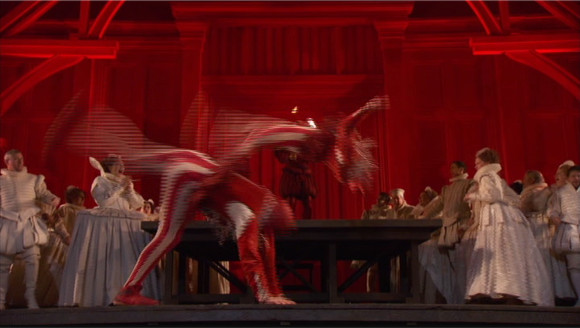
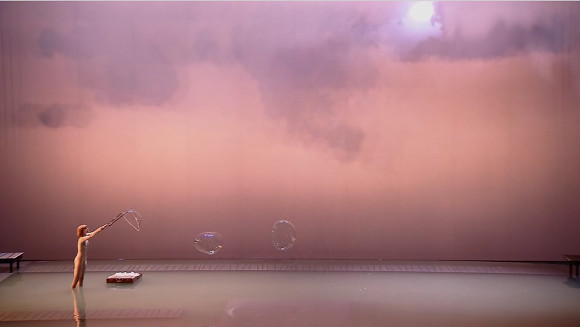
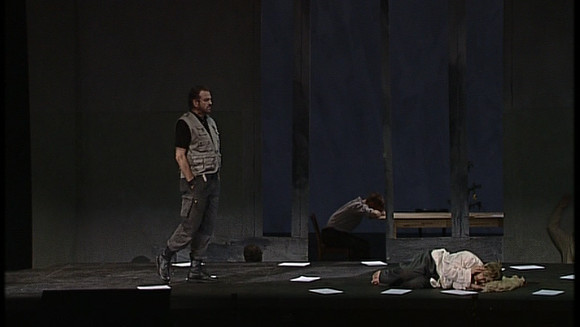
Donizetti’s Maria Stuarda featured in the MetHD series in January 2013 and has now been released on DVD. My review of the cinema broadcast is here. It’s always a bit different watching the DVD rather than the cinema version but in this case I think my somewhat different reaction has a lot to do with having recently seen various versions of the other Schiller/Donizetti Tudor queen operas, especially Stephen Lawless’ Roberto Devereux at the COC.
Category Archives: DVD review
Katerina Izmailova
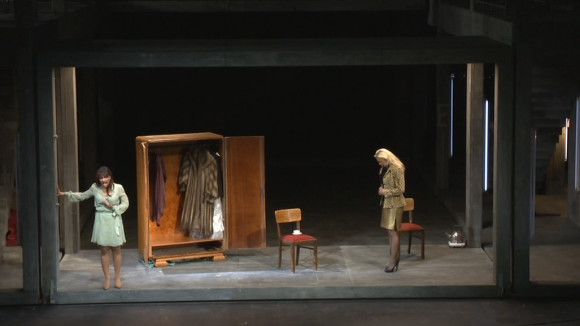
Shostakovich’s The Lady Macbeth of the Mtsensk District has become a modern classic but only after it was the cause, or at least purported cause, of his disgrace under Stalin in which the work was criticised both for the subject matter and the “bourgeios formalism” of the music. A revised version of the work was made into a film under the title Katerina Izmailova in 1966 as part of Shostakovich’s formal rehabilitation in the Soviet Union.
The Harnoncourt show
Unusually, the Theater and der Wien’s 2011 production of Handel’s Rodelinda features a father and son team. Philippe Harnoncourt directs and Nikolaus conducts. It’s an interesting production with great acting, very decent singing and the always excellent Concentus Musicus Wien in the pit.
Continue reading
All star Carmélites
The 2013 recording of Poulenc’s Dialogues des Carmélites from the Théâtre des Champs Elysées has a cast that reads like a roll call of famous French singers; Petitbon, Piau, Gens and Koch are all there. Throw in Rosalind Plowright and Topi Lehtipuu and one gets some idea of the star power on display.
Intermezzo
It has been said that the best music in Richard Strauss’ Intermezzo is in the orchestral interludes that link the various scenes. It’s probably true and certainly the singers don’t get much interesting to sing with the best music given to the orchestra even during the scenes. That said, all of the music is vastly better than the truly cringe-worthy libretto, also by Strauss. It’s in prose, much of it is spoken and there are odd interjections of more vernacular German for the servants, rather in the manner of the random cockney in ancient Ealing films. The plot is based on an, aaparently real life, episode in the married life of the Strausses, here thinly disguised as the Storches, in which Frau Storch gets the wrong end of the stick about suspected infidelity by her husband and threatens divorce. If Frau Strauss ever saw the piece, which is apparently unlikely, she might reasonably have seen the portrayal of herself by her husband as much sounder grounds for dumping him. Christine Storch is the sort of woman one wants to tie up in a sack and drown!
Puzzling Così
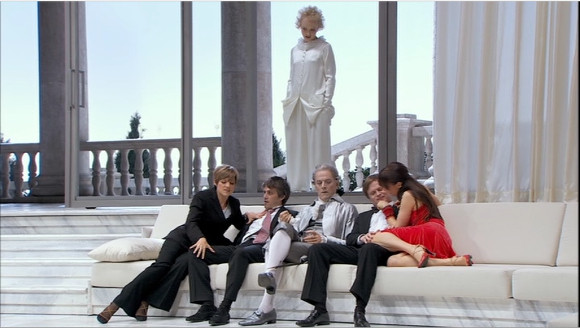
The 2013 production of Mozart’s Così fan tutte from Madrid’s Teatro Real is one of German film director Michael Haneke’s comparatively rare forays into opera. Naturally I was expecting a highly conceptual interpretation but, although his vision is far from conventional, Konzept found I not. What I saw was a collection of ideas that didn’t quite cohere for me. Costume and sets are a mix of 18th century modern. We are in Don Alfonso’s inconsistently modernised mansion. There are enormous 18th century paintings and chandeliers but also leatherette banquettes and the Giant Fridge of Booze. The boys and girls wear contemporary party attire, including a rather fetching red dress for Fiordiligi, but Don Alfonso is in full 18th century gard and Despina seems to be dressed as Pierrot. Perhaps it’s some sort of party where some of the guests have decided to do the costume thing and some haven’t? When the boys go off to the army they do so in some sort of distant past opera version of military uniform; wigs and swords.
Ravel double bill
In 2012 Glyndebourne staged an interesting and contrasting double bill of Ravel one-acters in productions by Laurent Pelly. The first was L’heure espagnole. It’s a sort of Feydeau farce set to music. The plot is classic bedroom farce with the twist that most of the doors the lovers come in or out of belong to clocks. Concepción is the bored wife of a nerdy clockmaker. She’s not overly impressed by her two lovers; a prolix poet and a smug banker, who show up while hubby is out doing the municipal clocks. She’s much more taken by the slightly simple but very muscular muleteer who spends most of his time lugging lover infested clocks up and down stairs for her. Pelly wisely takes the piece at face value and brings off a mad cap forty five minutes timed to the split second.
High contrast Traviata
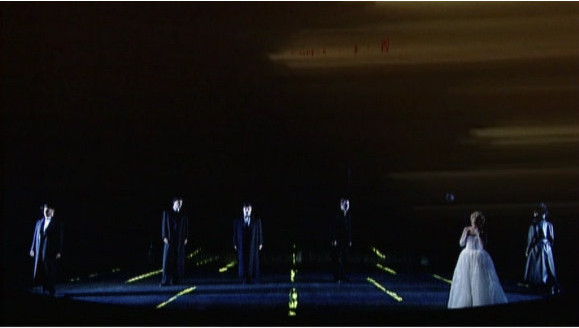
The starting point for Peter Mussbach’s 2003 production of La Traviata for the Aix-en-Provence festival is his knowledge, as one trained as a medical doctor, of the effects of TB on a person’s appearance. He argues that the disease produces a strange kind of beauty with the skin translucent and pale. So, here Mireille Delunsch, as Violetta, wears a white dress, a platinum wig and very pale powder throughout while everyone else is dressed in black. Couple this with a high contrast and highly dramatic lighting plot and very sparse sets and you have the essence of the “look”. The blocking and Personenregie reinforces this with Violetta often appearing to be an ethereal, not quite solid, presence surrounded by a rather coarse material world.
I ask on my knees, as a blessing, for death
So sings the heroine of César Franck’s early piece Stradella, Léonor, during her abduction and imprisonment by the Duke of Pesaro. I felt pretty much the same watching the 2012 production from L’Opéra Royale de Wallonie. The company has a well deserved reputation for reviving neglected works from the French repertoire. I suppose once in a while if one does that one is pretty sure to come up with a complete turkey and, frankly, that’s how I’d classify Stradella. Franck left it in piano score and it was orchestrated recently by Marc van Hove so the 2012 Liège production is the premiere. The plot is essentially trivial. Stradella, a singer and protegé of the Duke of Pesaro is in love with Léonor, an orphan. They plan to marry secretly but the duke is also obsessed by the girl and has her kidnapped. Stuff happens and they both end up dead and the duke repents. Stradella and Léonor are united in Heaven. The music is rather dull and highly sentimental. The sentimentality is reinforced both by the injection of a bunch of morbid religiosity into the plot and the overuse of a children’s chorus. In fact I ended up wondering whether “Stradella” wasn’t the brand name for a Belgian artificial sweetener.
In 1618 twelve million people lived in Germany
Sometimes one comes across a previously unfamiliar work that just blows one away. Karl Amadeus Hartmann’s Simplicius Simplicissimus did that to me. It’s a work written by Hartmann in 1934/5 as he watched the early years of Nazi power and the banning of “degenerate” art. By the time it got its premier in 1949 it’s story of a Germany physically and morally ravaged by war would seem all too prescient. It’s a simple story based on the early chapters of a novel by Grimmelshausen set during the Thirty Years War(1). It concerns a simple shepherd boy who is drawn into the conflict. There are three scenes. In the first, the entirely innocent boy witnesses the brutal destruction of the farm he works on by vagrant Landsknechten. In the second he is befriended by a hermit and undergoes a sort of moral education before once again being left abandoned by the hermit’s death. In the thirdhe becomes jester to the drunken and corrupt Governor; the idiot who tells the truth, until all is overthrown by a Peasant’s Revolt.