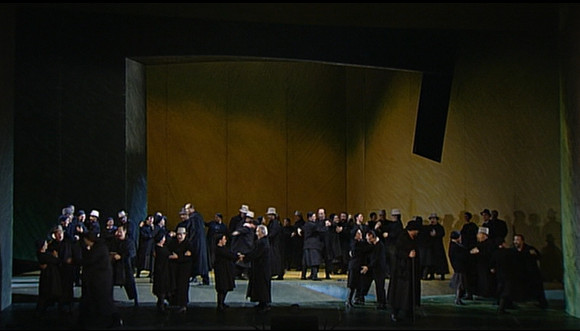
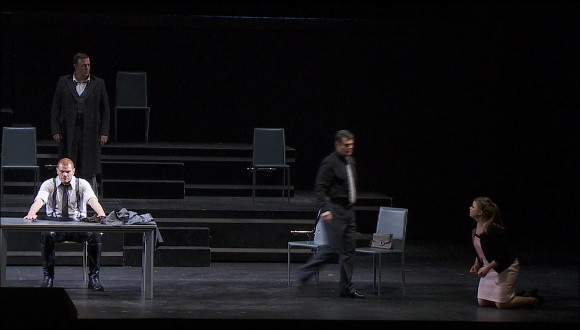
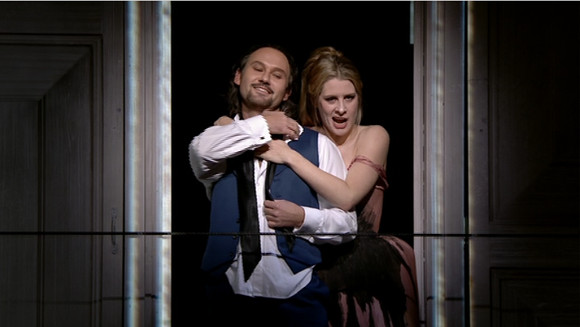
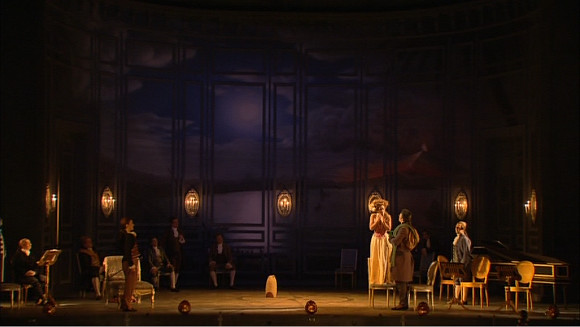
Aribert Reimann’s Lear is a pretty good example of how to create a thoroughly modern opera within a thoroughly traditional framework. It’s a classic story of course. Here librettist Claus Henneberg has taken the classic German translationof the Shakespeare play and condensed it in a highly intelligent fashion; retaining all the emotional drama while sacrificing some fairly peripheral narrative. Reimann’s score is modern though not strictly twelve tone. He creates a distinct musical voice for each character; speech/Sprechstimme for the Fool, weird coloratura for General etc. This is reinforced by many of the characters having a tone row that serves as a sort of leitmotiv. Atonality and quarter tones are used for varying effects from the violence of the Blasted Heath scene; apparently inspired by the composer’s experience, as a nine year old, of the bombing of Potsdam, to the shimmering, ethereal quarter tones of Lear’s final monologue. For anyone with even a vague tolerance for “modern” music it’s a fascinating listen.
Category Archives: DVD review
Eine Frau von Heute
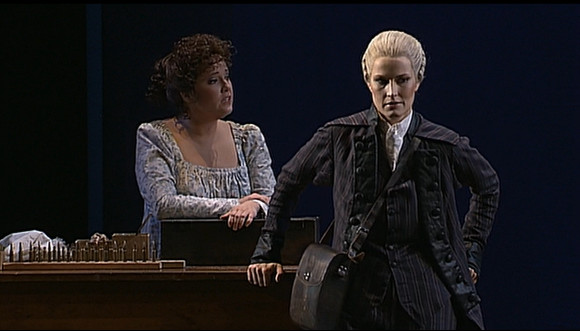
I don’t usually associate Arnold Schoenberg with comedy but he did write a one act comic opera Von Heute auf Morgen which premiered in 1929. It was an attempt to cash in on the vogue for satirical operas on modern themes characterised by Brecht and Weill and , if a bit slight and lacking Brechtian punch, it works well enough. A bourgeios husband and wife have returned from an evening out where they have met an iold friend of the wife who has become something of a femme fatale. There’s also a singer, inevitably a tenor, involved. The husband is rabbiting on rather gormlessly about the charms of the “other woman” so his wife decides to teach him a lesson. She apes the manners of a “modern woman”, neglects their child, plans assignations etc. There’s a long phone conversation inwhich the “friend” and the singer invite them back to the bar. By now the husband is beginning to realise what he stands to lose. The wife realises she has won. The other couple show up and there’s a “modern” vs. “traditional” quartet after which the “moderns” leave in disgust and the husband and wife revort to bourgeois domesticity.
Hands on Figaro
In the booklet accompanying David McVicar’s production of Le nozze di Figaro, recorded at the Royal Opera house in 2006, there’s an essay by the director in which he raises all kinds of questions about the rise of the bourgeoisie, the nature of revolution and romantic conceptions of love. He even appears to draw a parallel between Joseph II and Tony Blair. Then he declines to explain how he has embodied all these ideas on the stage and challenges us to “Watch, listen, participate”. Well I did and I’m none the wiser. What I see here is an essentially traditional approach; transferred cosmetically to 1830s France but so what? It’s darker than some Figaro’s but not nearly as dark as, say, Guth. Curiously, the main “extra” on the disks “Stage directions encoded in the music” tees this up much more clearly than the essay.
Fatal attraction
Kasper Holten’s Royal Opera House production of Don Giovanni, seen in cinemas, is now available on DVD and Blu-ray. It’s a visually and dramatically complex production so it’s probably as well that there’s plenty of explanatory material on the disks and in the booklet. Es Devlin’s set is a two storey structure that rotates and serves as a screen for a heavy use of video projections by Luke Halls. These start wth the 2065 names of the women Don Giovanni has seduced and seem to be mostly about what’s going on in Don Giovanni’s head. The sequence during Fin ch’han dal vino calda la testa is particularly spectacular.
Glorious Alcina
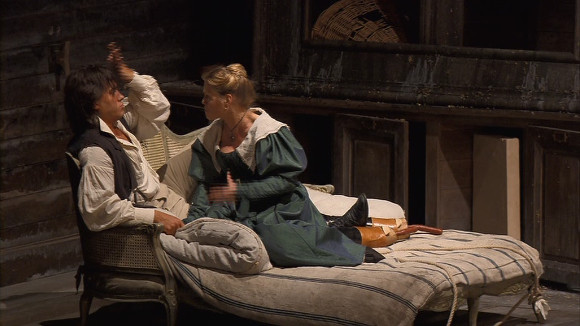
The 2011 production of Handel’s Alcina at the Wiener Staatsoper marked the first time Handel, or any other baroque work, had appeared in the house since Karajan’s reign in the 1960s. In mounting it they went big. There’s a starry cast headed by Anja Harteros, Marc Minkowski and Les Musiciens du Louvre – Grenoble, a large group of dancers and former Royal Shakespeare Company boss Adrian Nobel. It paid off.
Odds and sods
This is a collection of disks that didn’t make it onto one of the previous lists but seem to me to be noteworthy in some way; if not always for their excellence!
Contemporary opera on DVD
Opera needs new work or it’s just a museum not an art form. The trouble is the opera world (often for entirely understandable financial reasons) is very conservative and so one gets relatively few opportunities to see new works. There’s also a distinct geographic divide. The chance of seeing a new German opera in North America is very small and I don’t see a lot of American work (John Adams and Philip Glass aside) being performed in Europe. But at least we can see what’s going on on recordings. So here are some recordings of 21st century operas that I think are worth a look.
A Mountain of Mozart
There are a lot of really good video recordings of the Mozart operas. So many that they risked swamping the other categories so I decided to pull them out into a separate post. What I’ve tried to do is select the best recording for each of the major operas. Same rules as the all time best category. To be considered the disk must be a worthwhile production, excellently performed and filmed and with better than average sound and video quality. So herewith the three da Ponte operas, the two major Singspiels, La clemenza di Tito and Idomeneo.
Going for Baroque
Well not strictly baroque. I wanted a category for pre-Mozart rep since so many houses (and audiences) ignore it and there are some very odd ideas about performing it. So we are going to cover ground from the earliest days of opera to the late 18th century here, including staged versions of oratorios, because I rather like them. Here, in rough order of composition, then are my picks; from Monteverdi to Rameau. Continue reading
From the Archives
The opera video recording is in some ways a rather recent phenomenon. Before the DVD there really wasn’t a very satisfactory way of distributing a product with a decent sound though there were TV broadcasts and some have been preserved in the catalogue. Most of the extant recordings are “made for TV” and tend to show the limitations of the technology of the time. Interestingly, most pre 1980 recordings are of films made in the studio and lip synched to a pre-recorded track. There are only a handful of recordings of live performances in the opera house plus some pioneering BBC recordings of Britten works where the singers are “live”.
Here then, in reverse chronological order, are the pre 1980 recordings I find most interesting. Continue reading