Dream Cendrillon

Massenet’s Cendrillon is an interesting take on the Cinderella story.  There are a lot of references in the libretto, especially in acts 3 and 4, to suggest that it’s all really a dream. So maybe it’s not unreasonable for Barbara Mundel and Olga Motta in their 2017 Freiburg production to riff of that and give us elements that don’t, at first blush, make sense.  Dreams are like that. It would also explain why, in many scenes, Lucette seems to be more of a spectator than a participant.

1.knife

Continue reading

Nabucco a la Visconti

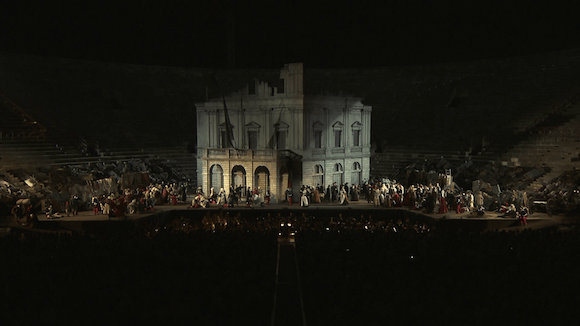
I guess Verdi’s Nabucco is even more closely associated with the Risorgimento than his other works so it’s not perhaps surprising that, for his 2017 production for Verona, Arnaud Bernard made the connection explicit.  We are in Milan during the Five Days.  La Scala; which does duty as the Temple, the Hanging Gardens and itself, stands in the middle of the huge performance space of the Arena di Verona.  Italian and Austrian soldiers, including cavalry, ride around the arena or clamber over the terraces.  It’s wild and spectacular but it’s more than that.

1.lascala

Continue reading

La scala di seta

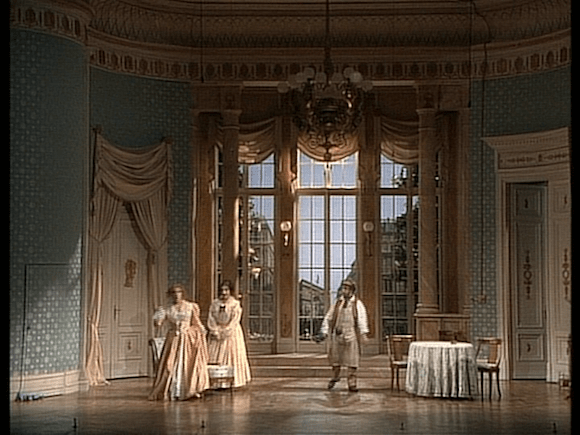
So here’s another Rossini one act farsa from Schwetzingen.  It’s a 1990 La scala di seta in, inevitably, a production by Michal Hampe.  It’s predictably pretty to look at and well constructed dramaturgically.  The Paris background is a nice touch.  There’s some fine singing and energetic fooling from Alessandro Corbelli as the servant Germano.  The principal quartet of lovers; Luciana Serra, David Kuebler, Jane Bunnel and Alberto Rinaldi backed up by David Griffith as the girls’ guardian are stylish and toss off the various quick fire ensembles with aplomb.  Gianluigi Gelmetti and the Radio-Sinfonieorchester Stuttgart round things out with an equally accomplished reading.  So there it is, straightforward Rossini in a typical Hampe production pulled of nicely in Scwetzingen’s elegant rococo theatre.

1.room

Continue reading

The other Naples opera

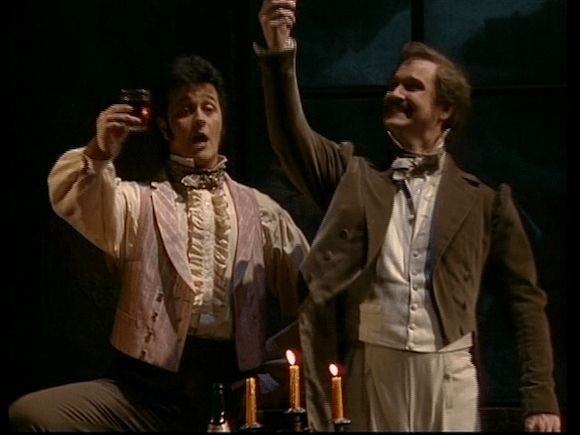
There are two girls and two guys.  The guys are not who they appear to be.  Nobody is sure who is pairing off with who and there’s a scheming servant.  And we are in Naples.  You know the opera of course.  It’s Rossini’s L’occasione fa il ladre. It’s one of Rossini’s early one act farsi for La Fenice and it’s quite good, if very silly.  There are plenty of musical high jinks with fast paced ensembles and some wicked coloratura.  And it has an unambiguously happy ending.  You will also likely recognise some of the music as, in best Rossini fashion, he used chunks of it in later works.

1.drink

Continue reading

Send in the clones

Stefano Poda’s production of Turandot (he is also responsible for the sets, costumes and lighting) for Teatro Regio Torino, recorded in early 2018, is one of the most visually effective productions of this (or perhaps any opera) that I’ve seen.  I don’t know whether it makes “sense” (but I’m also not sure that any Turandot does) and, if it does, I doubt one would be able to unpack it in a single viewing because there’s a lot going on (but see comment at the end).

1.cube

Continue reading

500

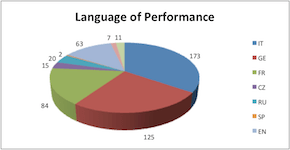
I reached the milestone of 400 DVD/Blu-ray reviews on June 20th 2016.  The 500 mark came up last weekend.  Let’s see how the stats have evolved.

500-languageItalian has increased its lead to 35% with German now on exactly 25%.  English has dropped marginally to 12%, despite its prominence in contemporary works.  I think multiple Salzburg Mozart cycles are playing a role here. Continue reading
Only the Sound Remains

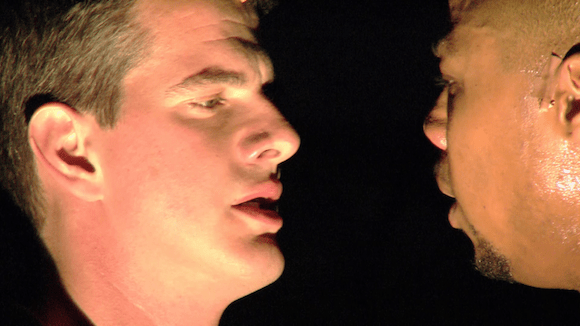
Only the Sound Remains is a chamber opera by Kaija Sariaho based on two Noh plays translated by Ernest Fenellosa and Ezra Pound.  The piece was premiered in Amsterdam in 2016 by Dutch National Opera, where it was recorded.  It’s a co-pro with Teatro Real, Finnish National Opera and the COC so Toronto audiences will likely get a look at it eventually.  Which is good because it’s really hard to figure out much of it from the video recording.  As he so often does, Peter Sellars directs for both stage and camera and while I like his stage work here I find his video direction quite annoying, especially in the first piece.

1.faces

Continue reading

Lucio Silla moda grunge

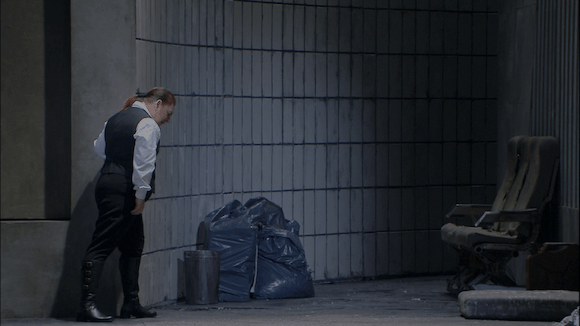
Claus Guth has a way with Mozart.  At his best; with his Salzburg productions of the da Ponte operas for example, he’s superb while I was unconvinced by his Glyndebourne Clemenza, despite its ambition.  I was really keen to see what he would do with an opera like Lucio Silla which, despite some lovely music, is formulaic and potentially very boring.

1.bins

Continue reading

More than the kitchen sink

I’m a bit surprised that Berlioz’ 1838 opera Benvenuto Cellini hasn’t come my way before. It’s got all the operatic elements; romance, politics, murder (and the Pope) etc and some really rather good music.  There’s a lovely duet between Cellini and his girl, Teresa, in the first act and Cellini’s aria Sur les monts les plus sauvages is long and demanding in the way that Rossini writes long and demanding tenor arias.  The plot maybe has a few holes.  One might expect that after the pope has decreed that Cellini will be hanged if he doesn’t finish a statue by nightfall that he might just get on with it rather than running around fighting duels and stuff but there you have it.  It’s French opera after all.

1.celliniarrives

Continue reading

La campana sommersa

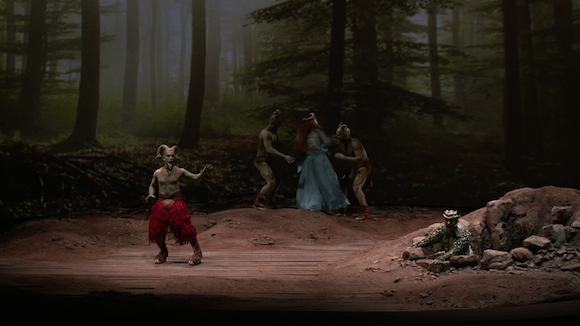
Respighi’s La campana sommersa is interesting in that it’s one of comparatively few post-Puccini Italian operas to get some sort of traction.  It premiered in Hamburg in 1927 and saw quite a few productions between then and 1939 including one at the Met in 1929.  Then it pretty much descended into obscurity before being revived in 2016 by a co-pro between Teatro Lirico di Cagliari (where the recording reviewed here was made) and the revived (more or less) NYCO (which used the Cagliari orchestra and chorus but American soloists).  It’s based on a symbolist poem by German poet Gerhart Hauptmann and concerns a bell; which has been hoofed into a lake by fauns, a master bell maker who thinks he is the pagan god Balder, a water sprite, Rautendelein, and assorted mortals, elves, witches, fauns and so on.  As with all these works no-one lives happily ever after.

1.faunsetc

Continue reading