A French Comte Ory

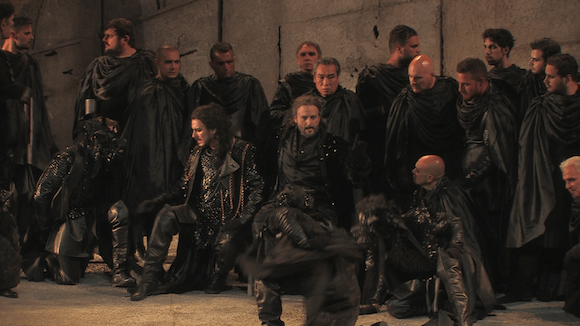
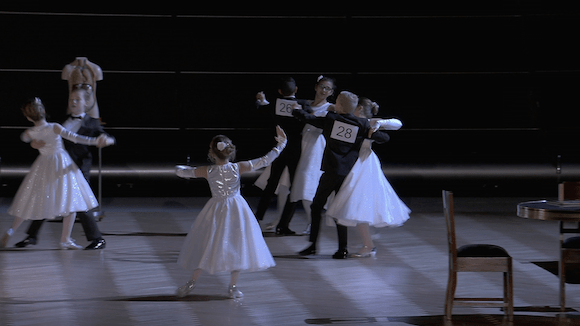
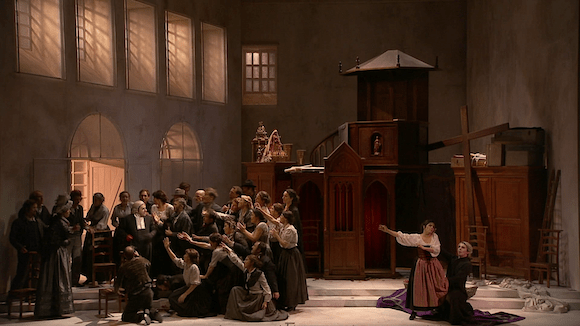
Rossini’s Le Comte Ory was written for Paris so it’s appropriate that there should be a recording from the Opéra Comique.  It’s directed by Denis Podalydès who chooses to set it around the time of the opera’s creation (1828) with the “crusader” element replaced by the French conquest of Algeria.  The sets and costumes are pretty conventional with a heavy emphasis on religious symbolism; some of it rather awry.  There’s also a heavy element of sexual frustration.  The comedy is all very much there but it’s not too slapstick and there’s none of the annoying cheesiness of Bartlett Sher’s New York version.  It all feels very French.
1.hermit

Continue reading →

Another Giasone

Cavalli’s Il Giasone is a bit of a rarity but perhaps, like the rest of his opus, it’s getting more attention than it used to.  The latest video recording of it was made at the Grand Theâte Genève in 2017.  There’s a summary of the rather convoluted plot in my review of an earlier version from Vlaamse Opera.  Oddly in this version Isifile’s final aria omits the weird section about her cold dead breasts.

1.prologue

Continue reading →

Giulietta e Romeo

Nicola Vaccaj was a contemporary of Rossini and composer of numerous operas of which only his 1825 work Giulietta e Romeo survives.  It was produced and recorded at the Festivale della Valle d’Itria in 2018 on the outdoor stage of the Palazzo Ducale in Martina Franca.  Giulietta e Romeo, like Bellini’s work on the same subject, is based on earlier material rather than the Shakespeare play and it’s quite different apart from the basic faked death and dual suicide at the end.  Here we are less concerned with two young lovers.  There’s more broad-scale political stuff.  Romeo commands the Ghibelline army that is besieging the Guelfs (including the Capulets) in Verona.  He has already killed Giulietta’s brother in battle and the lovers have known each other for some time.  So Romeo is rather more than a boy though still sung by a mezzo.  The themes are more about bereavement and revenge than young love.  The conflict is more than a quarrel between two urban dynasties.

1.wolves

Continue reading →

Tosca noir

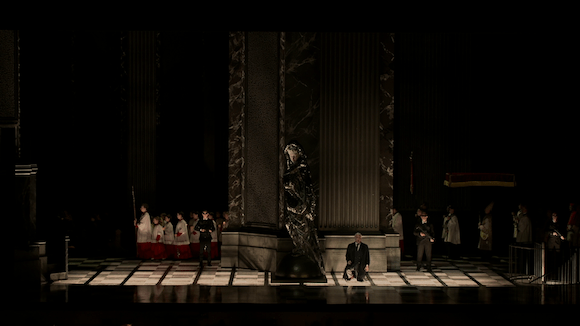
The 2018 Salzburg Easter Festival production of Puccini’s Tosca was directed by Michael Sturminger.  The only Sturminger works I’ve seen before are his rather odd Mozart collaborations with John Malkovich; The Giacomo Variations and The Infernal Comedy so I really wasn’t sure what to expect.  The production riffs off film noir and is updated to more or less the present.  It opens with a shoot out between Angelotti and the police  but that lasts only a few seconds and the first act and the first half of the second act are fairly conventional, bar Scarpia on an exercise bike as Act 2 opens.  That said, it’s big and monochromatic and it does have a noir feel.  It starts to get a bit more conceptual around the Scarpia/Tosca confrontation.  It’s an interesting take on Scarpia; perhaps more bureaucrat than psychopath.  The relationship between the two is well drawn and Anja Harteros does a really convincing job of her build up to killing Scarpia including a first class Vissi d’arte sung from some unusual positions.  There’s a hint of what’s to come at the very end of the act when an “I’m not dead yet” Scarpia is seen crawling towards his phone.

1.church

Continue reading →

The Adventures of Pinocchio

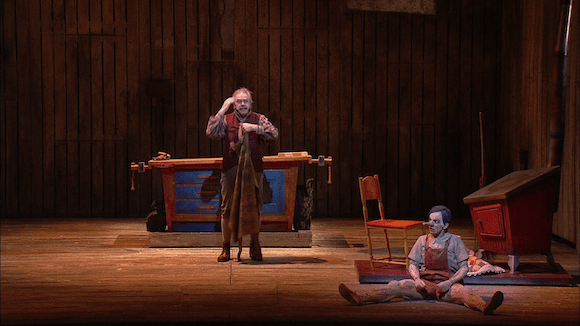
I’ve been impressed by Jonathan Dove’s art songs so I was glad to be able to take a look at one of his operas.  It’s The Adventures of Pinocchio and it was recorded in a production by Opera North at Sadlers Wells in 2008.  I feel a bit ambivalent about it.  I really like the music but I’m not hugely engaged by the libretto.  I think this is largely because of the subject matter so it may come off better for someone else.
1.pingep

Continue reading →

Ekstasis

Ekstasis is a multi-media collaboration between Kaija Saariaho and Jean-Baptiste Barrière.  There are six pieces on the Blu-ray disk.  Three were written by Saariaho with the visual elements added later by her husband.  The Barrière works were conceived from the outset as multi-media pieces.

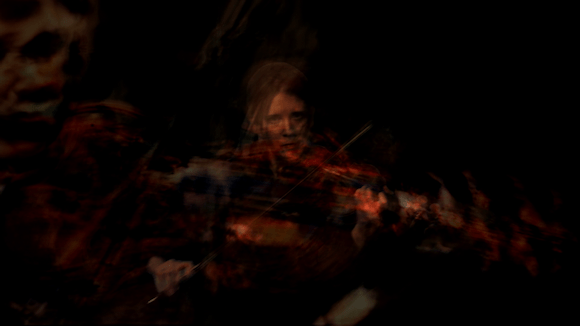
The three Saariaho pieces come first.  There’s Nocturne for solo violin which is the only piece that doesn’t include electronics.  It’s played by Allisa Neige Barrière and is a kind of meditation for extended violin techniques.  The video element is the violinist sort of semi superposed on a rippling pond.  It’s typical of all the visuals.  An image, often the player, is combined with another image, often, as here, of a landscape element.  The images merge and flicker in a sort of kaleidoscopic way.

1.nocturne Continue reading →

Creepy Wozzeck

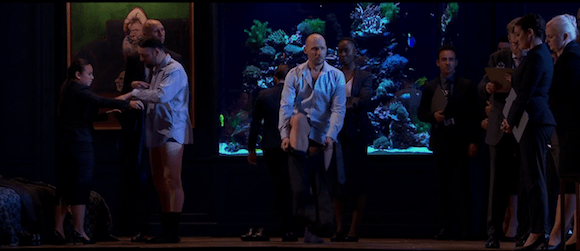
Alban Berg’s Wozzeck seems to attract just about every possible treatment from directors other than a straightforwardly literal one.  Krzysof Warlikowski’s approach, seen at Dutch National Opera in 2017, is to go back to the original story on which the Büchner play, in its turn the source for the opera, is based.  Wrapped around that are several interesting ideas which I can’t fully unpack but which make for a rather creepy but compelling production.  Alas, the disk package has nothing to say about the production so, interpretively, one is on one’s own.

1.dancers

Continue reading →

More Lessons in Love and Violence (and frustration!)

I requested a review copy of the Blu-ray release of George Benjamin’s Lessons in Love and Violence when it came out in December.  There was a bit of a hiatus in supplies from them which resumed again recently but when several packages arrived without the Benjamin piece I decided I was out of luck so I wrote a review based on a copy of the BBC’s broadcast of the work.  That was two days ago.  Today the Blu-ray arrived!  I’ve watched enough of it to convince myself that I only need to make minior changes to the review which I have done.  The revised review is here.

Lessons in Love and Violence

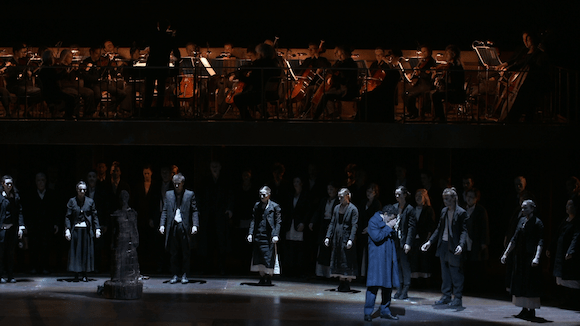
George Benjamin’s latest opera Lessons in Love and Violence debuted at Covent Garden last year.  It was broadcast on the BBC and is still available on the web from Arte and has also been released on DVD and Blu-ray.  This review is based on the Blu-ray version.

1.trousers

Continue reading →

The actual Paris Orphée

Gluck’s Orfeo/Orphée is one of those works where things get a bit complicated because an Italian and a French version wre produced and then all kinds of mash ups of the two versions.  It’s a bit like Don Carlo/Don Carlos or Guglielmo Tell/Guillaume Tell.  The original Orfeo ed Euridice, which premiered in Vienna is quite short and has Orfeo written for a castrato.  The Paris version spreads the piece out over three acts, adds both new vocal music and lots more dance music and has Orphée written for haut-contre.  Today, when people do the French version they usually cut some of the new music and use the higher Orphée music; casting either a mezzo or a counter-tenor.  This is true of both recordings  (Paris 2000 and Munich 2003) which have come my way in the past.

1.opening

Continue reading →