
 This review first appeared in the print edition of Opera Canada.
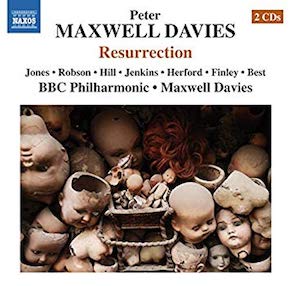
The 1994 recording of Peter Maxwell Davies’ opera Resurrection, previously released on Collins has now been re-released on the Naxos label. It’s a hugely ambitious and somewhat confusing work; even harder to get to grips with on CD than it might be with visuals. It’s an anarchic parody of establishment figures and attitudes executed via a pastiche of multiple musical styles.
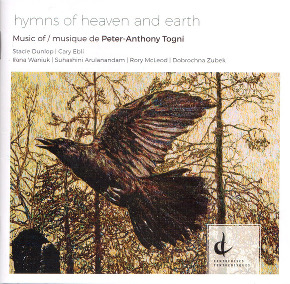 hymns of heaven and earth is a Centrediscs CD featuring three works by Halifax based Peter-Anthony Togni. I have limited experience with Togni. I thought his Responsio (reviewed for Opera Canada) was inspired but was less impressed with his
 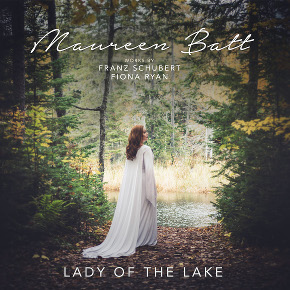 This is an interesting CD. It couples the rather rarely performed Schubert cycle to texts by Sir Walter Scott with a new Fiona Ryan cycle on the same theme. The reason the Schubert is a bit of a rarity is that, besides high and low voice and piano, one number requires a female chorus and another a TTBB quartet. In fact here those two pieces were recorded separately in different locations but I don’t think it’s apparent listening to the disc. The Schubert also includes the well known Ave Maria, the sixth song in the cycle, given here in the German originally used by Schubert rather than the Latin version usually heard. It’s a very decent performance. Maureen Batt is the soprano (and the evil genius behind the whole enterprise). Her voice is light and clear and her diction is excellent. Even a piece like the Ave Maria sounds fresh. Jon-Paul Décosse is the baritone. It’s a firm, confident voice, again with every word clearly audible. Simon Docking provides excellent accompaniment. The Bootgesang is performed by Leander Mendoza and Justin Simard; tenors with Robert O’Quinn and James Levesque; baritones, again with Docking at the piano. This might be the most fun piece of the cycle. For the elegiac Coronach we get The Halifax Camerata Singers conducted by Jeff Joudrey with Lynette Wahlstrom at the piano. They sound very pleasant.
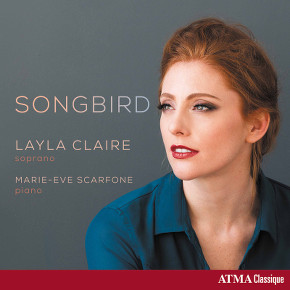 Layla Claire is one of a handful of young Canadian singers making something of a splash on both sides of the Atlantic with major roles in Glyndebourne, Zürich, Toronto and Salzburg and an upcoming Pamina at the Met. Her debut recital CD Songbird, with pianist Marie-Eve Scarfone, was recently issued on the ATMA Classique label. It’s an interesting and varied collection of songs though never straying very far from familiar recital territory. It’s tilted towards French (Gounod, Chausson, Debussy, Fauré, Bizet) and German (Wolf, Strauss, Brahms, Liszt) repertoire but there’s also Quilter, Barber, Argento and Britten (the comparatively rare Seascape which is, oddly, omitted from the CD liner).
 This review first appeared in the print edition of
  Carl Heinrich Graun isn’t exactly a household name today but he was court composer to the extremely musical Frederick the Great who was fond of both his flute and the opera when he wasn’t too busy being beastly to the Austrians. Anyway, Graun composed a ton of opera and based on the arias on this disk it’s surprising that they are almost completely neglected. The only Graun opera I have seen is
 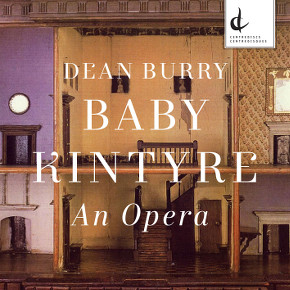 All families, they say, have secrets. Few perhaps are as lurid as what came to light at 29 Kintyre Avenue, Toronto (about 2km from here) in the summer of 2007 when a contractor renovating the house discovered the mummified body of an infant wrapped in a 1925 newspaper. Incredibly, the CBC was able to track down the last surviving member of the household from that era, a 92 year old woman living in a retirement home in up-state New York. Her recollections, which formed the subject of a short two part radio documentary, provided a lot of context and background but few hard facts. Who the baby was and how it came to be under the floorboards remains very much a mystery.
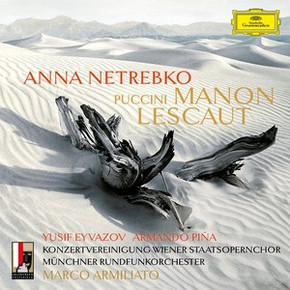 Not too many CDs of new opera recordings, at least of mainstream repertoire, come my way these days. Studio recordings have become rare and the usual medium is a video recording, itself a spin off from a live broadcast; TV, cinema or web, of a live performance. This makes sense to me. Just listening to an opera has always seemed a second best. Anyway, that’s all by way of saying that I was a bit surprised to find myself listening to a CD edition of a live recording of Puccini’s Manon Lescaut from the 2016 Salzburg Festival. How did this recording happen you ask? The answer is on the box, where Anna Netrebko in the title role, gets top billing, even over the composer.
 An email just in from Tapestry informs me that:
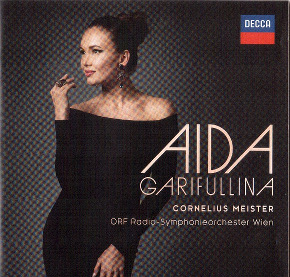 Aida Garifullina is a young lyric soprano of Tatar origin who already has some interesting achievements under her belt. She played Lily Pons in the Florence Foster Jenkins movie, placed first at Operalia in 2013, has sung a string of -ina roles at the Marinsky and is currently a member of the ensemble at the Wiener Staatsoper. She’s also done concert work with the likes of Dmitri Hvostorovsky and Andrea Bocelli. Now she’s released a debut CD called Aida Garifullina recorded with the ORF Radio-Symponieorchester Wien and Cornelius Meister.
