Mozart 225

mozart225Today marks the 225th anniversary of Mozart’s death.  To commemorate it Universal Records (Deutsche Grammophon and Decca basically) have put together a special commemorative edition which I have had a chance to dip into, but not much more than dip into, because it is huge.  It’s a cuboid about the size of an LP record and a little over half as deep.  It weighs 10kg.  Inside are 200 CDs containing the complete works of Mozart including juvenalia, fragments, arrangements and alternative versions.  There’s also a copy of the latest Kerchel catalogue, some prints and two very handsome hardback books; a new biography by Cliff Eisen and a second volume containing essays and work by work commentary.  What there isn’t is libretti for the vocal works but it actually gets better.  One can go to the website mozart225.com and download an app, offered in a choice of languages, with the libretti of all the works plus translation.  (You do need the code from the set to do this).  OK so I’m a bit of a gadget freak but all the Mozart libretti on my phone?  How cool is that?

Continue reading

In life, in death

remembranceRemembrance is a new CD, on the Harmonia Mundi label, from the Choir of Clare College and their director Graham Ross to be released October 21st in time for poppy season.  The main event is a performance of Duruflé’s Requiem given here in the composer’s organ reduction.  It’s recorded in Lincoln Cathedral with its great Father Willis organ.  It’s a very polished performance with a fair bit of drama.  There’s some lovely singing and cello playing from mezzo Jennifer Johnston and cellist Guy Johnston in the Pie Jesu and bass Neal Davies also makes a couple of trenchant contributions.  It’s not one of the most performed requiems but definitely worth a listen. Continue reading

Leçons de Ténèbres

leconsCouperin’s Leçons de Ténèbres sets texts from Lamentations and is incredibly beautiful in a very French baroque way as well as rather being music to cut your wrists to.  There’s a new CD recording of it by English sopranos Lucy Crowe and Elizabeth Watts with La Nuova Musica directed by David Bates.  It’s very fine.  Both Crowe and Watts give exemplarty performances.  They use minimal vibrato; just enough to create some resonance in louder passages and both have a wonderfully expressive trill.  Coupled with really expressive playing from Jonathan Rees – viola da gamba, Alex McCartney – theorbo and David Bates – organ, it’s a real pleasure to listen to.  Interestingly the three sections of the Leçons are separated by two trio sonatas by Sébastian de Brossard where the instrumentalists are joined by Bojan Čičić and Sabine Stoffer – violins.  It works really well.  The disc is rounded out by Brossard’s Stabat Mater, another rather lovely piece of Lenten dolorosity.  The singers on this last are Miriam Allan, James Arthur, Nicholas Scott and Simon Wall with Jonathan Rees – viola da gamba, Judith Evans – double bass, Alex McCartney – theorbo and Silas Woolaston – organ.  The recording, made in St. Augustine’s Kilburn, is clear and well balanced with an ambience that suits the music well.

The Far West

The+Far+WestThis review first appeared in the print edition of Opera Canada.
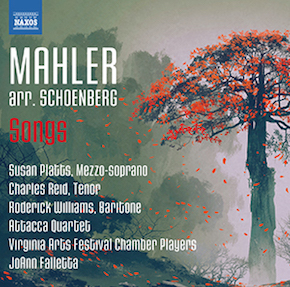
Zachary Wadsworth’s The Far West is a setting for tenor, chorus and strings of texts by poet/priest Tim Duglos, who died of AIDS in 1990. These are very personal and curiously optimistic texts. In G-9 for example death is described as “a great adventure” that will end “in just the right place”. Only in Parachuteis there much in the way of anger. Here AIDs is “an insatiable and prowling beast with razor teeth and a persistent stink”

Continue reading

Thread of Winter

Thread of WinterThis review first appeared in the print edition of Opera Canada.
Leslie Fagan and Lorin Shalanko’s new CD, Thread of Winter, is billed as the first CD in the Canadian Art Song Series(not, emphatically not, to be confused with the Canadian Art Song Project). The material it contains is said by the performers to have been selected for “accessibility” and as a resource for students who apparently find it hard to find recordings of Canadian repertoire.

Continue reading

Alma Oppressa

alma oppressaThis review first appeared in the print edition of Opera Canada.

Mezzo-soprano Julie Boulianne’s new CD Alma Oppressa, recorded with the Clavecin en Concert and Luc Beauséjour, features arias by Vivaldi and Handel as well as a few short instrumental pieces taken from their operas. It’s a pleasing combination of the dramatic and the more lyrically relaxed, though as pretty much all these arias were written for star castrati it’s also highly virtuosic. The first two numbers give a very good sample of what’s to come. The title track, from Vivaldi’s La fida ninfa is dramatic and allows Ms. Boulianne to use the darker colours of her voice to good effect as well as providing coloratura hijinks. “Sovvento il sole” from the same composer’s Andromeda Liberata is much more lyrical. Indeed, it’s very beautiful with a haunting melody line and an interesting dialogue between voice and violin. It shows off both the brighter tones of the voice and her very attractive lower register. The Vivaldi pieces will likely not be too familiar to most opera goers but there are much better known Handel pieces on the CD including “Lasci ch’io pianga” from Rinaldo and “Cara speme questo core” from Giulio Cesare. The latter shows off the brighter side of the voice as befits an aria for a juvenile character. The twelve piece band, with Beauséjour directing from the harpsichord is quite excellent. They provide a brisk and transparent accompaniment to the arias and sound really excellent in their three short instrumental pieces. I think this is a sensible sized ensemble for this music and probably not far away from what the composers would have expected.

Continue reading

The New American Art Song

okulitchThe New American Art Song is a CD of, unsurprisingly, American art songs.  Canadian bass-baritone Daniel Okulitch is accompanied by the composers in four contrasting sets.  The first set is Quiet Lives by Ricky Ian Gordon; eight songs setting texts by various poets.  The music is tonal with occasional elements of minimalism but overall a bit of a retro “piano lounge” feel that didn’t particularly excite me.

Second up were two songs, Of Gods and Cats, by Jake Heggie to texts by Gavin Geoffrey Gillard.  These are sly, witty, jazzy and much more contemporary sounding.  Much more musically inventive too.  It’s easy to see why Heggie is in the upper tier of contemporary American composers.  The disc also has a bonus Heggie song; a setting of Browning’s Grow Old Along With Me, that I really liked.

Continue reading

Rautavaara – Rubáiyát etc

Rautavaara_Rubaiyat_ODE12742This review first appeared in the print edition of Opera Canada.

This CD contains four recent works by Finnish composer Einojuhani Rautavaara. With the recent announcement of his death they are no doubt among his last and are representative of his final stylistic period in which he abandoned earlier experiments in dodecaphony, use of bird song etc to return to a high romantic style reminiscent at times, inevitably, of Sibelius and even more, perhaps, of Dvořák, though always, always sounding like Rautavaara.

Continue reading

Responsio

responsioThis review first appeared in the print edition of Opera Canada.

Peter-Anthony Togni’s Responsio is sub-titled “A contemporary response to Guillaume de Machaut’s Messe de Nostre Dame” and that is exactly what it is. It weaves sections of Machaut’s 14th century mass with sections designated “Response one”, “response two” etc. which are a kind of commentary on Machaut’s music. What’s really interesting though is the way Togni arranges the source material. It’s scored for soprano, mezzo, two tenors and bass clarinet. The use of high voices seems to emphasise the originality of Machaud’s music, which must have sounded pretty radical to its original audience, and facilitates him somewhat twisting and shaping the vocal line to bring out some fairly weird rhythms and harmonies. So unmediaeval did some of these textures sound that I went off in search of the source material. There’s no doubt that Togni has arranged to bring out the strangeness but it is very much there in Machaut’s original score. Then alongside the vocals there is the bass clarinet which, part scored, part improvised provides a rather compelling, even disturbing commentary in a more obviously contemporary vein. The Gloria and the Hosanna sections in particular juxtapose the vocals, already making the familiar words of the mass seem strange, with an insinuating clarinet line in ways that are almost physically jarring. It is a piece of great originality; beautiful, thought provoking and even weird, and quite fascinating.

Continue reading

Cold Mountain

CD-Cold-Mountain-CDThis review first appeared in the print edition of Opera Canada.

Jennifer Higdon’s Cold Mountain, which premiered at Santa Fe in 2015, is an example of what seems to be becoming the standard American formula for new opera. It takes a story from a best selling book that has already been made into a Hollywood film and turns it into an opera. Add to that that it’s a melodrama set in the currently fashionable Civil War South. Melodramatic it certainly is. Within five minutes Owens (Robert Pomakov) has been stabbed and buried alive and his son (Adrian Kramer) bound, gagged and dragged off to the army. A little later our hero, a Confederate deserter played by Nathan Gunn, rescues Laura (Andrea Nūnez) from being thrown from a cliff by her preacher boyfriend (Roger Honeywell). He ends up as part of a heap of chained together corpses. This production is rough on Canadian singers. There’s much more in the same vein with summary executions, baby torture, a choir of dead soldiers and the hero dying with the last shot of the piece. All of this is spun around the romance between the hero, Inman, and his classy but clueless girlfriend Ada (Isabel Leonard) who is busy dodging the attentions of the creepy and repulsive Teague (Jay Hunter-Morris) with the help of the sassy but practical Ruby (Emily Fons).

Continue reading