
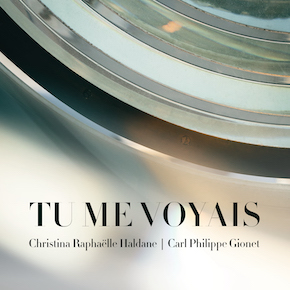
 Tu me voyais is a new CD from soprano Christina Raphaëlle Haldane and pianist Carl Philippe Gionet. It contains Gionet’s arrangements of Twelve Acadian Folk Songs plus a piece by Adam Sherkin setting poetry by Gionet and two pieces by Jérome Blais setting texts by Léonard Forest and Herménégilde Chiasson.
The twelve folk songs are all Acadien but unsurprisingly some of have roots further back in France. There are songs from Poitou and Gascony (so they are really English….) and so on. They are typically strophic songs with refrains and get a respectful treatment in the style of French chansons though this doesn’t mean the piano part is straightforward!. I like the simplicity of this approach because many of these songs are just gorgeous and Christina sings them with beauty and humour and, in some places, considerable agility coupled to a command of standard international French, Acadien and Poitevin. She really has a lovely rich yet flexible instrument. Gionet is a very sympathetic and accomplished accompanist too.
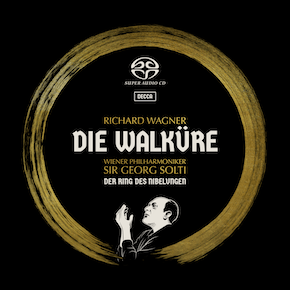 I have now had a chance to listen to the new SACD release of the 1965 Solti recording of Wagner’s Die Walküre. (For some reason Das Rheingold hasn’t arrived yet). I’m not going to do a detailed review of the performance since pretty much everything that could be said about it has been, and by people better qualified than me. As you might expect for a recording twice voted “recording of the century”. I’ve also already written about the technical details of the new transfer in
 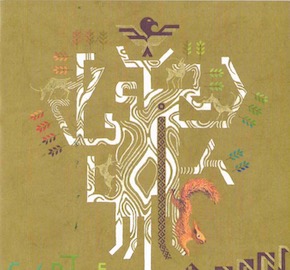 Yggdrasil is a new record by the Norwegian women’s choir Cantus conducted by Tove Ramlo-Ystad. There are eleven works on the record by various composers and all inspired, more or less loosely. by the idea of the World Ash Tree of Norse legend. Sometimes they are a fairly literal telling of some episode from myth, other times they explore broader ideas around a tree that lasts for a long time, but not for ever, and contains within it its own destruction and the seed of its rebirth. So, themes of humanity and Earth’s place in the Cosmos, the destructiveness of war, greed and climate change all have their place.
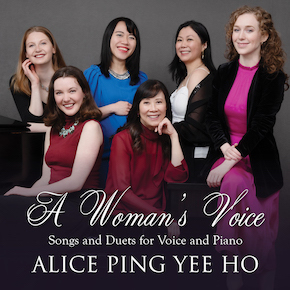 A Woman’s Voice is a record with 84 minutes of music for female voices and piano by Alice Ping Yee Ho. It’s a mixture of songs and excerpts from operas and a plkay. All but one track feature Toronto based artists who include no less than three Norcop prize winners. Overall, I found the songs more fun to listen to than the opera excerpts though they were interesting in their own way too and I’m seriously intrigued by a couple of them that I haven’t seen but now want to.
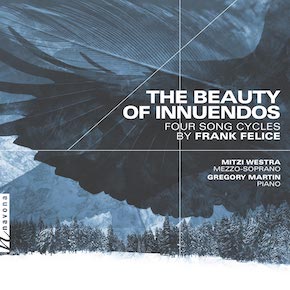 I think a lot of my motivation for listening to The Beauty of Innuendos was a desire to learn what on Earth the composer, Frank Felice, meant by “consonant adiatonicism”. I’m still not sure I really know. In any event there’s some enjoyable music on the record though I did find it a bit of a mixed bag.
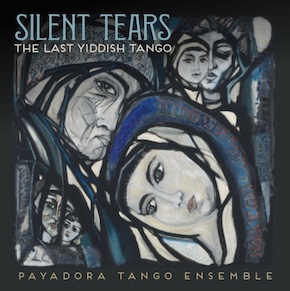 Silent Tears: The Last Yiddish Tango is a CD of songs based on the recollections of Holocaust survivors. Some of the songs deal with events during the Holocaust and others with the trauma of survivors. There are two main sources for the lyrics. One is the Baycrest Holocaust Surviviors Poetry Project facilitated by Dr. Paula David. The poems produced during that process were published in 1995 and adapted for this project. Other songs are based on the writings of Holocaust survivor Molly Applebaum who escaped by being buried under a barn in a small wooden box. The English texts have been adapted for this project by Dan Rosenberg and translated into Yiddish, others were originally written in Polish and remain in that tongue.
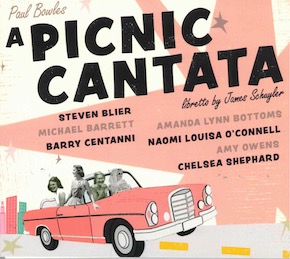 Today’s CD is a bit of an oddity and a bit of a period piece. It’s Paul Bowles’ 1953 work A Picnic Cantata setting a libretto by James Schuyler. It’s scored for two pianos and percussion plus a vocal cast of two sopranos and two altos. It’s hyperrealistic in detail and surrealistic in time line. The “plot” (roughly) is that friends decide to go on a Sunday picnic which is described in some detail, Then someone picks up the Sunday paper and starts to read bits from it. Then there’s a sort of clearing up and clearing out. Scene succeeds scene with almost breath-taking rapidity to complete a work that lasts less than half an hour
 My review
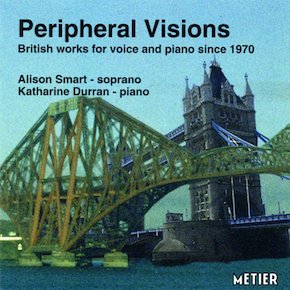 The first half of the 20th century was a sort of golden age for British art song unparalleled since the days of Purcell and Blow. There are works by, inter alia, Finzi, Britten Vaughan Williams and Butterworth that are still staples of the repertoire. After the second world war though it starts to tail off and I’m hard pressed to think of songs/song cycles from the last two or three decades of the century that have become at all popular. In fact, it seems to me, the most popular art song like works from this period are stage works which are based on a cycle of songs like Maxwell Davies’ Miss. Donnithorne’s Maggot. I was interested then to come across a 1999 CD of (actual) songs for voice and piano written since 1970. The CD is Peripheral Visions by soprano Alison Grant and pianist Katherine Durran.
  There are, perhaps remarkably, two operas on the theme of based on Anatole France’s short story about a juggler monk who impresses the Virgin Mary with his skills. There is a long one by Massenet and a much shorter one by Peter Maxwell Davies which I shall deal with here.
 operaramblings