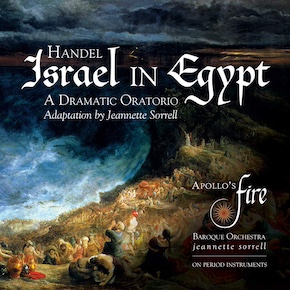
 Handel’s Israel in Egypt is one of the less well known of his English language oratorios. It’s also got a bit of an ofdd performance history with the first of the three acts often omitted. The new recording from period instrument ensemble Apollo’s Fire includes all three acts but omits some numbers and shortens others in a selection made by music director Jeannette Sorrell. This appears not to be uncommon. A quick scan of available recordings revealed performance durations of anywhere from 75 minutes to 150 minutes. This one comes in right on the bottom end of that range.
Israel in Egypt
Reply
 This is a really interesting and unusual album. French mezzo-soprano Stéphanie d’Oustrac teams up with a small baroque ensemble, Le Poème Harmonique (accordion, theorbo, strings, bassoon/flute) led by Vincent Dumestre to present a selection of music that ranges from traditional songs through 17th century opera/oratorio arias to cabaret music and modern chansons.
 Dame Ethel Smyth’s one act opera Der Wald is certainly of some historical interest. It was the first opera by a woman given at the Metropolitan Opera. That was in 1903 and 113 years would pass before the Met did another one; Kaija Saariaho’s L’Amour de loin in 2016.
 Probably pretty much everyone is familiar with Géricault’s painting Le Radeau de la Méduse, depicting scenes of horror after a shipwreck. The story behind it is much less well known. The year is 1816 and a French expedition is off to reoccupy Senegal which had been occupied by the British during the recent wars. The flagship of the expedition is the frigate La Méduse, which carries the governor and his staff and so on. Well ahead of the rest of the flotilla, and out of sight, La Méduse runs aground and is eventually abandoned. The governor, the officers and other nobs take to the boats towing the rest of the crew (154 men and boys) on a hastily improvised raft. Finding progress too slow after 24 hours they cut the raft adrift. When the raft is finally spotted fifteen men are still alive. A fitting allegory for the Bourbon restoration perhaps.
 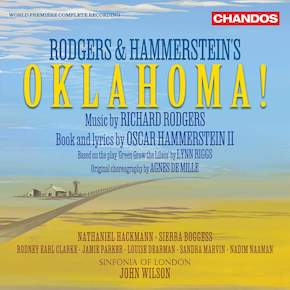 So, you may ask, what is Opera Ramblings doing reviewing a recording of Rodgers & Hammerstain’s Oklahoma!? Well, it’s a project in the same vein as my reviewing the Bru-Zane recordings of more or less forgotten late 18th and 19th century French operas. It’s an attempt to put the piece in the context of its early performances and also to look at how it was originally performed for, like many early 19th century French operas, if and when Oklahoma! does get performed it’s usually in a style very different from the original The occasion for doing so is a new Chandos recording that attempts to reconstruct the sound of the original 1943 Broadway run. That the recording is very high definition and released in SACD format only increased my interest.
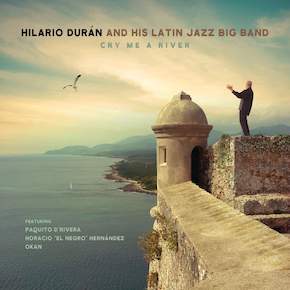 So one of the fun things about this writing project that I started twelve years ago is the unexpected ways that it has sometimes developed. One gets involved with projects, one meets people and one ends up connected with their other projects that may stray some way from, say, opera or art song. So last night I found myself at a film screening and CD release party for the new CD from Hilario Durán and His Latin Jazz Big Band. It was fascinating. First of all I really liked the music; original compositions and covers arranged for something like eighteen brass, woodwind, guitar/bass and percussion players with Hilario conducting from the piano and guests on some of the tracks including the amazing clarinet and sax player Paquito D’Rivera, vocalist/violinist Elizabeth Rodriguez, drummer Horacio “ElNegro” Hernández and bass player Marc Rogers.
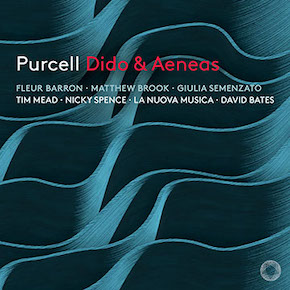 This new CD recording of Purcell’s Dido and Aeneas sets out to produce a version that might have been heard at court in the early 1680s. This is, of course, one of several theories about the work’s genesis and it’s the one I find most credible. Taking this as a starting point allows music director David Bates a framework in which to consider issues of style and casting.
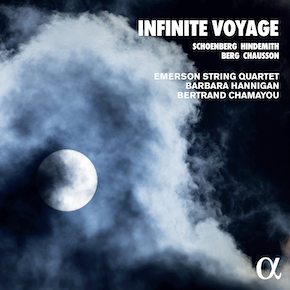 Infinite Voyage is billed as the final album from the Emerson Quartet capping a long and illustrious career. It’s also a collaboration with Barbara Hannigan so it’s perhaps not surprising that it includes music by Berg, Schoenberg and Hindemith though Chausson’s Chanson perpétuelle belongs to a rather different style.
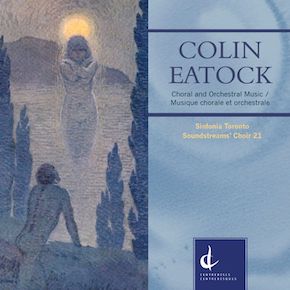 Centrediscs have recently released a CD of music by Toronto composer Colin Eatock. It’s a mix of choral and orchestral works; most of the former for unaccompanied voices. There are ten works on the disc making a generous 67 minutes or so of music.