Unknown's avatar

About operaramblings

Toronto based lover of opera, art song, related music and all forms of theatre.

Don Giovanni – delusion and collusion

This is a follow up to yesterday’s review of Martin Kušej’s Salzburg production of Don Giovanni.  What I want to explore here is how Kušej treats issues of collusion, consent and delusion as it applies to sexual relations.

There are some real problems in updating Don Giovanni.  After all, central to the plot is the death in a fight/duel of a man fighting to defend his daughter’s “honour”.  Since the notion that female “honour” is a simple matter of pre-marital chastity and post-marital fidelity makes no sense in the setting Kušej has chosen something else has to be seen to be happening. Continue reading

Don Giovanni in the 21st century

After a week of nostalgia wallowing in ancient “productions” from the met and the COC it’s back to Regietheater with a vengeance for the 100th DVD review on this blog.  The subject is Martin Kušej’s Salzburg production of Don Giovanni which premiered in 2002 but was recorded in 2006 as part of the M22 project.

For a start there’s nothing giocoso about this dramma. It’s a very bleak and complex production with lots of ideas; some of which work and some of which are more problematic, and it’s provoked more discussion at the Kitten Kondo than just about any other recording we’ve watched recently.  Rather than write a 3000 word review I’m going to write a normal length review and follow it up with one or more posts on aspects of the production that seem particularly worth exploring. Continue reading

Joan Sutherland on form

A while back I reviewed the train wreck that is the CBC recording of Joan Sutherland in Norma. Three years later the Canadian Opera Company and the CBC tried again with a recording of Donizetti’s Anna Bolena. As a recording and a production it has its limitations but it’s not a disaster and is enjoyable in many ways.

Continue reading

Spring in Toronto

It’s Spring in Toronto. The Canadian Opera Company has three productions in rehearsal and load ins and set building have started once more at the Four Seasons Centre. Here’s my take on what’s coming up.

Offenbach – Tales of Hoffmann April 10th to May 14th

Photo Credit: Kurt Van der Elst © 2000

This is a house debut for British director Lee Blakeley who brings his production previously seen at Vlaamse Opera.  The production looks on the face of it fairly conventional but word from the rehearsal studio is that it’s fairly “out there”.  The casting is a typical mix of “A list” talent, local favourites and Ensemble Studio members.  Probably the biggest draw is local boy John Relyea who is playing the four villains.  American tenor Russell Thomas sings the title role.  The four main female roles will be sung by Andriana Chuchman, Erin Wall, Keri Alkema and Lauren Segal; all familiar faces to Toronto audiences.  Johannes Debus conducts. More information.

Continue reading

Kathleen Battle steals the show again

In this next episode of our wallow in Met nostalgia we  are looking at the 1988 production of Richard Strauss’ Ariadne auf Naxos.  It’s a starry affair with James Levine conducting, Jessye Norman in the title role, James King as Bacchus, Kathleen Battle as Zerbinetta and Tatiana Troyanos as the Komponist.  There’s even a bit of luxury casting in the minor roles with Barbara Bonney and Dawn Upshaw among the nymphs.  It’s also as old fashioned as one could possibly imagine, being a revival of a production that premiered in 1962. Continue reading

Hockney’s Flute

It seems to be “looking back at older Metropolitan Opera productions” week here in the blogosphere.  Over at The Earworm there’s a series of posts on a 1980 production of Don Carlos.  Our subject will be the 1991 Die Zauberflöte.

The production was designed by David Hockney and the look varies from the whimsical; the opening scene, to the grandiose; the final scene, with bits of Egyptiana in between.  It’s very handsome.  The direction is described as “original direction” by John Cox and “direction” by Guus Mostart.  I’m not entirely sure what this means as there doesn’t really seem to be a production concept and the Personeregie is pretty basic.  Basically it looks like acting is considered to be an optional extra.  Some of the singers are good actors and some don’t even try.  There’s no consistency.  The impression is that the “production” is just a backdrop for the singers to do their thing. Continue reading

There’s the Moral to Draw

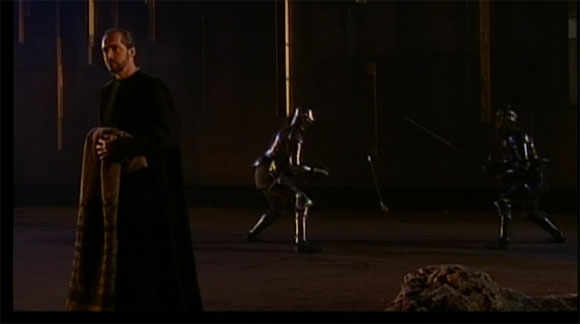
Robert Lepage’s 2007 Brussels production of The Rake’s Progress is fascinating on many levels.  I think all good opera productions start with the music and this is no exception.  Lepage sees a crucial relationship between Stravinsky at the time the work was written (1948) and film and television.  It was an era when insubstantial visual imagery was being supported emotionally by pretty impressive music.  Lepage works with that idea; setting the work in the 40s and incorporating film and film making imagery extensively.  I think this decision also frees up the music.  By taking the piece out of the 18th century it becomes possible to take the 18th century out of the piece.  For instance, there are elements in the libretto that mimic 18th century street ballads but Stravinsky absolutely avoids writing the kind of phrasing one might expect and quite deliberately breaks up the line.  That phrasing is respected here whereas I have often heard a false legato imposed on some of those phrases. In a way, the production is helping the viewer to hear the music differently which is perhaps the highest compliment one can pay an opera production.  There are other intriguing relationships between Lepage’s vision and Stravinsky’s.  Lepage sees Stravinsky as playing with time in a cinematic way i.e. rendering it non-linear.  Lepage seeks to mirror this in the spatial dimension by using some odd perspectives and some cinema devices; notably Anne driving her car in front of a moving backdrop just like a studio movie of the period.  There’s a lot going on and it would be tedious to describe it in detail.

Continue reading

Cavalli’s La Calisto

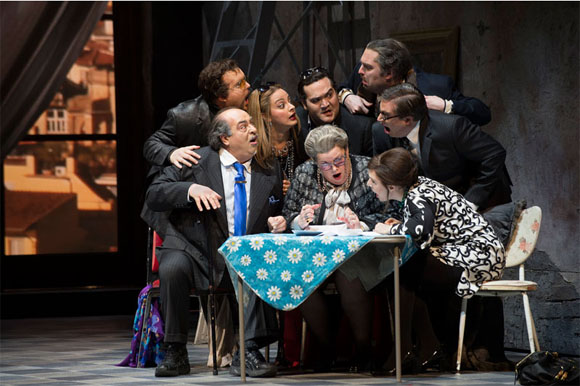
Last night was the first performance of this year’s production by the Glenn Gould Opera School at the Royal Conservatory.; the piece being Cavalli’s 1651 work La Calisto.  It’s one of those mythologically based pieces with a rather convoluted plot.  It starts with a prologue where various allegorical figures explain why Calisto, a nymph, should be immortalised as a constellation and then we flashback to the main action.  Jove (natch) fancies Calisto who is a chaste (and chased) devotee of the virgin huntress Diana.  With the help of Mercury Jove disguises himself as Diana and seduces Calisto.  This makes Diana and Juno (inevitably) very unhappy and Calisto is turned into a bear by the Furies though Jove reassures her that she will end up as a star.  Meanwhile there’s also sorts of stuff going on with Diana and a shepherd, Pan, assorted nymphs and a satyr.  Various permutations of women playing men pretending to be women etc allow for all sorts of broad sexual humour plus goat on goat action.  So it’s an odd blend of serious classical myth and pastoral farce that  works better when it doesn’t try to be too intellectual.

Continue reading

Northern Landscapes

Today’s lunchtime concert in the RBA was a recital of Nordic art songs given by students from the University of Toronto’s music programme.  The musical line up could certainly have been chosen for more variety.  With the exception of some Sibelius at the end it was all a bit “Grieg and his buddies greatest hits”.  This was rather reinforced by MC Steven Philcox’s rather prolix introductory remarks on each composer which can be summed up as as:

X was born into a wealthy family in Stockholm/Oslo/Copenhagen in 1840/50/60 and despite his father’s wish that he study law/medicine/for the Diplomatic he decided on a career in music and studied composition in Berlin/Dresden/Leipzig.  His music was influenced by Swedish/Danish/Norwegian folklore.  He wrote lots of stuff including no less than 200/400/800 songs for voice and piano

Continue reading