Unknown's avatar

About operaramblings

Toronto based lover of opera, art song, related music and all forms of theatre.

Very traditional Don Giovanni from the Metropolitan Opera

The 2000 Metropolitan Opera recording of Mozart’s Don Giovanni is based on Zeffirelli’s 1990 production somewhat modified by director Stephen Lawless.  It’s an entirely traditional “breeches and boobs” affair with baroque painted flats, tricorne hats etc.  Blocking is mostly very basic with a lot of “park and bark” just livened up with a bit of prop twiddling.  It works because it has a superb cast who sing and act (within the limits of the production) extremely well.

At the core is Bryn Terfel in the title role.  You get what you expect; a big voice that can be scaled back to quite beautiful, menace, physical presence and a touch of humour when required.  If you have seen his more recent Scarpia or Mephistopheles you know what to expect.  He’s backed up Ferruccio Furlanetto in a rather broadly comic take on Leporello which, though I find it unsubtle, isn’t inappropriate in this production.  The Terfel/Furlanetto relationship is very much master/servant.  No ambiguity about two sides of one character here! Continue reading

Back to Offenbach

After the hours of discussion about what Lee Blakeney really meant in his COC Les Contes d’Hoffmann a little light relief seemed called for.  Fortuitously I had just got my hands on the 1997 Opéra National de Lyon recording of Offenbach’s Orphée aux Enfers so I thought that might do the trick.  I was dead right.  The production by Laurent Pelly is an absolute hoot (or, to quote young British mezzo, Emilie Renard “FILTHY!”).  The high speed, somewhat surreal production is brilliantly executed by a predominantly French cast including Natalie Dessay as Eurydice and Laurent Naouri as Jupiter.  There’s so much going on that it would be tedious to provide a full description.  Continue reading

Tales of Hoffmann at Canadian Opera Company

Last night saw the third performance in the current run of Offenbach’s Les Contes d’Hoffmann at the Canadian Opera Company.

It’s a peculiar work.  It was Offenbach’s first and only foray into grand opera and he didn’t live to complete it.  This leaves all sorts of performance issues regarding orchestration, sequence of the acts and spoken dialogue vs accompanied recitatives among others.  The COC version uses the conventional act order; Olympia, Antonia, Giulietta, and recitatives with orchestral accompaniment which makes for a long night but is probably the best fit with director Lee Blakeley’s take on the piece, previously seen at Vlaamse Opera in 2000.

Continue reading

Tosca at La Scala

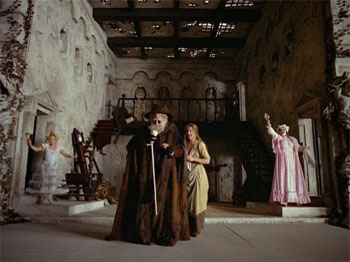
This 2000 La Scala recording of Puccini’s Tosca is straightforward and rather good.  It’s a revival of Luca Ronconi’s 1996 production which I’m somewhat astonished to read was regarded as controversial.  Sure, the sets are sort of fractured and feature some weird angles but everything else seems to be “by the book” down to the smallest details like the candlesticks and cross.  Regietheatre this isn’t.  In this performance the acting is OK, if tending to the “stand and wave your arms about” default Italian mode.  The stand out exception is Leo Nucci’s Scarpia.  He doesn’t have the physical presence to be brutal in the way that, say, Bryn Terfel can be but he manages to project a very nasty securocrat indeed.  This is a Scarpia who would be good at making Powerpoint presentations to his bosses detailing how many women and children his unmanned drones had killed today.

Continue reading

Some help from my American friends?

I believe in new opera. I think it’s vital to the survival of the genre and I like quite a lot of it. Most of what I like has come from European or British composers or John Adams. I love Reimann’s Lear and Birtwistle’s The Minotaur and Sariaaho’s L’Amour de Loin.  I’m equally impressed by Nixon in China and, maybe to a lesser extent, Doctor Atomic.  All of these, it seems to me, lie within the range of idiom of contemporary symphonic or chamber music.  I’ve had much less luck finding contemporary American opera, Adams aside, that I enjoy or even find interesting.  I loathed A Streetcar Named Desire and five minutes of Adamo’s Little Women had me reaching for the barf bucket.  It’s a combination of cloying sentimentality and music that sounds like South Pacific minus the good tunes.  It’s certainly not the sort of music one could imagine hearing at a symphony concert. Am I missing something?  What should I try to see if I want to see intelligent, musically interesting contemporary American opera?

Patchy Figaro

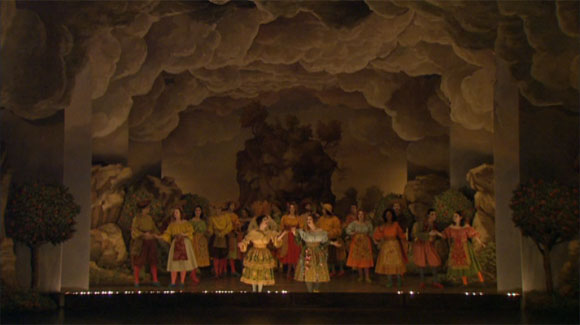
There are, I think, eighteen DVD versions of Mozart’s Le Nozze di Figaro currently available so there needs to be something very special about a recording for it to stand out. Unfortunately Stephen Medcalf’s 1994 Glyndebourne production doesn’t really despite having a strong looking cast. It’s a pretty traditional looking production with breeches and crinolines and sets which look a bit like a giant doll’s house. The Personenregie is well thought out and the stage picture often artfully composed. The acting is almost uniformly excellent. It’s a good solid production but with nothing original in the least about it. Continue reading

One can rob a bank or use a bank to rob others

I don’t really know whether the collaborations between Brecht and Weill deserve to be called operas but some of them at least are sung by opera singers and produced in opera houses so I think they are legitimately within the ambit of this blog.  Arguably the best known of them all is Die Dreigroschenoper which premiered in Berlin in 1931.  I’ve seen it a couple of times in English translation and, like most people I guess, I’m familiar with the music (in both English and German) through recordings by people like Lotte Lenya, Ute Lemper and Robyn Archer.  With that background I was very interested to take a look at the 1931 film of the work directed by GW Pabst. Continue reading

de Bello Gallico

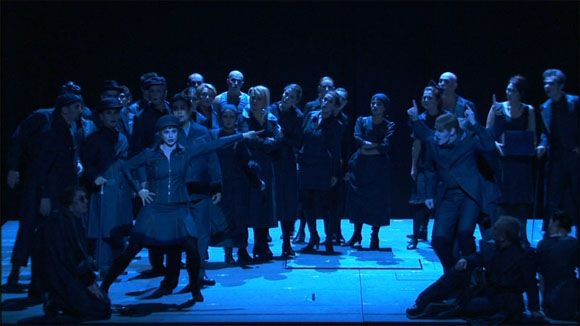
Bellini’s Norma is a tale of illicit love between two Gaulish priestesses (can women be called druids?) and a Roman tribune.  In this 2006 production for the Bayerische Staatsoper director Jürgen Rose has set the piece in the present day in a vaguely Middle Eastern setting.  Within that framework the story is told quite straightforwardly and there’s no attempt to project some kind of agenda.  The designs are very striking.  Blue figures a lot.  Norma’s home is an underground bunker.  When the Gauls arm for war they put on ski masks and supplement their spears with assault rifles.  It all looks really good.  The acting is also excellent and we get some real intensity in the Norma/Pollione/Adalgisa love triangle and in the tension between Norma and her father Oroveso.  It works as drama.

Continue reading

Adieu to Jacqueline

At lunchtime today, in the Richard Bradshaw Amphitheatre, Jacqueline Woodley gave her final recital as a member of the COC Studio Ensemble. In the two years she has been in the programme Jacqueline has given me maybe more pleasure than any other Ensemble Studio singer (stop sniggering at the back). What’s become clear in that time is that she’s an exceptional talent when it comes to interpreting difficult modern and contemporary music. Realistically I doubt we’ll see her sing Verdi at La Scala but few people who do that could do what Jacquie does with works by composers like Golijov, Saariaho and Sokolovic.  Perhaps no surprise then that she chose a recital programme that was 100% art song. Continue reading

Don Giovanni – choices and futures

This is a continuation of a discussion of how Martin Kušej treats sex in his Salzburg Don Giovanni. The first installment, dealing with Act 1, is here.

At the conclusion of Act 1 the cycle of, at least apparently, consensual kinky sex has been broken by the first clearly non-consensual action; Zerlina has been hunted down by Don Giovanni and forcibly borne off by the sisters of Persephone. Where is this going? Continue reading