

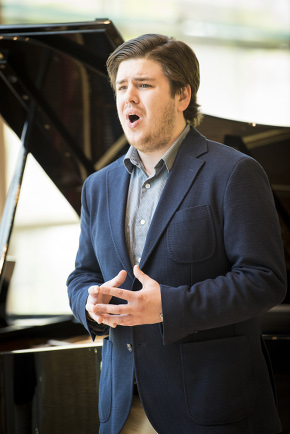
 Yesterday’s lunchtime recital in the RBA featured three current members of the COC Ensemble Studio. First up was tenor Aaron Sheppard making his adieux with Finzi’s A Young Man’s Exhortation; a setting of texts by Thomas Hardy. It’s an interesting cycle; quite spare with, despite its lack of density, an intricate piano part that reveals some interesting chromaticism. The vocal line calls for great delicacy and control with occasionally injections of power. We got all that in a very fine performance by Aaron, and by Stéphane Mayer at the piano. It was probably the best performance I’ve heard from Aaron. He’s always had a rather beautiful, but perhaps too delicate voice. Here the control, phrasing and emphasis was all there but so was some oomph when needed. His performance was very true to the texts which have that same quality that Houseman exudes; Merry England with Death just peeking in from around the corner when one least expects it. Good stuff.
Transformations
Reply

 This review first appeared in the print edition of
 I went to see the TSO last night because there was a Boulez piece programmed that I wanted to hear. It was a rather odd evening. It kicked off with Morawetz’ Carnival Overture Op.2. This was I suppose the designated Canadiana. It’s a roughly five minute piece that sounds like the Brahms of the Academic Festival Overture crossed with Dvořák. Too much brass and cymbals for my taste. Then came about ten minutes of faffing about reorganising the stage for the Boulez followed by Peter Oundjian coming out and making one of those cringingly apologetic speeches for programming something “difficult”. I hate this. If an orchestra, opera house or chamber ensemble is going to program atonal, serialist or what you will music (and they should) by all means explain how it works in a program note but don’t patronise the audience and, above all, don’t apologise. If it needs an apology why are you programming it?
 The Canadian Children’s Opera Company have announced their 50th anniversary season. The big news is that the main production will be a new piece by Alice Ping Yee Ho and Marjorie Chan (the team behind The Lesson of Da Ji). The new piece is called The Monkiest King and is based on the legendary (and comic book) character the Monkey King. Like the earlier work it will fuse western opera and traditional Chinese music techniques and instruments. It will play at the Lyric Theatre at the Toronto Centre for the Arts May 25-27 2018.
 Yes it is and here’s what’s coming up. Sadly Natalie Dessay’s Koerner gig tonight has been cancelled. Get well soon and please come back! Tomorrow at 8pm the TSO has a concert with Carla Huhtanen featuring Morawetz’ Carnival Overture, Boulez’ Le soleil des eaux and Rimsky-Korsakoff’s Scheherezade. On Sunday Lyndsay Promane has a recital at 3pm at Islington United Church with works by Dowland, Faure, Schubert, Vaughan Williams and Strauss. Admission is by donation
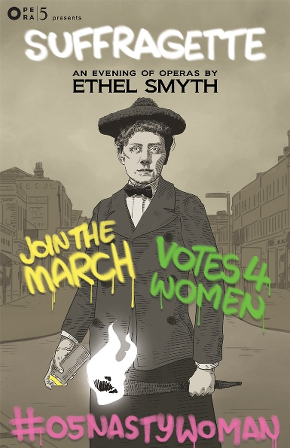 Details are now available for Opera 5’s double bill Suffragette featuring the works of Dame Ethel Smyth. The show will feature two works; Fête Galante, a rather grim “dance dream”, in a somewhat Stravinskian style, and the feminist opera The Boatswain’s Mate, which makes extensive use of folksong tunes. In her day Smythe tended to be written off by the critics for being too masculine so it will be interesting to see how the works have fared with time.
 operaramblings