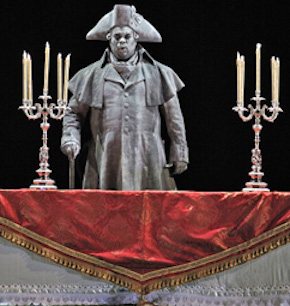
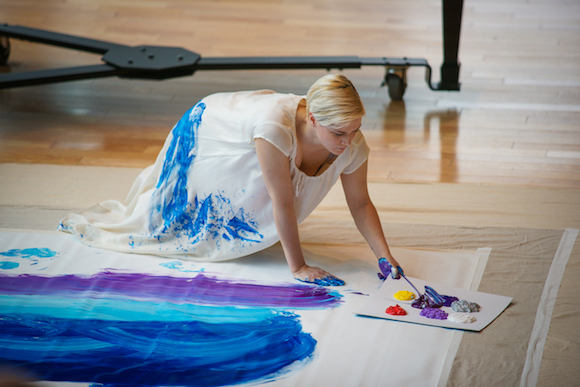
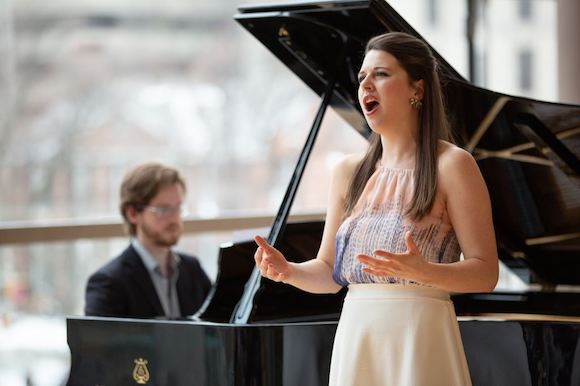
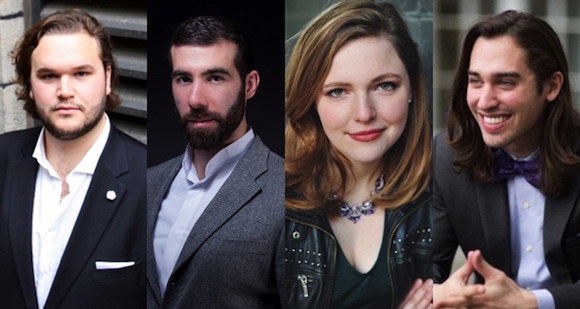
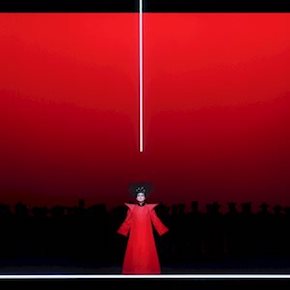
The current Tapestry Briefs is one of the most satisfying I have attended. Briefs is the performance edition of the LibLab; an intense where composers collaborate with librettists to create new opera scenes. Some of these disappear and some go on to be the starting point for new operas. The current crop is strong. There were eleven scenes in the show; sung by various combinations of Teiya Kasahara, Stephanie Tritchew, Keith Klassen and Peter McGillivray with Jennifer Tung at the piano and other keyboards. As a bonus, at intervals Keith appeared to sing a parody of a famous aria describing the tasty little tapas which were offered around.
Author Archives: operaramblings
I Call myself Princess
Jani Lauzon’s I Call myself Princess which opened Thursday night at the Aki Studio is a really good show and an important addition to the dramaturgy around Reconciliation and Cultural Appropriation. I was reviewing for Opera Canada where I trust the review will appear in due course but don’t wait… go see it.
Larry redux
The demise of Toronto Masque Theatre was never likely to lead to the retirement of Larry Beckwith from the Toronto scene and it hasn’t. He’s back with a new concert series called Confluence that describes itself as a “a new interdisciplinary, cross-cultural multi-media (many-hyphened) project”. There’s a Pay What You Can kick off next Sunday, 16th September, at St. Thomas’ Church at 383 Huron Street at 2.30pm where there will be performances and readings featuring many of the season’s artists plus food and drink.
The Hard Bargain
There are some unusual books coming my way these days. The latest is an autobiography (more or less) of David Tucker; the middle son of the late Richard Tucker; a fixture at the Met for thirty years until his death in 1975. I found it fascinating but I’m not entirely sure whether that’s because it’s a good book or because of the many places where it has a lot of personal resonance for me. Both I suspect. I also found myself having very ambivalent feelings about David (and perhaps even more so Richard) Tucker but I don’t think it’s the purpose of a reviewer of an autobiography to make moral judgements about his subject. The reader can do that for him/herself.
La campana sommersa
Respighi’s La campana sommersa is interesting in that it’s one of comparatively few post-Puccini Italian operas to get some sort of traction. It premiered in Hamburg in 1927 and saw quite a few productions between then and 1939 including one at the Met in 1929. Then it pretty much descended into obscurity before being revived in 2016 by a co-pro between Teatro Lirico di Cagliari (where the recording reviewed here was made) and the revived (more or less) NYCO (which used the Cagliari orchestra and chorus but American soloists). It’s based on a symbolist poem by German poet Gerhart Hauptmann and concerns a bell; which has been hoofed into a lake by fauns, a master bell maker who thinks he is the pagan god Balder, a water sprite, Rautendelein, and assorted mortals, elves, witches, fauns and so on. As with all these works no-one lives happily ever after.

September
It’s September and the long, slow awakening after the annual aestivation begins. There’s not a lot on yet but what there is is interesting. The middle of the month sees Native Earth’s production of I Call myself Princess at the Aki Studio; previews from 9th to 12th September with official opening on the 13th and then shows until the end of the month. My interview with playwright Jani Lauzon is here. Also opening on the 13th is Tapestry Briefs at the Ernest Balmer Studio. Hear the product of the LibLab, hear Stephanie Tritchew, Teiya Kasahara, Peter McGillivray and Keith Klassen and eat tapas. It runs until the 16th.
Lenin’s Torah
The 2018 Ashkenaz Festival opened last night at Koerner Hall with a concert titled Yiddish Glory. The background can be found in my preview post about it. So last night four vocalists and an assortment of instrumentalists performed nineteen numbers from the collection. They date from 1942; when the outcome of the Great Patriotic war was far from certain, to 1947; when it was already won. The bulk date from 1944/5; when the outcome was clear though maybe not the costs still to be borne.
Not all smiles
I’m never quite sure what I really think about an operetta like Lehár’s Das Land des Lächelns. I quite like the music, even if it can be a bit cheesey but I’m put off by the casual cultural appropriation (though it’s not nearly as bad as Puccini!). I’m not sure what the best directorial approach is either. Does one play it for froth? Does one try and mine some deeper meaning? Interestingly Andreas Homoki’s approach for his Zürich production filmed in 2017 is to play it straight and let whatever is there appear or not. It works rather well. It;s a typically lavish Zürich production with lots of colour and movement and he creates some spectacular visual effects. But he also allows for a sinister element to appear in the Chinese scenes. It may be over-interpreting but I think one can see shades of proto-Fascism here. It’s reinforced by the score that really has some rather sinister elements that I hadn’t noticed before. I think there’s even a nod to Siegfried’s Funeral March. All in all, quite interesting without being wildly unconventional.

Guth’s Clemenza
Claus Guth’s Salzburg da Ponte cycle is certainly my favourite trifecta and they are right up on my list for top picks for all three operas so I was intrigued to see what he would do with the much less recorded La clemenza di Tito which he directed at Glyndebourne in 2017. Bottom line, I’m not at all convinced by it.

UoT Faculty of Music @100
It’s 100 years since the beginnings of the Faculty of Music at UoT. There’s a pretty fair line up of concerts to celebrate it. The Opera Division, as ever has two main stage productions in the MacMillan Theatre, November 22nd to 25th 2018 sees Weill’s Street Scene with Sandra Horst conducting and Michael Patrick Albano directing. March 14th to 17th 2019 sees performances of Mozart’s rather too often seen La finta giardiniera conducted by Russell Braun and, again, directed by Albano. Given that on October 17th Albano is giving a public lecture titled The Concept Ceiling: Has avant-garde operatic production reached it’s zenith? I’d expect both of these to be on the decidedly conventional end of the scale. Albano and Horst are in tandem again for the Opera Student Composer Collective’s Who Killed Adriana?; a riff off Cilea’s Adriana Lecouvreur on January 20th 2019. The OSSC’s piece is almost always one of the highlights of the Opera Division year. There are also some other “excerpts” shows in the calendar.