Intersections

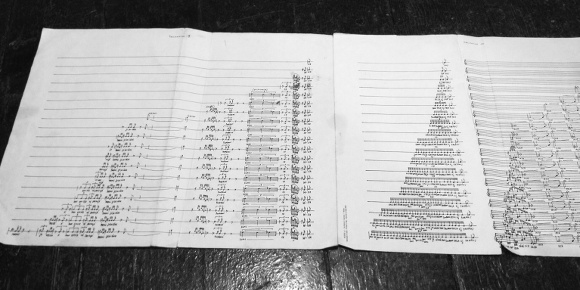
The third concert in the Heliconian Hall series from Adanya Dunn, Brad Cherwin and Alice Hwang was titled Intersections and was designed to explore “the sphinx like mind of Robert Schumann” through his own music and music inspired by him.  First up was Kurtàg’s Hommage à Robert Schumann featuring Alice and Brad and guest violist Laila Zakzook.  This is a complex and difficult piece.  Some sections consist of short fragments of “conversation” between the instruments.  At other times there is a more obvious line and it varies in mood from extremely violent to almost lyrical.  It’s an interesting exploration of Schumann’s various musical personalities through a completely different sound world.

aphergisscore

Continue reading

A Woman’s Life and Love

laureneYesterday’s lunchtime concert in the RBA featured mezzo Lauren Eberwin, soprano Danika Lorèn and pianists Hyejin Kwon and Stéphane Meyer.  Lauren and Hyejin were first up with Schumann’s Frauenliebe und -leben.  I’ve rarely seen this sung by a singer so obviously “in” the story.  There was a real sense of first person storytelling as well as rather good singing.  I thought Lauren sounded surprisingly sopranoish in the first seven numbers but they are optimistic and happy and a bright coloured voice seems apt.  She certainly darkened it nicely for the final grim song.  Hyejin was a most sympathetic partner.

Continue reading

Artsong reGENERATION

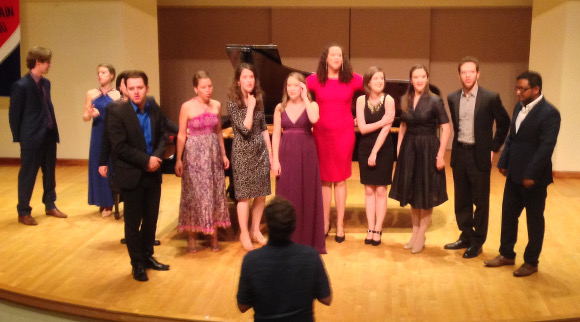
The Academy Program is an important part of the Toronto Summer Music Festival.  It allows selected young artists; singers, collaborative pianists and chamber/orchestral musicians, to work with experienced professionals in an intensive series of coachings, masterclasses etc culminating in a concert series.  This year the mentors for the vocal/collaborative piano component were pianist Craig Rutenberg, who has worked everywhere and with everybody, and mezzo-soprano Sasha Cooke; a last minute replacement for an indisposed Anne Schwannewilms.  I didn’t make it to any of the masterclasses, though word on the street is that they were exceptional, but I did make it to yesterday’s lunchtime concert in Walter Hall.

regen

Continue reading

Bryn!

It was my first time seeing Welsh bass-baritone Bryn Terfel live and my expectations were high.  They were met, possibly exceeded, but not perhaps in the way I expected.The singing was brilliant across a wide spectrum of moods and genres (I’ll come back to that) but what really stood out was the man’s rapport with the audience which was extraordinary.  It’s really hard to describe but let me try with just one example.  It’s that thorny issue of people applauding for ages in the middle of sets.  The usual approach is to have some functionary come out and announce that “Herr Poffel-Woffel respectfully (huh) asks that the audience not applaud until the end of the set because he believes it spoils the atmosphere”.  Bryn’s approach was to wait for the first time it happened, gently shh the audience and announce “I don’t mind at all if you applaud every song but we’ll all get a home a lot earlier if you wait until the end of the set”.  There was a lot of that kind of thing and it seemed quite natural and not at all stagey.

bryn3 Continue reading

Russell Thomas in the RBA

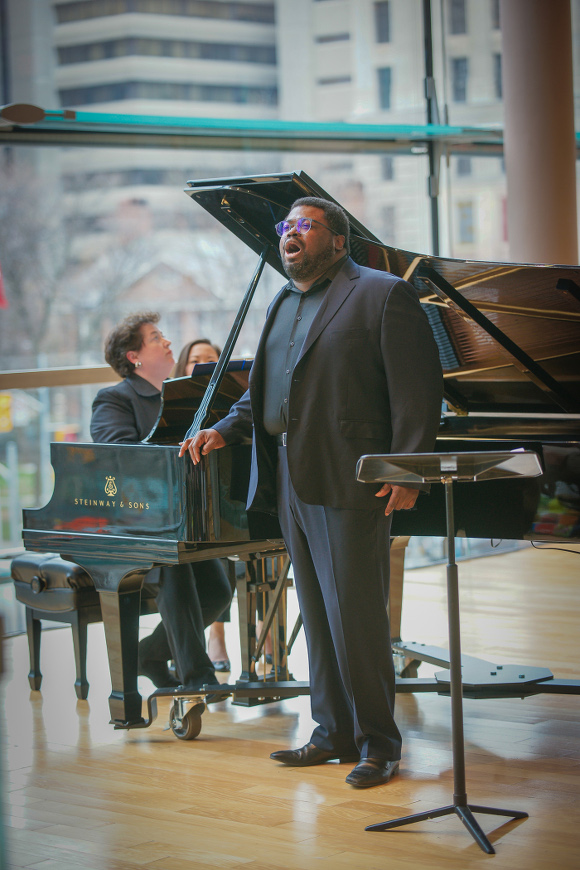
American tenor Russell Thomas, currently singing Don José in the COC’s Carmen, gave the lunchtime recital in the RBA yesterday.  The main item on the program was Schumann’s Dichterliebe; a setting of sixteen poems by Heinrich Heine and one of the great test pieces of the classic German lieder repertoire.  It was a red-blooded, operatic account.  Purists might think too much so but I enjoyed the sheer power and beauty of it, even at the expense of the (incredibly wonderful) text not getting the sort of attention it might get from someone like Ian Bostridge.  There was plenty of variation of tone and colour, some real virtuosity and even some humour in, for example, Ein Jüngling liebt ein Mädchen but the the most impressive and striking thing was the ability to effortlessly project a lot of rather beautiful sound.  Liz Upchurch’s accompaniment was very much in synch emotionally and musically.

SONY DSC

Continue reading

Le travail du peintre

Yesterday’s concert in the Songmasters Series at Mazzoleni Hall featured Mireille Asselin and Brett Polegato with Peter Tiefenbach and Rachel Andrist in a program of songs more or less related to painting and painters.  The first half of the program was all French; Fauré and Debussy.  Mireille and Peter gave us two songs from Fauré’s Cinq mélodies de Venise plus three pieces from Debussy’s Fêtes galantes and Pantomime from Quatre chansons de jeunesse.  I thought the Debussy generally suited Mireille’s voice rather better than the Fauré.  The first three songs were beautifully and charmingly sung while Pantomime gave full rein to Mireille’s considerable comedic talents.  The highlight of the first half for me though was Brett’s singing of the Poulenc work that gave the concert its title.  Seven songs by Paul Eluard; each a brief portrait of a painter.  Written at the same time as Dialogues des Carmélites, these pieces have the same sort of intensity and drive (and decided non trivial piano parts!).  They were most expertly sung with fine diction and legato and a keen sense of the varied moods of each piece.

travail.jpg

Continue reading

Où dort la fantaisie

Yesterday’s lunchtime concert in the RBA featured two members of the Ensemble Studio.  Andrew Haji, standing in for an indisposed Charles Sy, and Jennifer Szeto performed Liszt’s Tre Sonetti di Petrarca.  These songs were unfamiliar to me and came as a pleasant surprise.  They are very Italianate and very operatic and have a pretty involved piano part (unsurprisingly).  Haji displayed his uncanny ability to find exactly the right idiom for the music and sang with beauty and expression as well as nailing the three high D flats.  Szeto was a most accomplished accompanist. Great dress too!  New Yorkers can catch these two in the Marilyn Horne Song Celebration at Carnegie Hall on Saturday where they will perform the same music.

Jan19RBA4

Continue reading

Puzzling Genoveva from Zürich

Schumann’s Genoveva is a rarity. It premiered in 1850 and quickly slipped into obscurity.  Recently it has been championed by Nikolaus Harnoncourt who has gone so far as to call it “the most significant opera of the second half of the 19th century”; a slightly eye popping claim.  So what’s it about?  On the face of it it’s a pretty typical German opera of the period, set during the wars against the Moors in Spain.  Siegfried (Graf in the libretto but mysteriously translated as Duke in the disk subtitles) is recently married but must lead his men off to the war leaving behind his young, beautiful, pious and virtuous bride Genoveva. He leaves Golo; a knight but a bastard so apparently not OK for active service, to guard his lands and wife.  Golo has the hots for Genoveva but when she rejects his advances he concocts, with the aid of a witch, a plot to make it appear that she’s having an affair with an elderly retainer.  She’s locked up by the servants and word is sent to Siegfried; returned from Spain but recovering from wounds in Strasbourg, of what has transpired.  He gives Golo his sword and ring and tells Golo to kill Genoveva.  Instead Golo tries to get her to run away with him but she refuses and he disappears.  The servants too are happy enough to humiliate Genoveva but pretty slow about killing her.  This gives time for Siegfried to arrive, having learnt of his wife’s innocence, and save the day.  All sing a hymn of praise to God.  Along the way there’s a magic mirror, a ghost, a magic potion and a whole lot of cloying sentimentality and piousness.
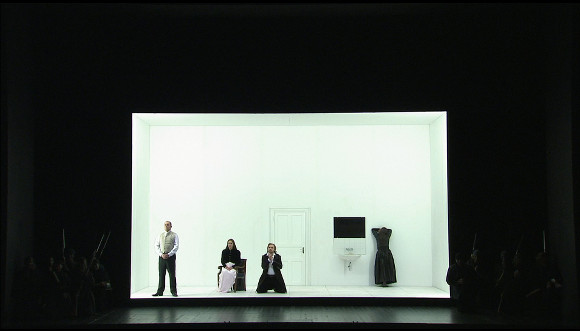
1.quartet Continue reading

Poetic Love

Today’s lunch time concert in the RBA was a lieder recital by two Ensemble Studio members; bass-baritone Gordon Bintner and tenor Andrew Haji.  Both singers sang settings of texts by Heinrich Heine.  Bintner, accompanied by Jennifer Szeto kicked off with selections from Schubert’s Schwanengesang to be followed by Haji and Liz Upchurch with Schumann’s Dichterliebe.

2015-04-09-COC-Poetic Love-002 Continue reading

From Severn to Somme

maltmanLast night at Walter Hall, as part of the Toronto Summer Music Festival,  Chris Maltman and Graham Johnson gave a recital that explored the experience of war through song.  It was a long and varied programme with twenty two songs in four languages commemorating most of the great empires that went to war in 1914 though many of the songs were from earlier periods.  At the core of the programme were early 20th century settings of English pastoral poems.  Butterworth’s settings of Houseman were there but, sneakily, we got Somervell’s much less well known setting of Think no more lad.  In a similar vein there were Gurney and Finzi.  The Americas were represented in a characteristically rambunctious Ives setting of a horribly jingoistic McCrae poem; He is there. McCrae may be the only well known war poet who managed to survive until 1918 without developing any sense of irony.  Beyond the English speaking world there were songs by Mussorgsky, Mahler, Fauré, Schumann, Wolf and Poulenc.

Continue reading