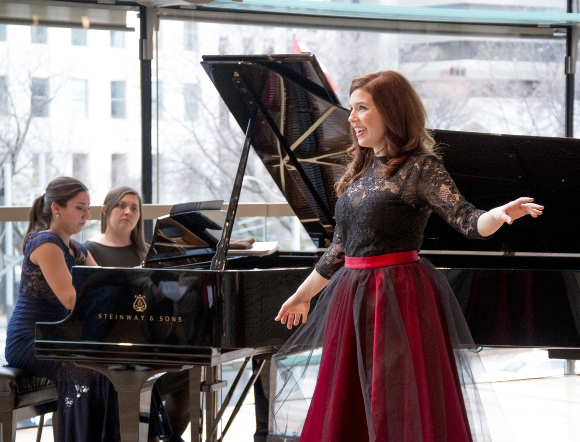
I went to see Whitney Mather sing yesterday afternoon. It was her second masters degree performance at Walter Hall with David Eliakis at the piano. (Probably the first time I’ve heard David play a proper piano!)

It was an interesting and well chosen program that allowed Whitney to demonstrate her musicianship and sensitivity to text. For the most part it avoided overly obvious territory, starting with Purcell’s rarely heard The Blessed Virgin’s Expostulation which was followed by the obligatory CanCon. In this case John Greer’s The Red Red Heart; settings of poems by Marianne Bindig. The Purcell allowed some tasteful decoration and an opportunity to display appropriately baroque style. The Greer, like so many modern songs, perhaps had more of interest in the piano line than for the voice but it did allow a brief coloratura flourish.
Next up were Respighi’s Quattro Rispetti Toscani to texts by Arturo Birga. These are rather beautiful songs and should be heard more often. Whitney brought out both the pathos and humour in the rather rustic (Tuscan dialect?) texts.
After the interval we were on more familiar ground with Schubert’s Der Hirt auf dem Felsen. Tiago Delgado played the clarinet part quite beautifully and Whitney managed the crazy pace of the piece very well, managing to maintain a clear sense of shape and line. She wrapped up with Milhaud’s Chansons de Ronsard. These are a bit of a tour de force. Some passages are really fast and much of the music lies high in the soprano range. Whitney may not have the easiest, most beautiful, high notes ever but she does have all the notes and she hit them here with accuracy and without sense of strain. She was particularly impressive in the crazy fast Tais-toi, babillarde.
All in all not a bad way to spend a late Saturday afternoon!
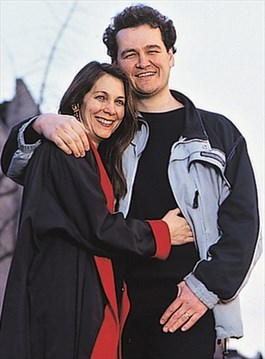 Yesterday’s Mazzoleni Songmasters concert featured Russell Braun and Caolyn Maule in a generous and varied program anchored on Schumann’s Dichterliebe; a setting of sixteen poems by Heine. It was framed by three Mendelssohn songs and a varied and intriguing second half program.
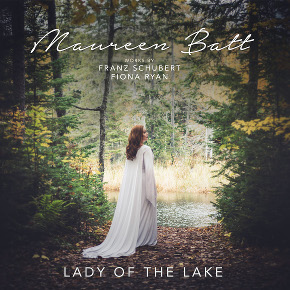 This is an interesting CD. It couples the rather rarely performed Schubert cycle to texts by Sir Walter Scott with a new Fiona Ryan cycle on the same theme. The reason the Schubert is a bit of a rarity is that, besides high and low voice and piano, one number requires a female chorus and another a TTBB quartet. In fact here those two pieces were recorded separately in different locations but I don’t think it’s apparent listening to the disc. The Schubert also includes the well known Ave Maria, the sixth song in the cycle, given here in the German originally used by Schubert rather than the Latin version usually heard. It’s a very decent performance. Maureen Batt is the soprano (and the evil genius behind the whole enterprise). Her voice is light and clear and her diction is excellent. Even a piece like the Ave Maria sounds fresh. Jon-Paul Décosse is the baritone. It’s a firm, confident voice, again with every word clearly audible. Simon Docking provides excellent accompaniment. The Bootgesang is performed by Leander Mendoza and Justin Simard; tenors with Robert O’Quinn and James Levesque; baritones, again with Docking at the piano. This might be the most fun piece of the cycle. For the elegiac Coronach we get The Halifax Camerata Singers conducted by Jeff Joudrey with Lynette Wahlstrom at the piano. They sound very pleasant.
 May continues to be a busy month. There are a couple of interesting concerts at noon in the RBA next week. On Wednesday 17th there is the unveiling of the annual Canadian Art Song project commission. This year it’s extremely ambitious. It’s a cycle of sixteen songs by Ana Sokolović setting texts drawn from right across Canada. It’s called dawn always begins in the bones and will be performed by Danika Lorèn, Emily D’Angelo, Bruno Roy and Aaron Sheppard with Liz Upchurch at the piano. (You can also hear this work in the Temerty Theatre at the Conservatory at 7.30pm on Thursday May 25th along with Andrew Staniland’s Peter Quince at the Clavier and Lloyd Burritt’s Moth Poem). On Thursday 18th tenor Charles Sy and pianist Hyejin Kwon bid farewell to the COC Ensemble Studio with a performance of Schubert’s Die schöne Müllerin. It should be a real treat.
 Schubert’s Winterreise is sometimes described as the Everest of lieder singing and, as such, is something of a rite of passage for baritones. It’s much rarer to hear it sung by a soprano but today, on a day when there was more snow in Toronto than one encounters these days on the Hillary step, Adrianne Pieczonka, accompanied by Rachel Andrist, offered it up in the intimate Mazzoleni Hall. It took me two or three songs to get into it. The colours of the soprano voice are so not baritonal that the music sounded unfamiliar and disconcerting. By Der Lindenbaum though I was won over. Here was singing of a limpid beauty few baritones could match and from then on I was revelling in the new perspectives that hearing a soprano sing this music brings. I think it was greatly helped by Adrianne’s approach which definitely favoured bringing out the drama and the emotion of the text rather than wallowing in beautiful tone. That was there when she wanted it but there was much else besides. It was an emotional roller coaster from the (relative) optimism of Die Post through to the devastating last couple of numbers. By the end of Der Leiermann I was a puddle but possibly not quite as damp and deep as the critic sitting next to me (whatever Twitter might report). Rachel’s work at the piano was equally illuminating. This is a show they need to take to a much larger audience.
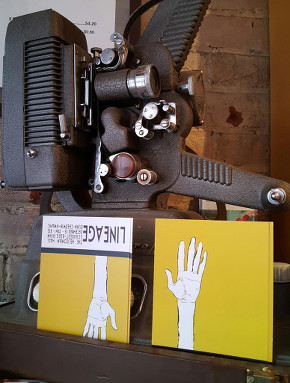 Lineage, performed last night at the Heliconian Club, is the latest show from Adanya Dunn, Brad Cherwin and Alice Hwang who brought us