Schubert to Mercury to Beethoven

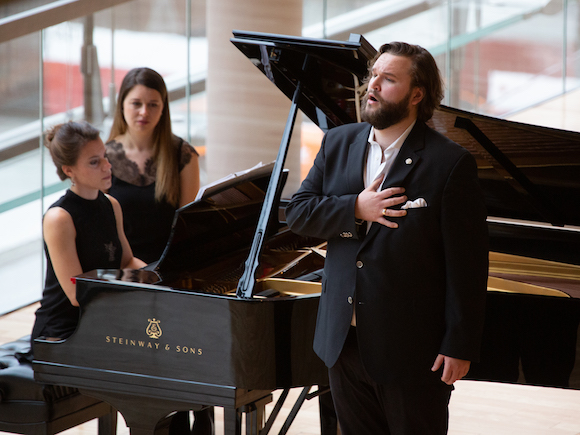
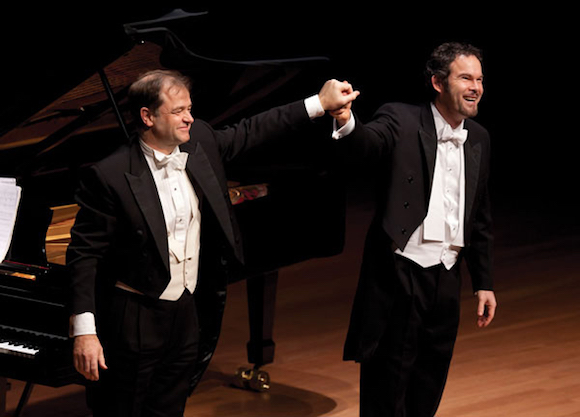
The main stage concert for TSM at Koerner Hall last night was given by the Art of Time Ensemble with vocalists John Southworth and Sarah Slean.  It’s my first encounter with Art of Time have been around for about ten years and specialise in cross genre collaborations inspired by their founder, pianist Andrew Burashko.
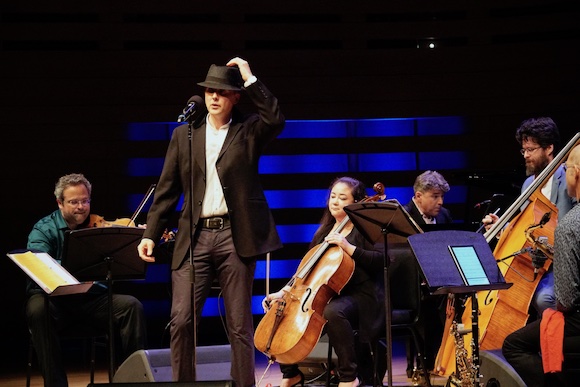
TSM July 25-Dale Butterill

Last night was classical meets singer songwriter.  There was an introductory piece by Christos Hatzis, some Schubert, plenty of Gershwin and lashings of Leonard Cohen plus much more (there was no set list and I didn’t take notes).  It’s rather out of my usual zone but I enjoyed.  Southworth is a really quirky vocalist, exemplified by a rather weird version of The Old Folks at Home; which needed to be weird!  Slean is quite a performer; good voice, very funny, great mover.  The ensemble was terrific across the board.  I’m sold.  There are lots of reasons to stretch the boundaries of classical performance.  Larry Beckwith does it very well with his Confluence series.  Here’s another example.

TSM July 25-Photo Dale Butterill

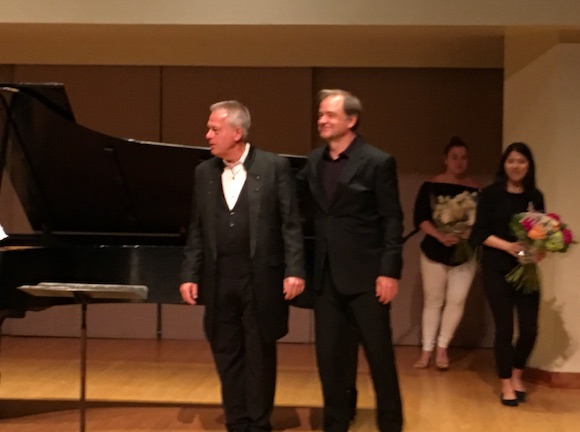
The late show, also at Koerner, featured Jonathan Crow, Katya Poplyansky, Minkyoung Lee and Allison Rich in a performance of Beethoven’s String Quartet No. 12 in B-flat Major Op. 130 but with a twist.  They played the full original version in which the Grosse Fuge Op. 133 forms the finale.  So, basically, an hour long string quartet!  It was very well done though I confess late Beethoven at 10.30 pm was straining the grey matter.

Photo credit: Dale Butteril

1001 Nights with Miriam Khalil

Yesterday’s lunchtime concert in the RBA was a song recital with an Oriental(ist) theme by polyglot soprano Miriam Khalil and pianist Topher Mokrzewski.  It kicked off with the two Suleika songs by Schubert to texts by Marianne von Willimer.  For my taste Miriam’s voice and treatment of the songs was decidedly on the dramatic side.  It was interesting and there’s no doubting the commitment but it’s not my favourite way to hear Schubert.  It was all uphill from there though.  Ravel’s Shéherazade; Debussy inspired music to texts by Tristan Klingsor, was given an equally dramatic treatment, and Miriam is very dramatic in both voice and body language,  but here it worked for me, especially the passionate invocation of the invented East in Asie.

SONY DSC

Continue reading

Les Adieux: A Poetic Diary

This was baritone Sam Chan and pianist Stéphane Mayer’s farewell to the Ensemble Studio.  It was an all Schubert program; Poetisches Tagebuch (Schulze), the Impromptu in G flat and the Goethe Lieder.  It was a very classy performance by any standards.  There was no need here to make allowances for “young artists”.  One would have been happy to pay Koerner Hall prices to hear a recital of this quality.

190411_LesAdieuxAPoeticDiary05

Stéphane Mayer and Samuel Chan performing in the Canadian Opera Company’s Free Concert Series in the Richard Bradshaw Amphitheatre, photo: Dan Truong

Continue reading

Heimweh

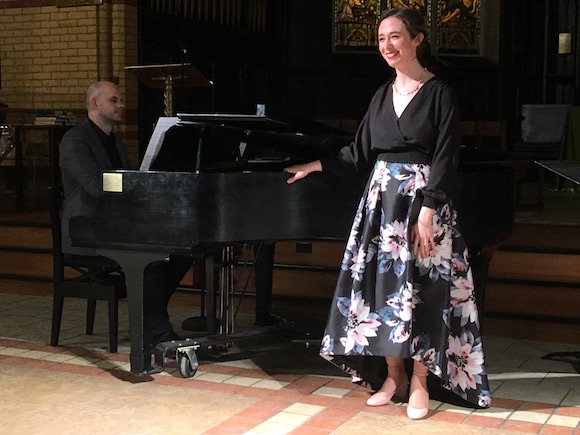
Heimweh_coverHeimweh is a CD of Schubert songs from young German soprano Anna Richter and pianist Gerold Huber with a bit of help from clarinettist Matthias Schorn.  It’s an interesting combination of the familiar and the less familiar with a bit of a leaning to the more lyrical, less dramatic end of the Schubert canon.  Familiar material includes Der Hirt auf dem Felsen and the three parts of Ellens Gesang but there’s material that I’m much less familiar with too like Der Zwerg and Viola.  I guess thirteen minute long songs about snowdrops just don’t get programmed that often.  There’s also the slightly odd Abschied; where the piano accompanies spoken text.
Continue reading

Voyage to Wien

Voyage to Wien, presented by Sara Schabas and Daniel Norman at the Church of the Redeemer last night was a nicely constructed tribute in song to that city on the Danube.  Things kicked off wittily with Bernstein’s (well he did conduct the Vienna Phil) “I hate music” followed by nicely rendered accounts of varied songs by the Mahlers and Schubert before exploiting the performers connections with the church choir to bring members of the choir in for “Ihr habt nun Traurigkeit” from Brahm’s German Requiem.

schabas-norman

Continue reading

The Three Tenors

Today’s RBA lunchtime concert featured the three tenors; Kammersinger Michael Schade, currently appearing as Aegisth in the COC’s Elektra, Irish tenor Mick O’Schade and Scottish folksinger Michael McSchade.  They were most ably supported by COC Concertmaster Marie Bérard and Sandra Horst at the piano.  The concert was billed as a tribute to John McCormack and Fritz Kreisler but sad events had morphed it into also being a tribute to the CBC’s Neil Crory.  I hope, and believe, that he would have appreciated the combination of whimsy and serious music making.

2019-01-29-homage-9815

Continue reading

Prégardien and Drake at Walter Hall

German tenor Christoph Prégardien and English pianist Julius Drake teamed up at Walter Hall last night for one of the finest Liederabends that I have ever been privileged to hear.  The first set was all Mahler; six songs from Das Knaben Wunderhorn plus one from the Rückert-Lieder.  It started strongly with three essentially comic songs; all donkeys, geese and magic rings.  The teamwork between the musicians was exemplary.  and the attention to text by both parties penetrating.  And then it was the little things that raised the bar from excellent to exceptional; the use of a pause, the slight lingering on a syllable, the accelerando into a comic line.

pregardiendrake

Continue reading

Not a review

This afternoon I saw Gerry Finley and Julius Drake in recital at Koerner Hall.  In other words, two supreme exponents of the art of lieder at the top of their game in a hall with near perfect acoustics.  They performed Beethoven and Schubert settings of Goethe texts, some Tchaikovsky and some Rachmaninoff, which gave Julius ample opportunity to show off.  They finished up with settings of folky things by Copland, Barber, Respighi and Britten.  The last was The Crocodile; a very silly and funny piece I hadn’t heard before.  The encore was by Healey Willans and Gerry gave a very nice plug for the Canadian Art Song Project.  Insert standard list of adjectival phrases describing top notch singing and accompaniment.  My humble scribing is not worthy.

SongChampionRecital5hdl5712

Not taken today.  My phone pictures were awful

Voicebox 2018/19

mahagonnyVOICEBOX:Opera in Concert announced their 2018/19 season last night.  There are three main stage shows.  Two of them, alas, I can’t muster much enthusiasm for; Massenet’s Werther (November 25th 2018) and Schubert’s Fierabras (February 3rd 2019).  The first features Goethe’s version of Fotherington-Thomas and the latter is one of the most confused and implausible messes ever to “grace” an opera stage.  I’m much more up for the third show; Weill’s The Rise and Fall of the City of Mahagonny (March 30th/31st 2019). No details on casting or anything else but I assume the first two will be piano score and the last a chamber ensemble.  There are also two shows at Gallery 345; Little Mahagonny: a Tribute to Weill (September 25th 2018) and Viva Verdi (April 3rd 2019).


Whitney Mather in recital

I went to see Whitney Mather sing yesterday afternoon.  It was her second masters degree performance at Walter Hall with David Eliakis at the piano.  (Probably the first time I’ve heard David play a proper piano!)

whitneymather

It was an interesting and well chosen program that allowed Whitney to demonstrate her musicianship and sensitivity to text.  For the most part it avoided overly obvious territory, starting with Purcell’s rarely heard The Blessed Virgin’s Expostulation which was followed by the obligatory CanCon.  In this case John Greer’s The Red Red Heart; settings of poems by Marianne Bindig.  The Purcell allowed some tasteful decoration and an opportunity to display appropriately baroque style.  The Greer, like so many modern songs, perhaps had more of interest in the piano line than for the voice but it did allow a brief coloratura flourish.

Next up were Respighi’s Quattro Rispetti Toscani to texts by Arturo Birga.  These are rather beautiful songs and should be heard more often.  Whitney brought out both the pathos and humour in the rather rustic (Tuscan dialect?) texts.

After the interval we were on more familiar ground with Schubert’s Der Hirt auf dem Felsen.  Tiago Delgado played the clarinet part quite beautifully and Whitney managed the crazy pace of the piece very well, managing to maintain a clear sense of shape and line.  She wrapped up with Milhaud’s Chansons de Ronsard.  These are a bit of a tour de force.  Some passages are really fast and much of the music lies high in the soprano range.  Whitney may not have the easiest, most beautiful, high notes ever but she does have all the notes and she hit them here with accuracy and without sense of strain.  She was particularly impressive in the crazy fast Tais-toi, babillarde.

All in all not a bad way to spend a late Saturday afternoon!