I put Rossini’s comedies in the category of “guilty pleasures”. They are silly, trivial, lack real human emotion and are musically pretty trite but they are frothy and fun and sometimes even funny.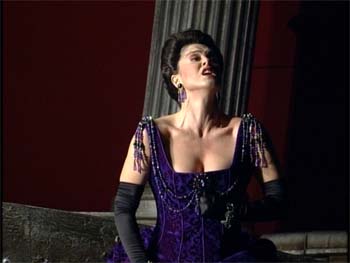 Rossini’s tragedies on the other hand are just that, tragedies. Ermione is no exception. The plot is emotionally beyond credibility, despite being (or perhaps because of) being based on Racine without managing to descend into the unintended humour of, say, Armida. The music is more suited to a comedy and so all that’s left is visual spectacle, vocal virtuosity and a lot of opportunities for the leading lady to chew the scenery. That, ultimately, is probably what it’s about. It was written for Isabella Gilbran. Presumably she coerced Rossini into providing a vehicle for her to display her talents as a tragedienne. Otherwise the whole thing is inexplicable.
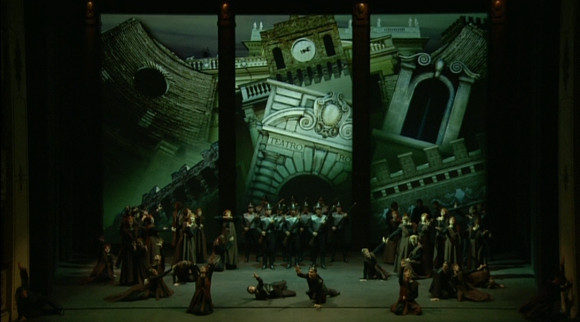
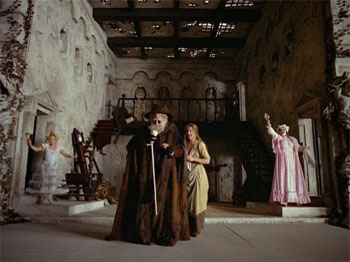
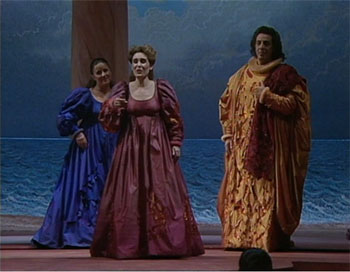
The production given at Glyndebourne in 1995 has a lot going for it. Anna Catarina Antonacci sings the title role, the majestic Diana Montague sings Andromache and Andrew Davis is in the pit. There are also four tenors, which is plenty though not quite in the Armida class. 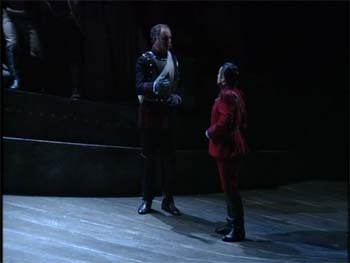 They all seem to be less than about five foot six tall which given that the bass role is sung by the lofty Gwynne Howells looks decidedly odd. Director Graham Vick sets the work in an opera house in the mid 19th century but for reasons obscure everything is tilted at odd angles. It looks like a wedding cake gone badly wrong. Blocking is all very basic, partly at least because Antonacci’s gowns have enough train to seriously inhibit movement. It’s basically park and bark with the odd swoon.
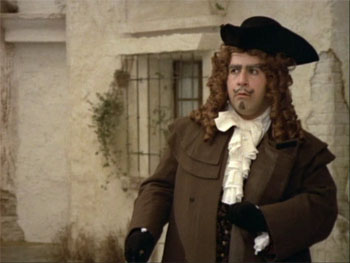
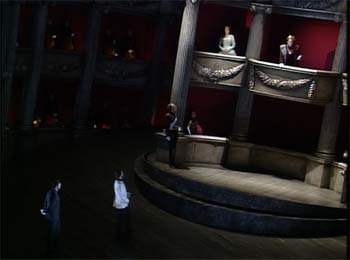 As a musical performance I can’t fault it. Antonacci, Montague, Howells, Jorge Lopez-Yanez (who plays King Pyrrhus) are all near perfect. Antonacci in particular runs through the whole arsenal of Rossinian fireworks with consummate ease. The other roles are never less than competent. Andrew Davis does his level best to breathe some life into the score but there’s really not much he can do about the jolly little tunes that keep popping out of the woodwinds at the least opportune moments.
Humphrey Burton video directs. It was originally filmed for Channel 4 and opens with the obligatory Glyndebourne sheep shots. It is very much a 1995 production for the small screen so lots and lots of close close ups. 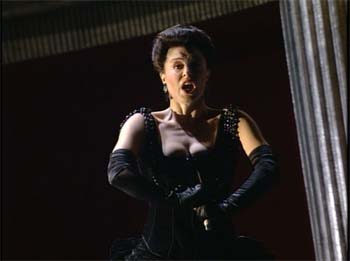 So many of these are of Antonacci’s cleavage that one wonders whether a dedicated boob cam was employed. Given the original motivation for the opera this may be a case of Historically Informed Videography. The disc package is typically basic Kultur label; 4:3 barely DVD standard picture, Dolby 2.0 sound, no extras. There are subtitles in English, French, German, Italian, Spanish and (oddly) Portuguese. The only documentation is a chapter listing.
One for the Rossini completist only.