Gounod’s Mireille

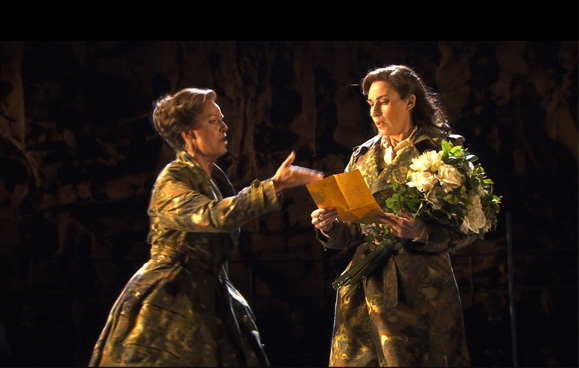
Gounod’s Mireille is a bit of a rarity and with good reason.  It’s got everything that modern audiences find hard to take in 19th century French opera.  It’s revoltingly wholesome with a bit of the supernatural, some patriarchal nastiness and a whole lot of Catholic schmaltz thrown in culminating in a final scene where the dying heroine (of course the heroine dies!) is carried off to heaven by angels while everybody else is suitably pious.  It also has some pretty good tunes and a fiendishly difficult soprano lead part.

1.cornfield Continue reading

Glorious Alcina

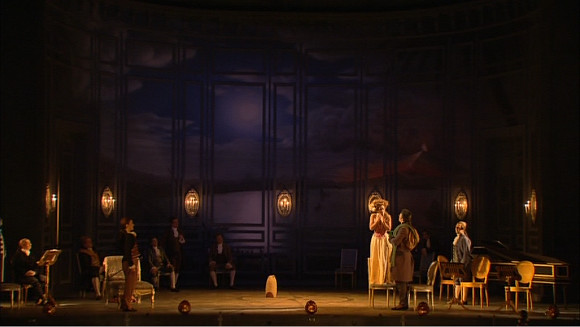
The 2011 production of Handel’s Alcina at the Wiener Staatsoper marked the first time Handel, or any other baroque work, had appeared in the house since Karajan’s reign in the 1960s.  In mounting it they went big.  There’s a starry cast headed by Anja Harteros, Marc Minkowski and Les Musiciens du Louvre – Grenoble, a large group of dancers and former Royal Shakespeare Company boss Adrian Nobel.  It paid off.

1.salon Continue reading

Poppea; stylised but stylish

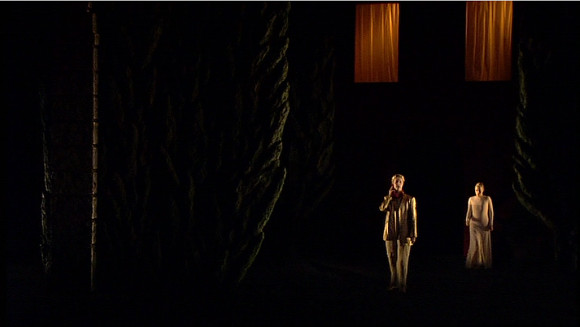
Klaus Michael Grüber’s production of Monteverdi’s L’incoronazione di Poppea, recorded at the Aix-en-Provence festival in 2000, is both stylish and stylised.  The stage and costume designs, by Gilles Aillaud and Rudy Sabounghi, are extremely elegant and, at times, very beautiful.  The Seneca scenes at the beginning of Act 2, set in a sort of lemon grove, are especially effective as ai the use of painterly backdrops looking like Greek vase paintings reinterpreted by a fauviste.  The director complements the designs with a somewhat formalised acting style that fits rather well. He also makes some changes to the narrative to tighten up the drama, dispensing with Ottavia’s nurse and ending with Pur tí miro, rather than Poppea’s coronation.  Coupled with excellent acting performances it’s a straightforward but effective way to tell the story.

1.entrance Continue reading

Abduction in Aix

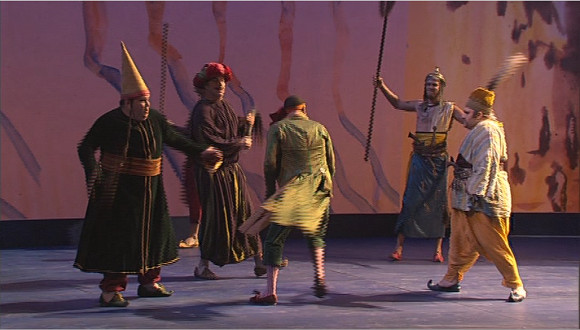
Mozart’s Die Entführung aus dem Serail is perhaps the most difficult of his major operas to bring off successfully.  I dealt with some of the issues in a review of Hans Neuenfel’s production so I won’t repeat myself here.  Jérôme Deschamps and Macha Makeïff’s production for the Aix-en-Provence Festival, filmed in 2004, has several interesting features that cast an interesting light on the main characters.  The most drastic is the treatment of Osmin.  Here he’s rather dignified and far from the fat, brutal, somewhat comic lecher of convention.  That side of his character is conveyed by five, mostly silent, sidekicks.  These guys are everywhere, portraying both Osmin’s baser nature and the “walls have eyes and ears” aspects of the story.  They are made to look rather dim and get some fairly funny business to play with.  Next we have Bassa Selim played by a dancer.  This makes it easier to portray him as sensitive but not a wimp through the use of extremely virile choreography.  Clever!  Finally, both Pedrillo and Blondchen are sung by people of colour.  That can’t be a coincidence.  It certainly puts a very interesting spin on the confrontation between Osmin and Blondchen about how English girls are different from Turks.  These ideas are played out against rather dramatically colourful sets and costumes with lots of comic business to make a fast paced and enjoyable romp that makes one think just enough about the underlying meanings.

1. goons Continue reading

Where’s the Champagne?

It’s really hard to know where to start with Hans Neuenfels’ Die Fledermaus.  It’s a prodcuction that enraged the more conventional patrons when it opened at the Salzburg Festival in 2001.  It even provoked a “false pretences” lawsuit!  There is so much going on that it almost seems to call for a catalogue raisonnée of the various scenes though one fears that would actually be both tedious and unhelpful.  Let’s try instead to explore it thematically.  Neuenfels takes very considerable liberties with the libretto.  A lot of dialogue is cut, a lot is added and numerous non-canonical characters are inserted.  That’s just a start.

1.nosejob Continue reading

More Iphigénie

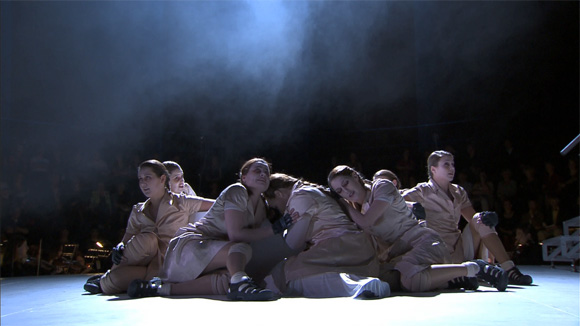
The second half of the Amsterdam double bill that opened with Iphigénie en Aulide is, of course, Iphigénie en Tauride.  In this piece the more usual version of the Aulis story, where Diana substitutes a stag for Iphigenia on the altar and whisks the girl off to be her priestess among the savage Scythians of Tauris, is assumed.  So the piece opens with Iphigenia and six other Mycenean priestesses (how they got to Tauris is a mystery) in Diana’s temple at Tauris where their job is to sacrifice any strangers who show up.  Almost at once the capture of two Greeks is announced.  They turn out to Iphigenia’s brother Orestes and his sidekick Pylades and the the next 90 minutes turns on Iphigenia failing to sacrifice either of them.

1.priestesses Continue reading

Iphigénie at last

Gluck’s Iphigénie en Aulide is finally available on Blu-ray and DVD.  It was staged and recorded as a double bill with Iphigénie en Tauride at De Nederlandse Opera in September 2011 in productions by Pierre Audi.  It’s excellent in just about every respect.  The cast is to die for, the production is interesting and so is the staging in the rather challenging space of The Amsterdam Music Theatre, which also poses problems for the video director.  Backed up, on Blu-ray, by a 1080i picture and DTS-HD-MA sound it’s a pretty compelling package.

1.camo Continue reading

Let us laugh at heaven and earth

Rameau’s Plateé is a comedy in three acts with the obligatory allegorical prologue and lots of ballets.  It tells the story of the bizarrely ugly water nymph Plateé.  In an attempt to calm down Juno who, as usual, is angry at Jupiter’s infidelities, Mercury and the satyr Citheron arrange for Jupiter to pretend to fall in love with and marry Plateé.  Juno arrives during the wedding in a fury but when she sees Plateé she realises the joke and is reconciled with Jupiter.  Plateé returns, distraught, to her swamp.  It’s all really rather cruel but does have a few good jokes.. and lots of ballets.

1.amour Continue reading

La Belle Helène in Paris

When I reviewed the 1997 Zurich production of La Belle Helène about a week ago the commentariat was strong in the belief that I should take a look at the 2000 Paris-Châtelet production.  So I did and they were right.  It’s excellent.  It also reinforced my belief that operetta; English, French or German, works best when it’s taken seriously by which I mean using the best available singer/actors, a good director and a top notch orchestra, chorus and conductor.  All of these are in place in this Paris production. Continue reading

Back to Offenbach

After the hours of discussion about what Lee Blakeney really meant in his COC Les Contes d’Hoffmann a little light relief seemed called for.  Fortuitously I had just got my hands on the 1997 Opéra National de Lyon recording of Offenbach’s Orphée aux Enfers so I thought that might do the trick.  I was dead right.  The production by Laurent Pelly is an absolute hoot (or, to quote young British mezzo, Emilie Renard “FILTHY!”).  The high speed, somewhat surreal production is brilliantly executed by a predominantly French cast including Natalie Dessay as Eurydice and Laurent Naouri as Jupiter.  There’s so much going on that it would be tedious to provide a full description.  Continue reading