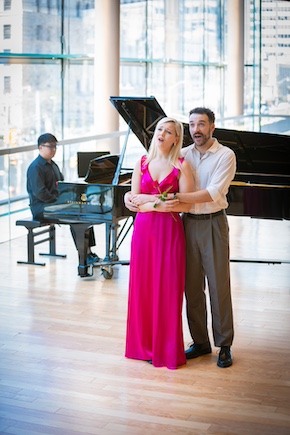
 So Thursday lunchtime I went to see Karoline Podolak and Wesley Harrison supported by Mattia Senesi and Brian Cho in the RBA. It was a “schmaltzy” programme (Wesley’s description not mine!). The whole thing consisted of arias and duets from La Traviata, The Barber of Seville and Don Pasquale with a bit of Lehar and a final Prayer chucked in.
It was the sort of rep that if it came up on University Challenge any opera goer would be hitting the buzzer in under two seconds! And it’s all lovely of course. It was beautifully sung by two beautiful people with two excellent pianists. They sing beautifully separately and wonderfully together and Karoline’s coloratura is spectacular. It’s rep that fits them like a glove at this stage of their careers and I’m not going to bore you with a blow by blow account. It was unalloyed, undemanding enjoyment made all the better by being in the RBA on a sunny day!
Photo credfit: Karen E. Reeves.

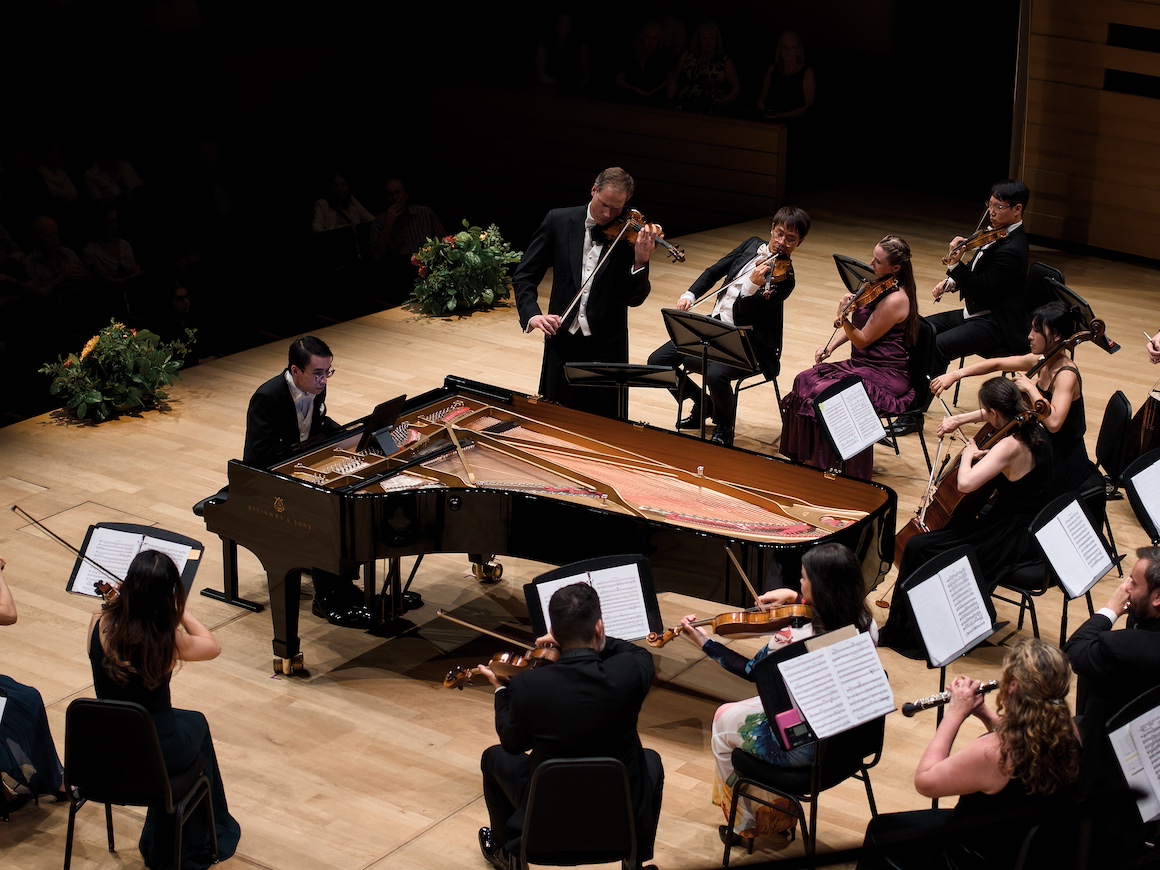
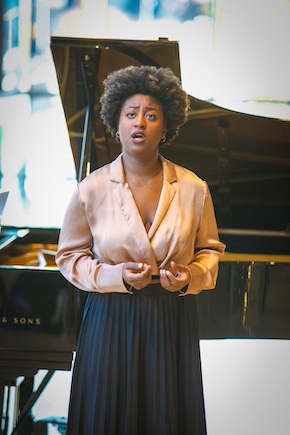 Tuesday’s RBA concert with members of the Ensemble Studio was themed around composer rivalries though not the really toxic ones. No Mozart/Salieri or Wagner/Meyerbeer here! The most convincing as a rivalry was the first; Berlioz vs Rossini. So Queen Hezumuryango sang “Le spectre de la rose” with some sensitive handling of the text and a pretty fiery “Cruda sorte” from L’Italiana in Algeri with plenty of emotion. I definitely like her voice more when she’s going for drama as she’s got plenty of power and expressiveness.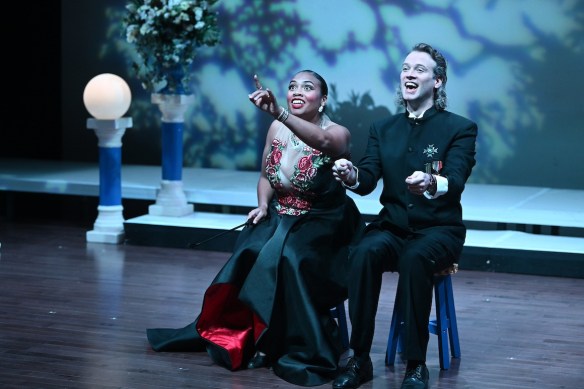
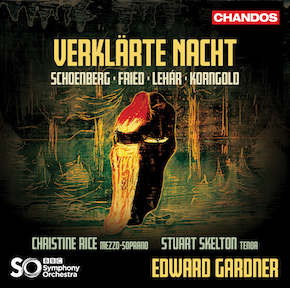 No, not Flanders and Swann but rather a well constructed new recording from Edward Gardner and the BBC Symphony Orchestra. It contains music by four composers exemplifying that lush territory that lies emotionally, if not always temporally, between Wagner and the Second Vienna School. The two central works were both inspired by Richard Dehmel’s Verklärte Nacht. The first is a 1901 setting of the text for mezzo, tenor and orchestra by Oskar Fried. It’s lushly scored and rather beautiful. The sound world is not dissimilar to Schoenberg’s Gurrelieder. Gardner gets a lovely sound from his players and some really gorgeous singing from Christine Rice and Stuart Skelton. The second Verklärte Nacht is the more familiar Schoenberg piece for string orchestra. It’s curious how without voices and with only strings it manages to sound almost as lush as the Fried.
 Toronto Operetta Theatre have released preliminary information on their 2018/19 season. There are three main stage productions at the Jane Mallett Theatre. First up is Die Fledermaus by Johann Strauss which runs December 28th, 2018 to January 2nd, 2019. There’s been no shortage of Fledermice in Toronto in recent years with Christopher Alden, Aria Umezawa and Joel Ivany all contributing quite individual productions. I imagine Guillermo Silva-Marin’s treatment will likely be designed to appeal more to the traditionalists!
 operaramblings