Song of the Earth

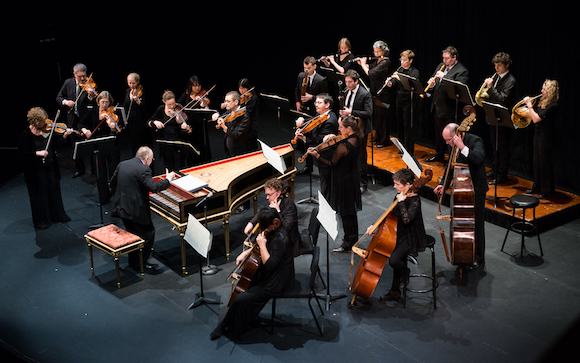
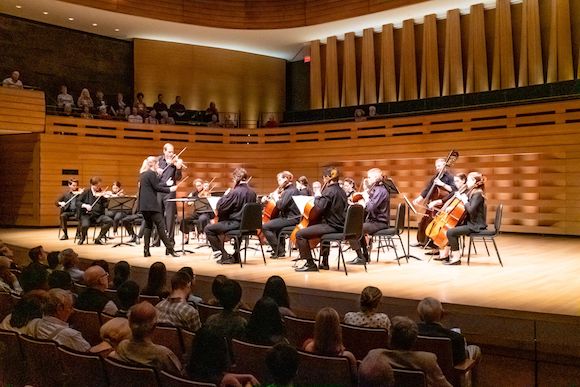
Last night’s final Koerner Hall event in Toronto Summer Music started off with Mozart’s Violin Concerto No. 5 in A Major.  It’s a tuneful, well constructed piece which in places riffs off Romany music, hence its nickname “Turkish”.  Jonathan Crow was the soloist with a small orchestra drawn from all the area’s major orchestras plus TSM Fellows.  Gemma New conducted.  It was very satisfying.  The orchestra was excellent and the interplay between solist and orchestra worked very well.  It’s quite a demanding piece for the soloist and I really enjoyed the sound that Jonathan produced.  He plays an instrument with a rather distinctive timbre which worked well here.  I’m curious about the first movement cadenza.  I don’t know the work well enough to knoew what the options are but this one was very virtuosic though sounding distinctly post-Mozartian.

sote1

Continue reading

Schubert to Mercury to Beethoven

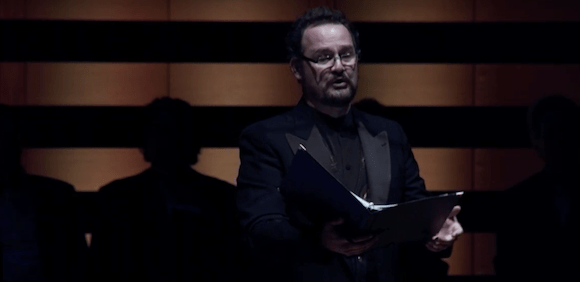
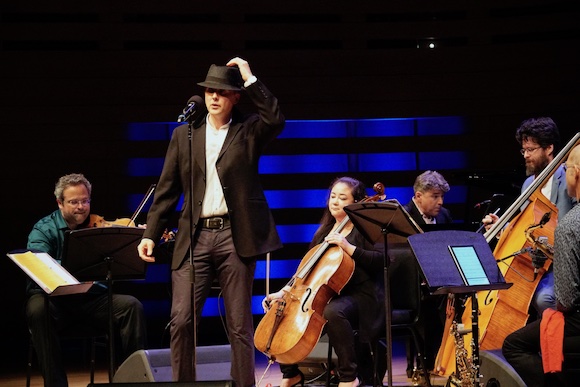
The main stage concert for TSM at Koerner Hall last night was given by the Art of Time Ensemble with vocalists John Southworth and Sarah Slean.  It’s my first encounter with Art of Time have been around for about ten years and specialise in cross genre collaborations inspired by their founder, pianist Andrew Burashko.
TSM July 25-Dale Butterill

Last night was classical meets singer songwriter.  There was an introductory piece by Christos Hatzis, some Schubert, plenty of Gershwin and lashings of Leonard Cohen plus much more (there was no set list and I didn’t take notes).  It’s rather out of my usual zone but I enjoyed.  Southworth is a really quirky vocalist, exemplified by a rather weird version of The Old Folks at Home; which needed to be weird!  Slean is quite a performer; good voice, very funny, great mover.  The ensemble was terrific across the board.  I’m sold.  There are lots of reasons to stretch the boundaries of classical performance.  Larry Beckwith does it very well with his Confluence series.  Here’s another example.

TSM July 25-Photo Dale Butterill

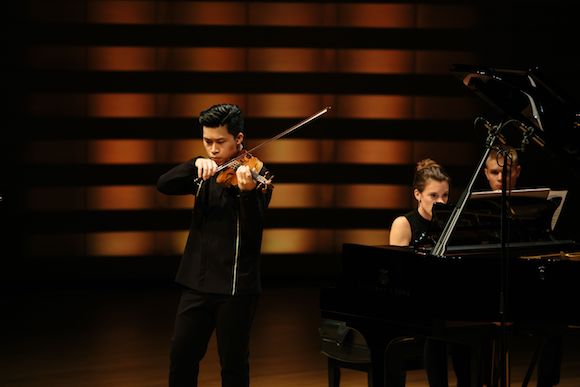
The late show, also at Koerner, featured Jonathan Crow, Katya Poplyansky, Minkyoung Lee and Allison Rich in a performance of Beethoven’s String Quartet No. 12 in B-flat Major Op. 130 but with a twist.  They played the full original version in which the Grosse Fuge Op. 133 forms the finale.  So, basically, an hour long string quartet!  It was very well done though I confess late Beethoven at 10.30 pm was straining the grey matter.

Photo credit: Dale Butteril

Toronto Summer Music opener

Last night saw the first concert of this year’s Toronto Summer Music Festival.  The theme was “Beyond Borders” with most of the works presented; a mixture of piano, violin and vocal, having been influenced by other cultures/places or written in exile.

bb1

Continue reading

Royal Conservatory 2019/20

ldspThe RCM 2019/20 season has been announced.  It’s the usual mix of chamber, orchestral, piano, jazz, world music, the completely indefinable and, of course, vocal.  There are 91 concerts in total.  With such a wide range of material it’s hard to imagine anybody being interested in all of it or, conversely, anybody unable to find something to their taste.  My tastes, of course, run largely to classical vocal music so what follows is what I find most interesting: Continue reading

A brace of baritones

Last night Thomas Hampson, his son in law Luca Pisaroni and pianist Vlad Intifca appeared at Koerner Hall.  It was a curious program.  The first half was made up of opera arias and excerpts.  There was a sequence of Conte/Figaro and Leporello/Don G numbers.  They were, of course, very well sung.  Both singers are noted exponents of these roles but I really didn’t see the point.  They were pieces I’m sure pretty much every audience member has seen with orchestra, on stage, multiple times.  With piano accompaniment it all seemed a bit pointless.  There followed two longish scenes; the Riccardo/Giorgio confrontation from I Puritani and the scene from Don Carlo where Posa pleads with the king for a change in policy in the Netherlands.  These worked better; perhaps because they are less familiar but more likely the fact that each featured Pisaroni in a genuine bass role.  This allowed for more variation of timbre and colour than the Mozart pieces.

DSC_5885

Continue reading

The Magic Flute at the GGS

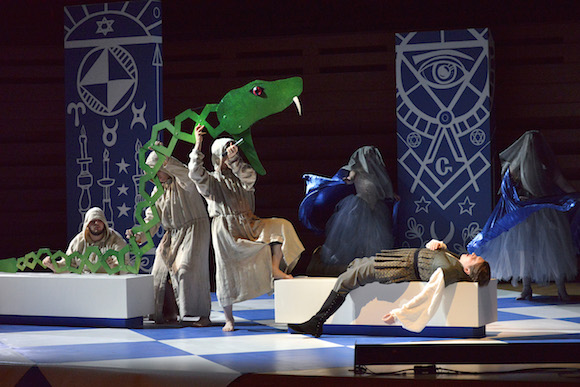
I went into last night’s Glenn Gould School performance of Mozart’s The Magic Flute at Koerner Hall with all kinds of questions buzzing around in my head; partly because of an earlier conversation with director Joel Ivany and partly, well, Magic Flute – that most enigmatic of operas.  If only one could go back (more than forty years) to seeing it for the first time!

Photo: Nicola Betts

Continue reading

Joel Ivany’s Magic Flute

nikpix_joelmiriam_01I sat down a couple of days ago with Joel Ivany to discuss his upcoming production of Mozart’s Die Zauberflöte at the Royal Conservatory.  Here are some of the things we talked about.

What’s Die Zauberflöte “about”?

This opera has had whole books written about it but no-one seems to agree on what’s at the core of it.  Is it a simple fairy tale?  Is it an allegory of Reason versus The Church?  Is it a Coming of Age story?  Unsurprisingly we didn’t come to firm conclusions here but it’s clear that Joel wants to particularly explore some of the aspects of gender raised by the piece; especially the apparent misogyny of the piece.  There’s potentially more to Pamina than being the bait to trap Tamino or, alternatively, his completion.  What is her roles in the Trials?  What happens to either of them if they fail?  If Tamino needs to be “completed” what are we to make of the unpartnered Sarastro?  But, if Pamina has strength what kind of agency does she have?  The other female character are equally problematic.  How does one humanize the Queen of the Night?  Who, or what, is Papagena?  Neither of us think there are easy answers here and I’m looking forward to seeing how Joel’s take pans out.  What we could agree on is that even if the simple equation of male = good/rational and female = irrational/disposable worked in 1791 (if, indeed, it did), it won’t work in 2019.

Continue reading

Highlights of the 2019/20 season at the Royal Conservatory

There are a few interesting items in the initial announcement of the RCM’s 2019/20 season:

  • The Amici Chamber Ensemble with Russell Braun and the Elmer Iseler Singers offer a celebration of the 150th birthday of Armenian composer Komitas Vardapet. That’s on October 25th 2019.
  • Karina Gauvin and the Paciifica Baroque Orchestra have a programme called Russian White Nights: Opera arias from 18th century St. Petersburg.  That’s on November 1st 2019.
  • Phillipe Sly and Le Chimera Project are presenting a staged version of Schubert’s Winterreise with chamber ensemble.  That’s on January 17th 2020.
  • Perhaps the biggest deal of all is Peter Sellars directing the Los Angeles Master Chorale in a staged performance of Orlando di Lasso’s final work, Lagrime di San Pietro; 27 madrigals sung a cappella in seven parts by 21 singers.  That’s on February 1st and 2nd 2020.
  • And after all the fancy stuff there is a classic Liederabend with Matthias Goerne and Jan Lisiecki in an all Beethoven programme on April 24th 2020.

All of the above are at Koerner Hall.

Lenin’s Torah

The 2018 Ashkenaz Festival opened last night at Koerner Hall with a concert titled Yiddish Glory.  The background can be found in my preview post about it.  So last night four vocalists and an assortment of instrumentalists performed nineteen numbers from the collection.  They date from 1942; when the outcome of the Great Patriotic war was far from certain, to 1947; when it was already won.  The bulk date from 1944/5; when the outcome was clear though maybe not the costs still to be borne.

Continue reading

Yiddish Glory

YiddishGloryOK so it’s a bit off the Operaramblings beaten path but there’s a concert coming up at Koerner Hall on August 28th that intrigues me.  It’s called Yiddish Glory and it resurrects anti-fascist music that documents Nazi atrocities and Jewish resistance/partisan activities in the Soviet Union after the German invasion of 1941.  They were collected by a team of Jewish Soviet ethnomusicologists led by Moisei Beregovsky during the war, but shortly afterwards, during Stalin’s anti-Jewish purge, the members were arrested, their work confiscated, and they died thinking the music was lost to history.  In the early 2000s, a lucky coincidence brought University of Toronto Professor Anna Shternshis to Kiev, where she learned that the music had actually survived in the intervening decades following the researchers’ arrests, and in the years since, has led the research project to restore these songs.  There’s also a CD.  I’ve listened to a few tracks.  The music is clearly Jewish and very much of the time.  It’s redolent of horror and resistance and ultimately, hope.  I find it deeply moving.

Continue reading