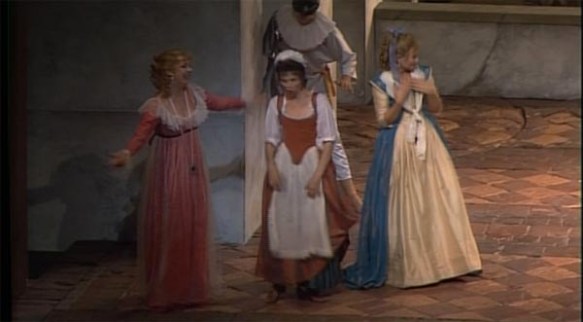
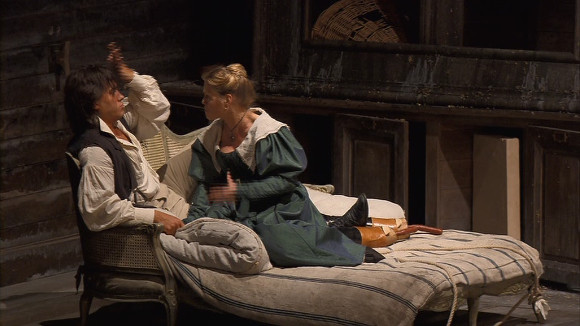
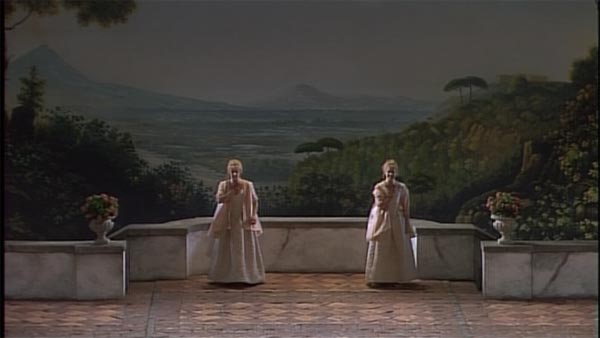
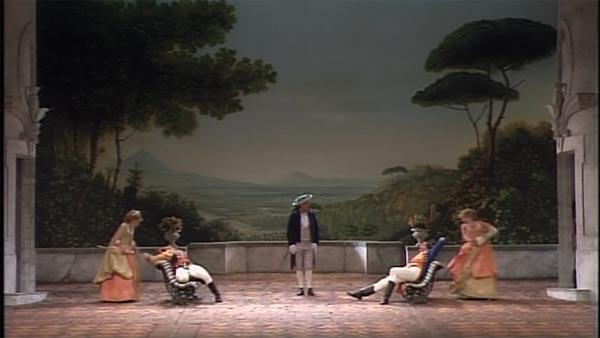
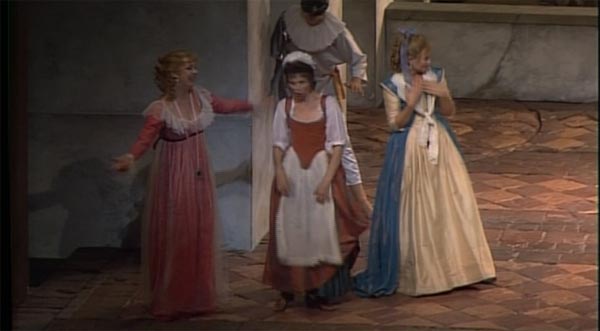
John Eliot Gardiner’s 1992 Cosi Fan Tutte is, on the face of it, very similar to the Il Nozze di Figaro he recorded the following year. Both feature period costumes and sets and no attempt is made to hide that these are stage productions in a theatre (the Châtelet). Both productions feature young, attractive singers of talent drawn from Gardiner’s orbit. However , where the Figaro seems devoid of original dramatic ideas, the Cosi is more densely constructed. Gardiner produced this himself and although he leaves the detailed stage direction to Stephen Medcalf the concept is clearly his. He sees the piece being largely about the development of the two sisters from essentially undifferentiated stereotypical unmarried girls of their class in Act 1 into fully self aware adults in Act 2. He roots this interpretation in the score arguing that Mozart wasn’t even sure which of the girls he was writing for in the first act. To support this concept he casts two similar sounding sopranos. To cast a mezzo as Dorabella is, says Gardiner, “a 20th century aberration”. In Act 1 they are dressed identically transitioning in the final scene to mirror images of each other. In Act 2 they are visually fully differentiated. This overall idea is backed up bu careful direction of the singers and painterly sets evoking the Bay of Naples. Good use is made of the auditorium as well as the stage especially in Guglielmo’s Act 2 aria “Donne mie, la fate a tanti”. So, it’s pretty to look at but there’s a good deal more to it than that.
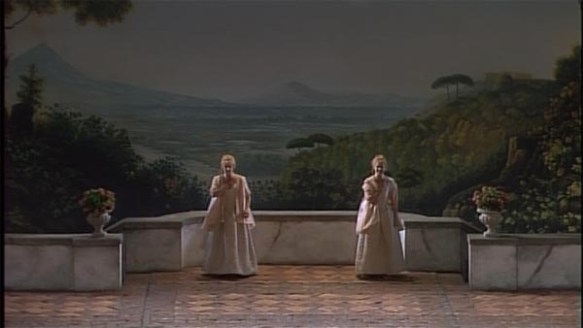 Musically it’s of the highest quality; at least if you like period instruments in Mozart and I do. From the very first bars of the overture; taken at a pretty fair lick, I bounced to the spritely sound of the English Baroque Soloists. The singers are excellent. Amanda Roocroft is Fiordiligi and she manages a vocally sure but psychologically conflicted “Come scoglio” with aplomb. She also sings a really lovely “Per pietà”. Rosa Mannion is not far behind as Dorabella though, of course, she has rather fewer opportunities for display. Rainer Trost is a wonderfully lyrical Ferrando with a lbeautiful rendering of “Un’aura amorosa”. Rodney Gilfrey is a muscular, even macho, Guglielmo. Mezzo Eirian James plays Despina and is more convincing than many in that role especially in the doctor/attorney scenes. She’s the scheming maid to the life. Don Alfonso is played by baritone Claudio Nicolai and he’s much lighter voiced than is usual for the role. This fits with an interpretation that is nuanced rather than buffo. Ensemble work is consistently excellent.
 Peter Mumford directed for DVD. I think this was specifically recorded for home use rather than for TV broadcast and, for the era, it’s really good. He uses some unusual camera angles but never gratuitously and we can see what we need to see to understand the production. There are a few moments of gratuitous artsiness with head shots fading to backdrop and so on but it’s not really troubling. The picture is 16:9 and good DVD quality though not on a par with true modern HD. The production was recorded in stereo but DGG have worked some digital wizardry to produce Dolby 5.1 and DTS 5.1. The DTS is pretty vivid and well balanced. The only extras are some trailers for other Gardiner Mozart recordings. The documentation includes an interesting essay by Gardiner. There are English, German, French, Italian , Spanish and Chinese subtitles.
 All in all, this is well worth seeing for anyone interested in HIP versions of mozart or just looking for a solid, undistracting well played and sung version. It won’t do much for the Regie fans though.

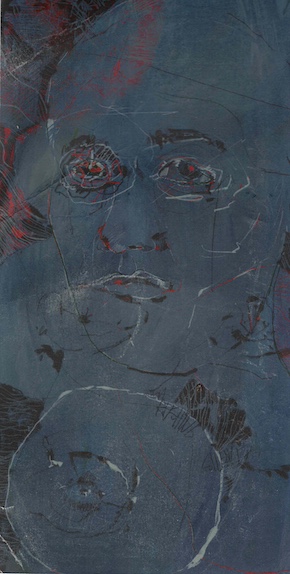 The latest Happenstancers gig, which took place at 918 Bathurst on Thursday evening, was an exploration of the death of Ophelia and related ideas with works for assorted chamber ensembles plus/minus voices. Ten composers; all of whom could at a stretch be considered “contemporary”, were featured in a programme that, with interval, lasted two and three quarter hours. That’s a feat of stamina for performers and audience alike as none of the music performed was “easy” and no notes or introductions were provided.
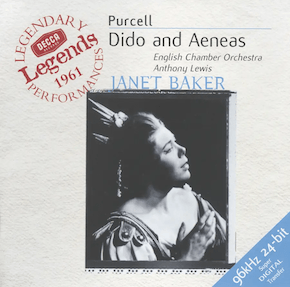 So, to continue our look at the recording history of Purcell’s Dido and Aeneas we turn to the 1961 Decca recording with Janet Baker in the title role. This has won so many awards and featured on so many “best of” lists that it might reasonably be considered to serve as some sort of “gold standard”. It’s certainly very good but I’m more interested in looking at what it says about the evolution of performance practice of Dido and Aeneas than in adding to the praise for Dame Janet’s performance.
 operaramblings