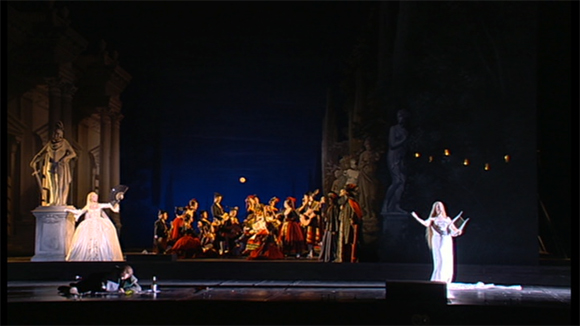
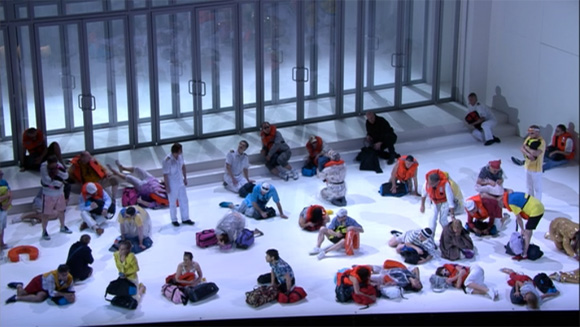
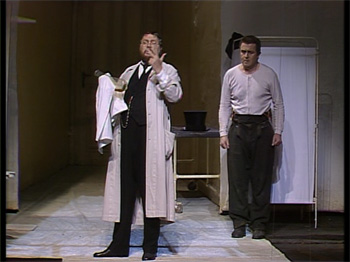
Robert Carsen’s production of Offenbach’s Les Contes d’Hoffmann does a very decent job of presenting this rather muddled and overly long piece. He sets it in and around a production of Don Giovanni in which Hoffmann’s current infatuation, Stella, is singing Donna Anna. There are several quite clever DG references scattered around. By and large it works and is one of the better “theatre in theatre” treatments that I’ve seen.
Tag Archives: dvd
200 disks
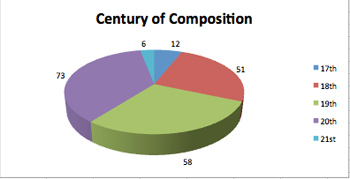
I’ve now reviewed 200 opera performances on DVD and Blu-Ray. They range alphabetically from Adams to Zemlinsky and chronologically from Monteverdi to Reimann. The oldest performance is a 1931 film of Die Dreigroschenoper and the latest a 2012 recording of Arabella. Just for fun I did some quick stats on four parameters; century of composition, decade of performance, language of performance and place of performance.
The century of composition stats show, perhaps unsurprisingly, that my tastes don’t lie in opera’s temporal sweet spot, the 19th century. My most popular century is the 20th with lots of Britten and Richard Strauss contributing a good chunk of the 73 disks. The 19th does come in second at 58 but it’s only just ahead of the 18th at 51 with strong contributions from Mozart (of course), Handel and Rameau. Continue reading
Slapstick stick slapping
If you have ever wondered why a slapstick comedy is so called then look no further than Gilbert Deflo’s production of Prokofiev’s L’Amour des trois oranges recorded by L’Opéra de Paris in 2005. There’s a great deal of smacking with sticks; most of it by Barry Banks who gleefully whacks just about any bottom, male or female, that comes within range. The production is also slapstick in the generally understood sense of broad physical comedy. There are elements of commedia del arte and lots of circus; jugglers, clowns, fire swallowers, all wrapped up in a sort of 20s vamp aesthetic. It’s wildly chaotic in a rather fun way though it’s all a bit overwhelming and probably worked better in the theatre than on DVD.
Revelatory Carmélites from La Scala
I was somewhat underwhelmed by my first encounter with Poulenc’s Dialogues des Carmélites. Watching this recording of a 2004 La Scala production by Robert Carsen really opened my eyes. It’s the conducting that makes it I think, Riccardo Muti seems to find much more in the score than Jan Latham-Koenig. There are passages of great meditative beauty interspersed with quite shocking violence, all within an essentially tonal framework. It’s very striking. He’s helped by the sound on the DVD which is exceptionally vivid and three dimensional, even using the LPCM stereo option, though the Dolby 5.1 track is even better.
Look! No swan
Surprisingly perhaps I started out liking this 1986 recording of Lohengrin from the Metropolitan Opera quite a lot. It’s a very traditional, literal and 70s/80s dark production but the orchestra and chorus are great, the P-regie seems pretty well thought out and the singing in the opening scenes is great. Unfortunately it really rather goes downhill once Elsa, Lohengrin and Ortrud make their appearances.
The silliest opera ever?
Even by the standards of bel canto comedies Donizetti’s Le convenienze ed inconvenienze teatrali is insubstantial fluff. It’s basically a farce about a no hope opera troupe failing miserably to rehearse an opera in the face of prima donnaish Prima Donna, her overprotective husband, a flaky German tenor and the overbearing mother of the Seconda Donna (played by a man, natch). Half of the jokes turn on cast members singing badly and the rest on standard opera clichés. None of them are particularly funny. The music is a bit non descript too. The best bits are when the Prima Donna and the tenor inexplicably decide to sing Rossini and Mozart in the middle of a rehearsal.
Brotherly love
Rameau’s Castor et Pollux is a tragédie lyrique in five acts. It’s a mythology based libretto which, ultimately, celebrates the fraternal love of the twins who rise to immortality while rather callously discarding the female human love interest. Pierre Audi’s 2008 production for De Nederlandse Opera nods both to the baroque and to the mythological by staging the work in a rather abstract Sci-Fi sort of way but with moving sets and Fx that suggest, rather than reproduce, the stagecraft of the baroque.
Secret Senta
Martin Kušej’s production of Der fliegender Holländer for De Nederlandse Opera recorded in 2010 is high concept and it’s worth looking at the interviews with the cast and conductor before watching the main event. Certainly the essay in the booklet will do little to prepare you. For Kušej, Daland’s ship is a cruise ship or pleasure yacht full of expensively dressed partygoers. The Dutchman’s “crew” are refugees or desperate economic migrants. The Dutchman himself has made his pile in human trafficking. The framework of the “outsiders” wanting a share of the “insiders'” goodies is the backdrop for the interpersonal drama of Senta, the Dutchman and Erik.
Traditional Wozzeck from Vienna
The 1987 recording of Berg’s Wozzeck from the Vienna State Opera is a bit of a mixed bag. Claudio Abbado’s reading of the score is incredibly intense and powerful and he gets great support from the orchestra, There’s also some very good singing. Dramatically it’s a bit of a mixed bag and the DVD production isn’t particularly good. Continue reading
Babes in bodices
After a less than satisfactory introduction to Donizetti’s Anna Bolena in a MetHD broadcast last year it was with some trepidation that I approached the DVD version recorded at the Wiener Staatsoper and also starring Anna Netrebko. I need not have worried because it’s very good indeed. It has a stronger cast, Eric Genovese’s relatively simple production trumps David McVicar’s overstuffed effort and Evelino Pido doesn’t try and make the orchestra sound like it’s playing Wagner. The sound on the DVD is also way better than it was on that broadcast.