What’s green and blue and Carsen all over?

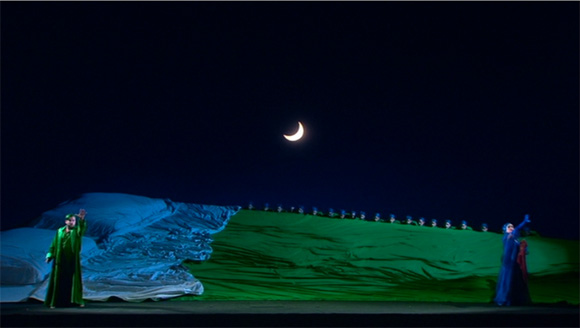
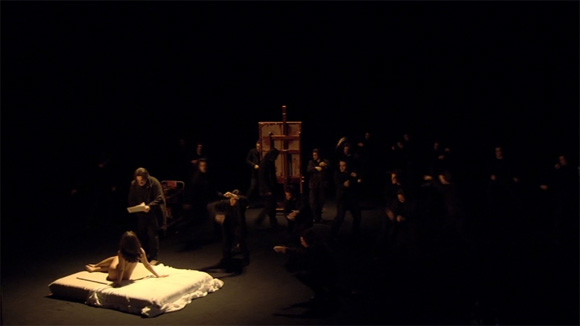
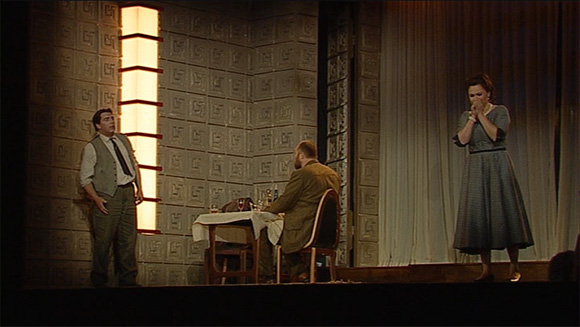
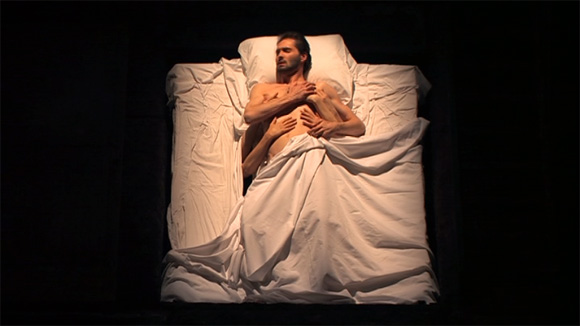
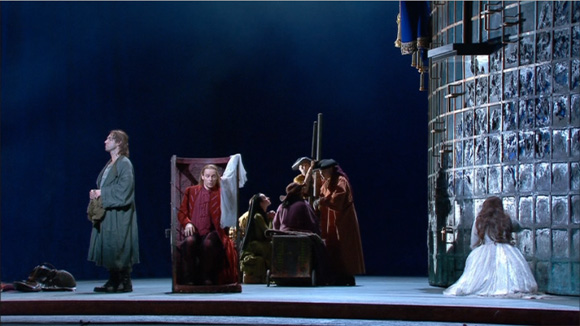
Robert Carsen’s production of Britten’s A Midsummer Night’s Dream is as visually striking as any of his productions.  It’s also one that’s done the rounds, playing in Aix and Lyon before being recorded by a strong cast at the Liceu in Barcelona in 2005.  The challenge with Dream is to create visual worlds for the Fairies and the Mortals that are different but work together.  Carsen and his usual design team do this very well in this case.  The Fairies are given striking green and blue costumes with red gloves.  The mortals mostly run to white and cream and gold and they seem to spend a lot of time in their underwear.  The lighting, as always with Carsen, forms an important part of the overall design.  Carsen completists will also notice certain other characteristic touches like starkly arranged furniture.

1. Fairies Continue reading

Sher ham

Bartlett Sher’s concept for his production of Rossini’s Le Comte Ory is a theatre within a theatre setting with scruffy bewigged footmen types operating old fashioned stage machinery.  Throw in costume design that seems to cross the slutty middle ages with My Little Pony and one gets a production that would probably appeal to the average seven year old girl.  Fortunately the singing and acting is really rather fine with splendid vocal contributions from Juan Diego Flórez, Joyce DiDonato and Diana Damrau well backed up by the likes of Stéphane Degout and Susanne Resmark and it’s Maurizio Benini and the Met orchestra so no problems there either.  To be honest they are hamming it up for all its worth but that doesn’t seem unreasonable in this very silly piece.  The second act trio which features some mind boggling gender bending with the three principals swapping partners faster than Liz Taylor swapped husbands is hilarious.

1.hermit Continue reading

But is it art?

Wagner’s Tannhäuser is the earliest of the canonical works.  In some ways it’s very Wagnerian.  It has screwed up theology with a heavy dose of misogyny and some recognisably Wagnerian music.  On the other hand it is structured more like a French grand opera and some of the music definitely has more than a hint of Meyerbeer to it.The basic plot is that of the hero seduced into sin by the pagan love goddess Venus and then redeemed by the love (and death) of the chaste virgin Elisabeth.

1.venus Continue reading

The Copenhagen Ring – Die Walküre

The Copenhagen Ring has been dubbed the feminist Ring with good reason and we’ll come back to that in looking at the relationship between Wotan and Brünnhilde.  It might also be called the drinkers’ Ring.  There’s an astonishing amount of boozing going on.  It was there in Rheingold with Loge’s hangover and Alberich staggering drunkenly after the Rhinemaidens.  It’s back in Die Walküre.  Hunding and Siegmund knock off the best part of a bottle of Bushmill’s Malt (Add a few cigars and this scene would be perfect for Stuart Skelton and Iain Paterson), Wotan has a flask in his pocket and the Walkyries; Ride is like a sorority party.  Actually it reminds me a lot of Denmark so maybe it just seemed natural.

1.hundingshall Continue reading

Gentle Death, I embrace you

1.urbainIt’s 1990 and Dame Joan Sutherland is retiring.  Australian Opera decide to stage Meyerbeer’s Les Huguenots as a farewell gala.  In some ways it’s an odd choice as the Sutherland character, Marguerite de Valois, only appears in two of the five acts of an opera that’s rather long despite cuts.  Still, as a vehicle for an ageing coloratura it’s not a bad choice.  The production is by Lotfi Mansouri so there is nothing to get in the way of the plot and, by the same token, nothing much to think about.  It’s also, equally characteristically, quite dark in places.  Everything then rests on the performances.  Continue reading

The Copenhagen Ring – Das Rheingold

This 2006 Copenhagen production of Wagner’s Ring has been written about a lot.  It’s been dubbed “the feminist Ring” and a lot has been made of the frequent camera cuts and odd angles.  Actually what struck me most about it was the comparative goriness.  The video direction (by Uffe Borgwandt) didn’t strike me as particularly unusual.  I’d say it was better edited than a typical Halvorson Met broadcast but not so terribly different in spirit.  The main difference is that this is very much presented as a film rather than a documentary record of a live performance.  Oddly it begins very much in live performance mode with footage of the Queen of Denmark taking her seat and of the conductor (Michael Schønwandt) complete with miniatures of his decorations on his tail coat going to the pit.  From then on though we get anything but what the audience in the house saw.

1.rhinemaidens Continue reading

A baroque rarity

Cavalli’s Il Giasone isn’t a work one sees performed often.  It’s a peculiar beast.  It’s about Jason and Medea and the Golden Fleece but has few of the elements of the version of the story that everone knows and everybody from Charpentier to Reimann has made into an opera.  In Cavalli’s version Giasone has got Isifile, a princess of Lemnos, pregnant with twins and then gone off after the Golden Fleece.  In Colchis he spends his time in bed with a mysterious local beauty, much to the disgust of Ercole who thinks he’s gone soft.  Eventually Giasone works out that his squeeze is Medea and with her help defeats some monsters and grabs the fleece.

1.giasone Continue reading

Catholic kitsch

Don Giovanni is one of the most fascinating operas in part because it can be reinterpreted in so many different ways.  There’s also the tension between a story with elements of murder, rape, revenge and damnation and broad humour.  It’s tricky to find a balance.  There’s also a decision to be made between a concept based production and a more laissez faire approach.  Francesca Zambello’s production for the Royal Opera House, recorded in 2008 doesn’t really have a concept and sort of goes with the flow mixing very broad humour with lots of Catholic kitsch and some flamboyant stage effects.  As a production I find it distinctly underwhelming.

1.dglep Continue reading

Campy Clemenza

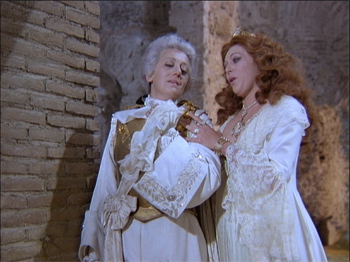
1.sestovitelliaBesides the production of La Clemenza di Tito still in repertory at the Met, Jean-Pierre Ponelle also made a film of the piece.  It was shot among the ruins of ancient Rome in 1980 and is one of those lip synched opera films popular in that era.  The forces involved are eclectic.  James Levine conducts the Wiener Philharmoniker and the Konzertvereinigung Wiener Staatsopernchor with mainly American soloists.  Continue reading

Carsen’s Hoffmann riffs off Don Giovanni

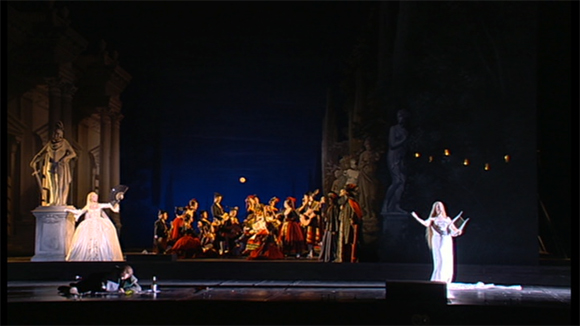
Robert Carsen’s production of Offenbach’s Les Contes d’Hoffmann does a very decent job of presenting this rather muddled and overly long piece.  He sets it in and around a production of Don Giovanni in which Hoffmann’s current infatuation, Stella, is singing Donna Anna.  There are several quite clever DG references scattered around.  By and large it works and is one of the better “theatre in theatre” treatments that I’ve seen.

1.Muse Continue reading