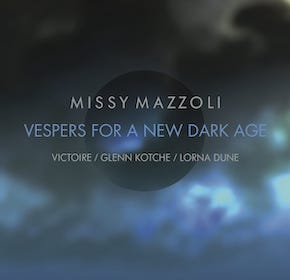
 Feel like listening to something different? Then I can recommend Missy Mazzoli’s 2014 genre defying Vespers for a New Dark Age. Conceptually it reimagines the traditional vespers prayer service with its, perhaps, archaic formality to explore he way we confront technology, ghosts, death, doubt and God in our “new dark age”.
Structurally there are eight movements run together which set fragments of poems by Matthew Zapruder. The setting uses vocals, amplified strings, winds, organs, synthesizers and lots of electronics to create a weird and disturbing soundscape of many moods though the overall tone is very dark.
The performance is created by Mazzoli’s ensemble Victoire, Glenn Kotche (of Wilco) and vocalists Mellissa Hughes, Martha Cluver and Virginia Warnken (of Roomful of Teeth). Electronic production is by synth producer Lorna Dune, who plays a crucial role, and is also responsible for the bonus track; an electronic remix of Mazzoli’s A Thousand Tongues.
The only criticism I have of the disk is that I couldn’t find the texts anywhere. Sometimes they are clear enough on the recording, sometimes not so much.

 Debut albums from young singers usually play it fairly safe but mezzo-soprano Emily D’Angelo’s is anything but. Her new album, enargeia, on the Deutsche Grammophon label is bold indeed. All twelve tracks on the album feature works by contemporary female composers, though with a nod to Hildegard von Bingen. The accompaniments vary from solo cello to orchestra augmented with electric guitar, electric bass and drum kit. Singing style varies from austerely classical to verging on rock opera.
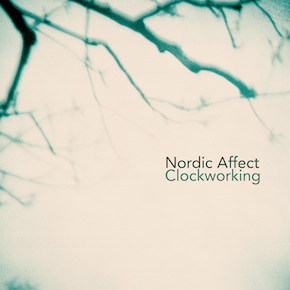 Listening to Emily D’Angelo’s new CD set me off on a search for more music by Hildur Gu∂nadóttir. This led me to Nortdic Affect; an ensemble who play contemporary music, mostly by female Iceandic composers) on baroque instruments. The older of the two albums is Clockworking, from 2015. It’s rather hypnotic. The music kind of inhabits the space between ambient sound and something more structured. Certainly the range of sounds that the musicians generate is remarkable, even when electronics aren’t involves, as they sometimes are. The
  I’ve been listening to Emily D’Angelo’s debut album elageia (find out more in the next edition of Opera Canada). It features music by Missy Mazzoli, with whom I’m a bit familiar, and by Sarah Kirkland Snider and Hildur Gudnadóttir, who are both new to me. Like Mazzoli, Snider is an exponent of that kind of cross-genre vocal music that seems to be assuming some significance in the US music scene. I’ve been listening to her song cycle Penelope which riffs off Homer’s Odyssey from a woman’s POV. Specifically the texts, by playwright Ellen McLaughlin, tell the story of a woman re-engaging with the man she was married to who has gone missing missing for 20 years and returned with PTSD.
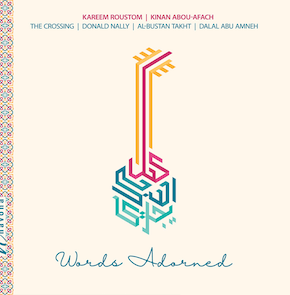 I’ve been listening to another new CD release by American choir The Crossing and their conductor Donald Nally. It’s called Words Adorned and contains two cycles by contemporary Arab-American composers setting really beautiful 11th century Andalusian texts.
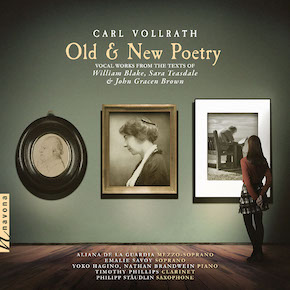 Navona have just produced an interesting album of art song by Alabama based composer Carl Vollrath. Old & New Poetry consists of three cycles setting texts by William Blake, Sara Teasdale and John Gracen Brown.
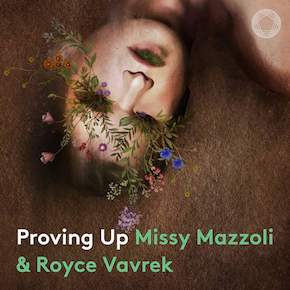 Missy Mazzoli’s Proving Up is an 80 minute opera consisting of a prologue, six scenes and an epilogue. The libretto is by Royce Vavrek after a short story by Karen Russell. It was recorded after a production at Opera Omaha in 2018. One might perhaps expect an opera about homesteading in Nebraska to be a worthy piece of uplifting Americana but nothing could be further from the truth here. The Prologue, it’s true, is based on a 19th century popular song Uncle Sam’s Farm which appears to offer the American Dream to all comers but after that we get a surrealistic tale of drought, despair, drinking and death all based on the search for an elusive glass window that will allow the Zegner family to “prove up” and gain title to their land under the 1862 Homestead Act. What then, of the American Dream?
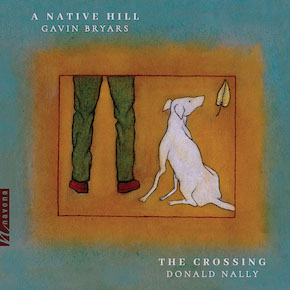 Gavin Bryars’ A Native Hill is a setting of sections from Wendell Berry’s 1968 essay of that title. It was written for, and recorded by, Philadelphia based choir The Crossing and their conductor Donald Nally. The essay was written by Berry shortly after moving back to Kentucky to farm. It deals mainly with how landscapes and the humans in them are shaped by each other in profound ways. It’s very local and specific and reminded me in a curious sort of way of WG Hoskins’ The Making of the English Landscape that came out a few years before the Berry essay.
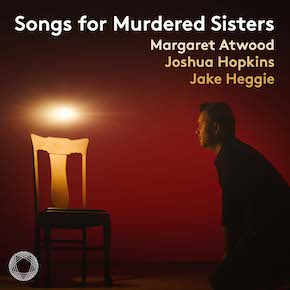 Songs for Murdered Sisters is a new song cycle by Jake Heggie setting poems by Margaret Atwood. It came about as a result of an initiative by Canadian baritone Joshua Hopkins ,whose own sister was murdered by her ex in 2015, to raise awareness about violence against women. It’s now been recorded by Heggie and Hopkins and will be released by Pentatone in digital format tomorrow. It’s also available as a free video stream on the Houston Grand Opera website until March 21st. (ETA March 18th – extended to April 30th)
 The Travelled Road is a new recording of songs by Saratoga Springs based composer Evan Mack. Mack sets a rather eclectic set of texts and his musical style is varied. His roots in opera are evident and I enjoyed these songs much more than most American art song that comes my way.
 operaramblings