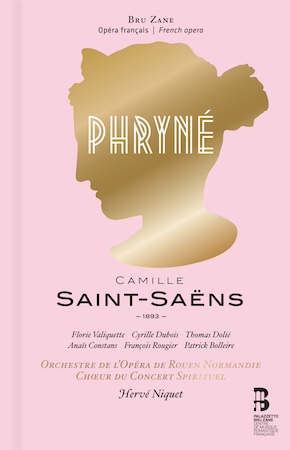
 The latest release in the CD/book series from the Palazetto Bru Zane is Saint-Saëns’s 1893 opéra comique, Phryné, loosely based on an incident in the life of the famous 4th century BCE courtesan. It’s a two-act piece lasting about 65 minutes. The original was given with spoken dialogue, but as so often with this genre, recitatives (here added by André Messager in 1896) have been used in this recording, as they were in most contemporary performances.
The plot is straightforward enough. Dicéphile is a rather pompous magistrate and has just been honoured by the city with a bust. His nephew/ward Nicias is in love with Phryné, but also broke and about to be arrested for debt. With the help of Phryné’s servants, he beats up the officials sent to arrest him and hides in her house, where, after the usual confusion, she admits to being in love with him. Dicéphile shows up to find that his bust has been disfigured with a wineskin and remonstrates with Phryné, who quickly changes the subject to her upcoming trial on a charge of impiety. Dicéphile is overcome by her (obvious) charms and agrees to drop the charges. He also agrees to share his fortune with Nicias and all live happily ever after. Continue reading →

 So what do you get when you try to use music to explore The Ultimate Question of Life the Universe and Everything or at least that part of it that deals with epistemology and metaphysics and the relationship between music and text? Maybe you get something like Kate Soper’s The Understanding of All Things which consists of three works separated by two improvisatory passages.
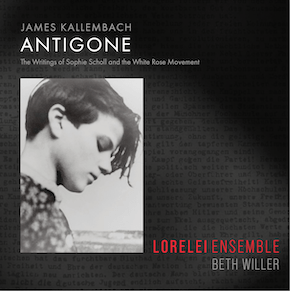 James Kallenbach’s 2017 work Antigone: The Writings of Sophie Scholl and the White Rose Movement is a sort of cantata for female voices and cello quartet on the theme of what we must/can do when the diktats of authority clash with what we know to be undeniably just. The piece lasts just over half an hour and intersperses the words of Sophocles’ Antigone with those of Sophie Scholl. It’s tremendously effective and moving. The texts fit seamlessly and the soundscape of female voices (the Lorelei Ensemble collectively and singing various solo parts) and four cellos seems really apt as well as being rather beautiful in a meditative sort of way. Beth Willer conducts
 Deutsche Grammophon has just re-released the recital by Bryn Terfel and Llyr Williams that was recorded live at the Verbier Festival in 2011. It’s a generous package. It kicks off with a couple of exquisitely sung Schubert songs which are followed by Schumann’s Liederkreis Op.39. This is gorgeous lieder singing with the voice sounding very fresh, the diction spot on and lovely accompaniment.
 Mr. Emmet Takes a Walk is the latest in the series of rereleases of works by Peter Maxwell Davies performed by the Manchester ensemble Psappha. The work premiered in 2000 and was recorded in 2005 and it’s the composer’s penultimate work for the stage. (FWIW I’ve heard five of PMD’s stage works but never seen one performed).
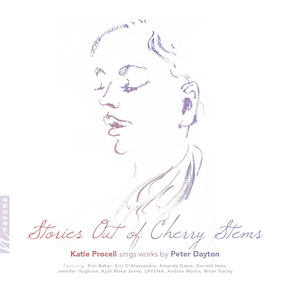 Stories Out of Cherry Stems is a recording of four works for soprano and various accompaniments written by American composer Peter Dayton for soprano Katie Procell. There four works are:
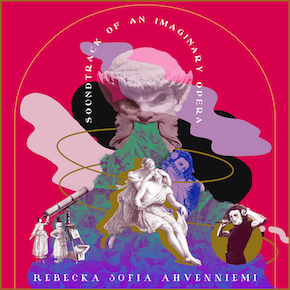 So continuing my exploration of music by contemporary female composers I listened to Rebecka Sofia Ahvenniemi’s Soundtrack for an Imaginary Opera. Ahvenniemi is both a composer and a philosopher who is inviting us, in this work, to reflect on opera as a social construct as much as text and music. There’s lots of information on what she’s getting at plus all the texts at
 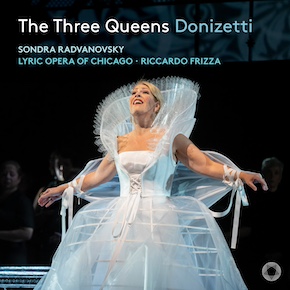 Donizetti’s three “Tudor Queen” operas; Anna Bolena, Maria Stuarda and Roberto Devereux (of which, despite the title, the real star is Elizabeth I) are often seen as a sort of trilogy and have occasionally been performed as such with a single soprano starring in all three. It’s a feat Sondra Radvanovsky managed at the Metropolitan Opera in the 2015/16 season. It’s not particularly surprising then that she should have been sought after by Lyric Opera of Chicago to star in a show featuring the final scenes of each opera which was recorded live at the Lyric in December 2019.
 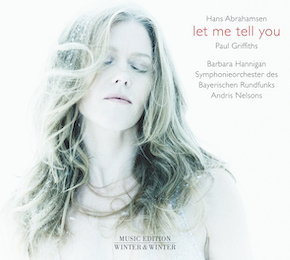 Hans Abrahamsen’s let me tell you is a work for orchestra and soprano setting text arranged by Paul Griffith from Ophelia’s lines in Hamlet. It was written for and dedicated to Barbara Hannigan who recorded it in 2015 (I think) with the Symphonieorchester des Bayerischen Rundfunks and Andris Nelsons.
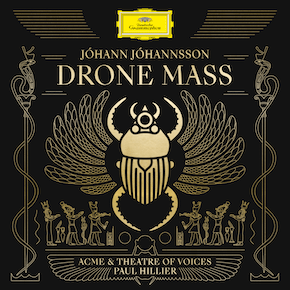 So continuing my exploration of somewhat off the wall contemporary Icelandic music I come to Jóhann Jóhannson’s “oratorio” Drone Mass. The inspiration and textual base is the gnostic “Coptic Gospel of the Egyptians” discovered in 19435. These appear to be very obscure texts and Jóhannson really just uses syllable combinations from them to create a series of vocalises. These are then set for string quartet, eight member choir and electronics.
