
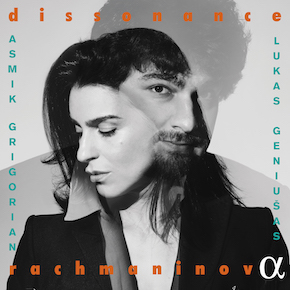
 Dissonance is a new CD of Rachmaninov songs from Lithuanian pair Asmik Grigorian and Lukas Geniušas. Regular readers will know Ive been getting quite excited by Ms. Grigorian’s opera performances so I jumped at the chance to hear her sing art song; especially paired with Geniušas who is more of a concert pianist than an accompanist.
The result is very pleasing. The songs, drawn from throughout Rachmaninov’s career are quite varied. There’s definitely a bias towards fin de siècle tristesse and, indeed, some of the songs sound quite French but there is plenty of contrast though. The song that opens the recital and gives it its name; Dissonance Op.34 No.13 is long and has a very assertive piano part played boldly by Geniušas. They Answered Op.21 No.4 is a rather dramatic call and response number based on a poem by Victor Hugo. What Happiness Op.34 No.12 is actually a bit demented, putting heavy demands on both singer and pianist while Let Us Rest Op.26 No.3 sets the closing lines of Chekhov’s Uncle Vanya and is achingly beautiful.
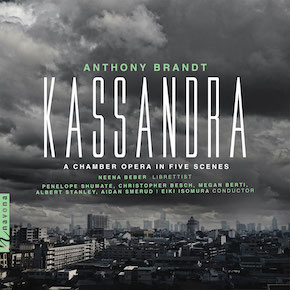 Kassandra is a new chamber opera from Anthony Brandt (composer) and Neena Beber (librettist). It’s an updating of the classic myth of Kassandra who was cursed by Apollo to always be right but never believed for having rejected his advances. In the new version Kassandra is an AI scientist who builds a computer with great predictive power, particularly with respect to climate. Apollo is a venture capitalist who bankrolls Kassandra then fires her and trashes her reputation when she rejects his unwelcome sexual overtures. So #metoo meets climate change denialism. Prophets, especially female ones, shouldn’t get in the way of profits or embarrass powerful males.
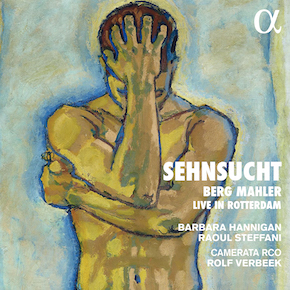 Sehnsucht is the title of a new CD from Barbara Hannigan and friends. It features three works in new arrangements for voice and chamber ensemble. Hannigan sings Berg’s Sieben frühe Lieder in an arrangement by Reinbert de Leeuw. Baritone Raoul Steffani sings the Vier Gesänge Op.2 in an arrangement by Henk de Vlieger. There’s also a performance of Mahler’s Symphony No.4 in an arrangement by Erwin Stein. The eleven member Camerata RCO is conducted by Rolf Verbeek.
 My review
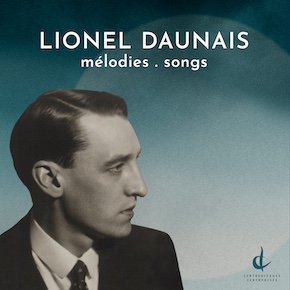 This recent Centrediscs release contains 27 songs (a generous 76 minutes of music) written by Québecois singer and composer Lionel Daunais in the mid 20th century. The songs really fall into two distinct groups. Some are art songs written for concert hall performance while others are works in a more popular style written for a wider audience. The art songs are very French; the others distinctly of Quebec.
 The Leader and other works is a new record of music by Karim Al-Zand. The most substantial piece is the one act chamber opera The Leader based on Ionesco’s 1955 play Le Maître. A reporter and two devoted fans follow the Leader wherever he goes mesmerised by his often absurd antics. A young couple is gradually drawn into the fascination.
 Having enjoyed the performance in the Toronto Music Garden of Alec Roth’s Songs in Time of War I downloaded the CD of the original version with violin rather than erhu. There are actually three pieces on the CD. There’s the complete Songs in Time of War with tenor Mark Padmore, guitarist Morgan Szymanski, harpist Alison Nicholls and violinist Philippe Honoré, there are two solo guitar pieces Canción de la Luna and Danza de la Luna (Szymanski) and Padmore and Szymanski collaborating on Chinese Gardens; a setting of four Vikram Seth poems inspired by the Ming dynasty gardens at Suzhou.
 Born is the latest album from Philadelphia based choir The Crossing conducted by Donald Nally. There are three pieces on the album. Two works by Michael Gilbertson book end the line up. The first, Born, sets words by Wisława Szymborska translated by Stanislaw Baranczak and Clare Cavanagh. It deals in a very allusive way with the relationship between a man and his mother. The music is intricate but still sounds a bit “church choiry” for my taste. There’s nothing wrong with it. It’s well crafted and beautifully performed but not really my thing.
 A Cup of Sins is a new CD release of works by Iranian-Canadian composer Parisa Sabet. If there’s a unifying theme it’s religious/cultural persecution in Iran and there’s a strong Bahai influence. The six pieces are scored for various combinations of voice, piano and small ensemble and add up to about an hour of very rewarding music.
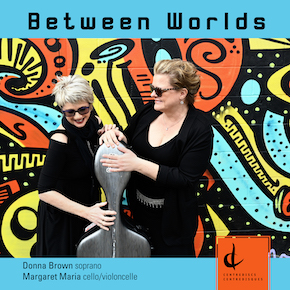 Between Worlds is a collaboration between composer/cellist Margaret Maria and soprano/poet Donna Brown. It uses words and music to explore the tension between Thanatos and Eros via a symbolic journey from Sunset to Sunrise. The piece is in eight movements totalling a little over half an hour of music. The style and technique varies widely. Two poems “Sunrise” and “Sunset” are spoken over a sparse cello commentary. Others are sung but they too vary from a fairly conventional singing style backed up by complex, extended cello technique to a more declamatory style with metronomic accompaniment. To me it felt (in a weird way) “bardic”. By which i mean that the instrument was largely being used to emphasise the text in a way that Homer or the Beowulf poet might have related to. It’s also clearly a very personal statement about art, life and death and one’s reception of it is going to be impacted by how closely one can align with it philosophically.
