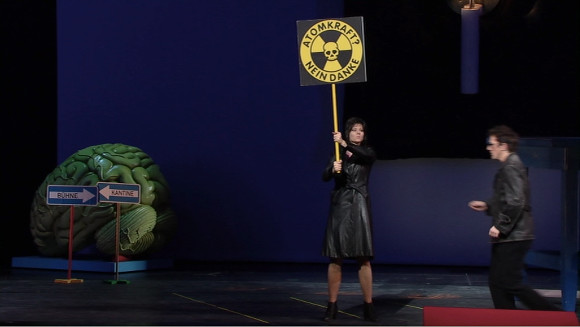
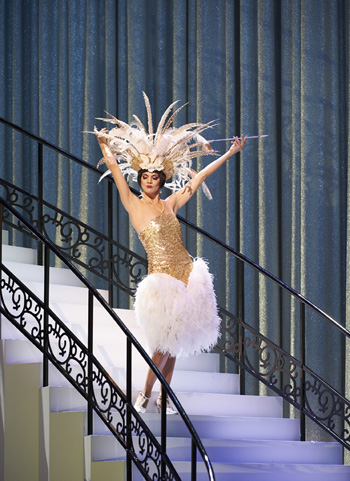
Spuren der Verirrten (The Lost) is described on the box as an opera by Philip Glass. That’s pretty misleading. It’s more a theatre piece/ballet by David Pountney and Amin Hosseinpour with a soundtrack by Philip Glass. It was created for the opening of the new Landestheater Linz at the instigation of Artistic Director Rainer Mennicken (carefully trimmed beard, wire rimmed glasses) who wanted a piece that would encapsulate all the various theatrical forms the new building would stage, as well as show off its technical capabilities. Mennicken also wrote the “libretto” based on a highly abstract play by Peter Handke which seems to deal with the hopelessness of the human condition in some sort of post apocalyptic world. There’s no plot as such and the work unfolds in a series of scenes. For example there’s a ballerina point shoeing across the stage followed by a “spectator” in the auditorium commenting on the action followed by dancers with roadsigns followed by a Gumby like couple sitting under a table followed by more narration. Then come more dancers in Hosseinpour’s signature “jerky” style followed by a woman with an anti-nuclear sign having a row with her boyfriend in front of a giant green brain. And that’s just the first ten minutes of a piece that goes on for nearly two hours. Along the way we get a reality TV show in which the characters discuss whether a serial killer is worse than a goalkeeper who lets in a soft goal, a confrontation between the patriarch Abraham and a giant rabbit and a scene where a naked woman cuddles a human head while two dancers do the fish slapping dance around her. The piece concludes with the orchestra on stage and the chorus in the pit miming playing instruments and singing “blah, blah, blah” which actually fits the music pretty well.
All who were lost are found
Thomas Adès’ 2004 opera The Tempest was given at the Metropolitan Opera in 2012 in a new production by Robert Lepage. It got an HD broadcast and a subsequent DVD release. It’s an interesting work which, on happening, was compared to Peter Grimes as the “next great English opera”. Whether this early hype will turn into a sustained place in the repertoire is yet to be seen. Musically it’s not easy to characterize. Adès very much has his own style; mixing lyricism with atonality and, in this piece, setting one of the roles, Ariel, so high it’s surprising anyone has been found to sing it. Certainly it’s a more aggressively modern style than most of the work currently being produced in North America. The libretto two is unusual. Shakespeare’s own words were, apparently, considered too difficult to sing though, of course, Britten famously set great screeds of unadulterated bard in A Midsummer Night’s Dream. For the Tempest, Meredith Oakes has rendered the text into couplets; rhymed or half rhymed. It works quite well with only the occasional touch of Jeremy Sams like banality.
Madama Butterfly revived but not revitalised
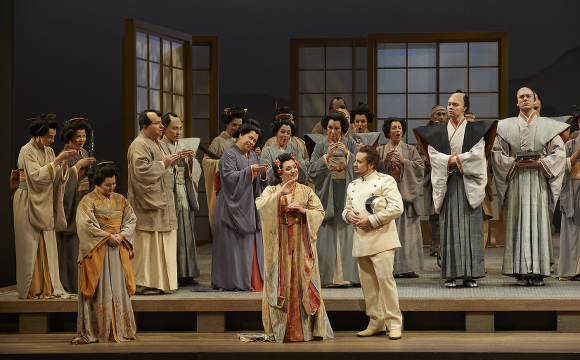
The COC’s production of Madama Butterfly opened last night at the Four Seasons Centre. I’m not a huge Madama Butterfly fan and it takes a really good production and a really good performance to get me past my instinctive dislike for a libretto based on child rape and sex tourism backed by Puccini soup with an infusion of Mikado. This production, being revived for the umpty umpth time (It dates back to the Brian Dickie era) just wasn’t that. Director Brian Macdonald writes in the programme “We both (he and Dickie) had had experience at the Stratford Festival. That meant wood, simple props, no decoration that wouldn’t bespeak the essence of the play”. Throw in an Allen key and it would sound like a trip to IKEA. Which is pretty much what the designs are like; clean, functional and inoffensive. Throw in costumes and gestures straight from the Mikado and you have it. Not bad. Just meh.
Falstaff again
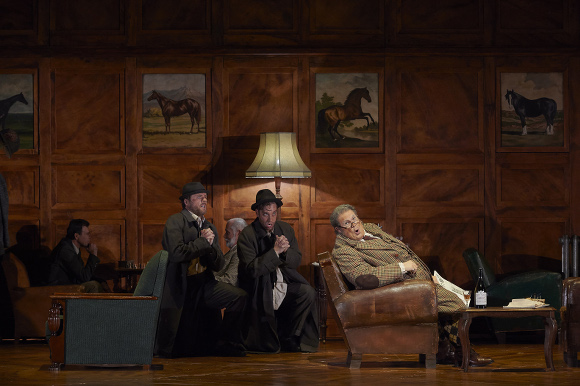
Back to the COC’s production of Falstaff last night for a second look. I felt I spent so much time last week trying to figure out who was who and what was what in this rather madcap comedy that I was really looking forward to seeing it in a more relaxed way. I had figured out that there was a lot of detail to unpack that I had missed first time around; partly because I was attention challenged and partly because I had forgotten my opera glasses. Last night; perched up in Ring 5, I watched a good part of this show through the glasses and saw many things I missed first time around. I think I want to watch it from close up if I can, even if there’s an acoustical price to pay for that.
Born out of Wenlock
Ever since they were first published the poems that make up AE Housman’s A Shropshire Lad have exerted a fascination over English composers. Today in the Richard Bradshaw Amphitheatre we heard two first year members of the Ensemble Studio give performances of two settings that take quite different approaches to the texts.
Bit of a giveaway
I clipped and blew this up from a shot taken by Kevin Lloyd at yesterday’s Derek Holman concert. At least this one didn’t make me the one invisible member of the audience!
Porgy and Bess at SFO
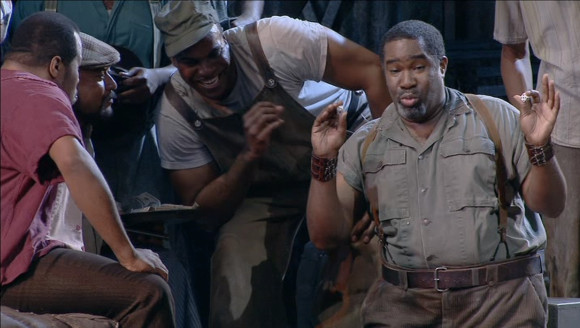
Gershwin’s Porgy and Bess has a really interesting history. It was always intended as a “grand opera”; pretty much the first American one. It was written for the Metropolitan Opera but not performed there until 1985 and between it’s Boston debut in 1935 and a production in Houston in 1976 it was virtually always performed in a much cut edition designed for Broadway. In fact by the time of the Houston production it was being done much at all; being seen as dated and dealing with issues of race that were particularly highly charged in Civil Rights Era America. It took a bold, young Deneral Manager, David Gockley, and a Gershwin enthusiast, John DeMain, to recreate an opera rather than a musical. It’s been following them round ever since and so, not very surprisingly, Gockley, now in charge in San Francisco, chose to stage it there last year in a new production by Francesca Zambello with DeMain conducting.
A Play of Passion
Tenor Colin Ainsworth and pianist Stephen Ralls today presented three song cycles written for them by Derek Holman. The first, The Death of Orpheus (2004) sets two translations of Ovid by Arthur Golding; on the subject of Orpheus in the underworld sandwiching Shakespeare’s Sonnet XVIII. The parts form an interesting contrast. In the Ovid, Golding chose to write in rhyming iambic heptameters but Holman’s setting completely ignores that, breaking and reshaping the lines very freely. The piano line too is spare and more a commentary on the vocal line than a support. In contrast the Shakespeare is set much more “faithfully”; piano and vocal line both reflecting more closely the metre of the verse. Holman also rarely repeats a phrase of the text) it happens maybe five times in the eleven songs in today’s programme) which puts quite a burden on the listener given the allusive complexity of Ovid/Golding’s verse. Continue reading
Suzie leBlanc is crowdsourcing a Christmas album
Acadian soprano Suzie LeBlanc is crowd sourcing the marketing and tour of her new album La Veillée de Noël based on an old French songbook found in the now defunct Collège St-Joseph in Memramcook, New Brunswick. She’s looking for ten grand to finance the project. Details are here.
Why productions succeed in one place but not another?
In an age of co-productions many opera productions are seen in multiple houses. Some of them we get to see in multiple guises. For example I’ve seen Tcherniakov’s Don Giovanni on DVD and will be seeing it live later this season in Toronto. Spmething that’s been fermenting in my brain for a while now is why the same production can get a drastically different reception in different places. The piece that first made me think about this was Chris Alden’s Die Fledermaus. This was generally well received in Toronto (more perhaps by my friends and acquaintances than the print media but that’s par for the course) but universally panned in London when it played at ENO. Bryan’s interesting comments about the Carsen Falstaff kicked off the train of thought again and made me want to put some tentative thoughts into writing.