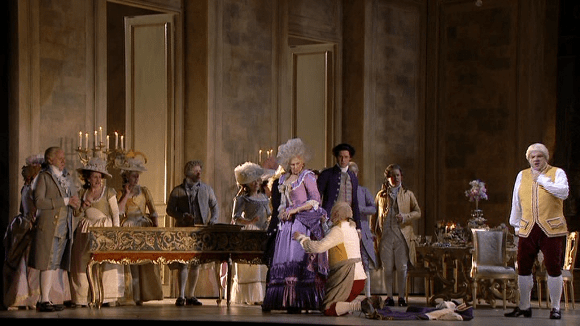
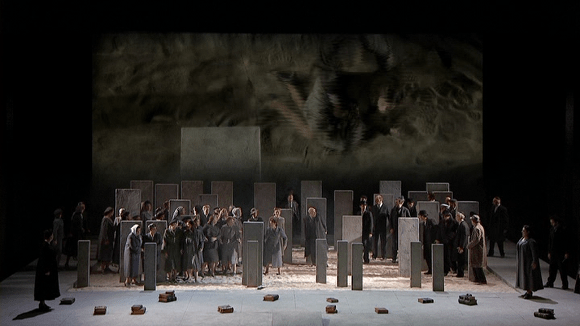
Daniele Abbado’s production of Verdi’s Nabucco, recorded at Covent Garden in 2013 was the vehicle for Placido Domingo taking on yet another Verdi baritone role. It’s set in the 1940’s because, Jews. At least it’s costumed that way because nothing else about the production has any kind of sense of time or place. It’s virtually monochrome and quite abstract. The Temple is represented by a set of upright rectangular blocks which are toppled at the appropriate moment. The idol of Baal is a sort of wire frame that comes apart rather undramatically and so on. There’s also nothing in the direction to suggest any kind of concept. It’s quite straightforward with rather a lot of “park and bark”. There’s some use of video projections behind and above the action but it’s rather hard to figure them out on video as they tend to appear in shot rather fleetingly.
 The full schedule of events around Bicycle Opera Project’s weekend in Hamilton in conjunction with the Hamilton Workers’ Arts and Heritage Centre have now been announced. We are looking at the weekend of July 15th/16th and the details are as follows: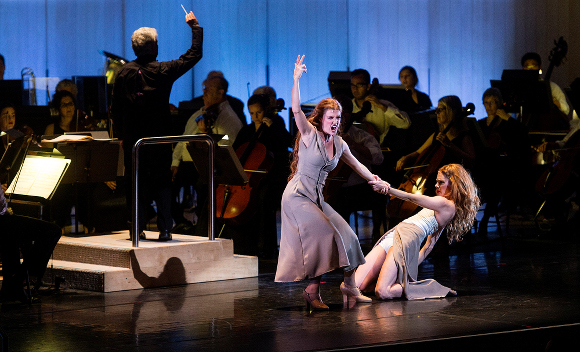

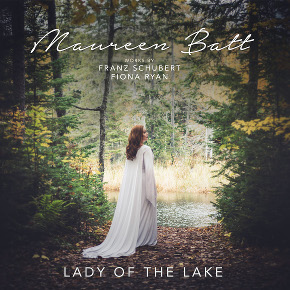 This is an interesting CD. It couples the rather rarely performed Schubert cycle to texts by Sir Walter Scott with a new Fiona Ryan cycle on the same theme. The reason the Schubert is a bit of a rarity is that, besides high and low voice and piano, one number requires a female chorus and another a TTBB quartet. In fact here those two pieces were recorded separately in different locations but I don’t think it’s apparent listening to the disc. The Schubert also includes the well known Ave Maria, the sixth song in the cycle, given here in the German originally used by Schubert rather than the Latin version usually heard. It’s a very decent performance. Maureen Batt is the soprano (and the evil genius behind the whole enterprise). Her voice is light and clear and her diction is excellent. Even a piece like the Ave Maria sounds fresh. Jon-Paul Décosse is the baritone. It’s a firm, confident voice, again with every word clearly audible. Simon Docking provides excellent accompaniment. The Bootgesang is performed by Leander Mendoza and Justin Simard; tenors with Robert O’Quinn and James Levesque; baritones, again with Docking at the piano. This might be the most fun piece of the cycle. For the elegiac Coronach we get The Halifax Camerata Singers conducted by Jeff Joudrey with Lynette Wahlstrom at the piano. They sound very pleasant.
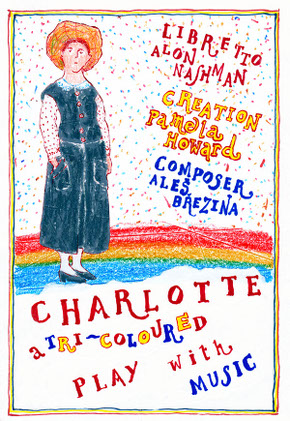 I didn’t actually see anything much in the Luminato line up that got my juices flowing but my attention has now been drawn to CHARLOTTE: A Tri-Coloured Play with Music. It’s a Singspiel about a young female Jewish artist struggling with her identity and art during the early 1940s. She ends up in Auschwitz. You get the picture. The title role is being played by Adanya Dunn and the musical director is Peter Tiefenbach which, frankly, are reasons enough to go see it. It plays June 16th to 18th at the Theatre Centre on Queen Street West. More details