The Christina and Louis Quilico Awards are a singing competition for members of the COC’s Ensemble Studio. This year’s edition took place early yesterday evening in the RBA. Only five members of the Ensemble Studio were competing. Megan Quick and Sam Pickett were not for reasons that I don’t think were announced and Aaron Sheppard was sick. So it was a pretty brief affair. The format as usual was that each contestant offered three arias and got to sing the one of their choice with the judges choosing which of the other two they should sing.

Winterreise
Schubert’s Winterreise is sometimes described as the Everest of lieder singing and, as such, is something of a rite of passage for baritones. It’s much rarer to hear it sung by a soprano but today, on a day when there was more snow in Toronto than one encounters these days on the Hillary step, Adrianne Pieczonka, accompanied by Rachel Andrist, offered it up in the intimate Mazzoleni Hall. It took me two or three songs to get into it. The colours of the soprano voice are so not baritonal that the music sounded unfamiliar and disconcerting. By Der Lindenbaum though I was won over. Here was singing of a limpid beauty few baritones could match and from then on I was revelling in the new perspectives that hearing a soprano sing this music brings. I think it was greatly helped by Adrianne’s approach which definitely favoured bringing out the drama and the emotion of the text rather than wallowing in beautiful tone. That was there when she wanted it but there was much else besides. It was an emotional roller coaster from the (relative) optimism of Die Post through to the devastating last couple of numbers. By the end of Der Leiermann I was a puddle but possibly not quite as damp and deep as the critic sitting next to me (whatever Twitter might report). Rachel’s work at the piano was equally illuminating. This is a show they need to take to a much larger audience.
Coming up this week
Late notice I guess but Adrianne Pieczonka and Rachel Andrist are performing Schubert’s Winterreise at Mazzoleni Hall this afternoon. It’s sold out anyway. Later, at 7.30pm, UoT Early Music is presenting a concert version of Purcell’s Fairy Queen in Trinity College Chapel. Tomorrow at the relatively unusual time of 5.30pm the members of the Ensemble Studio will be competing for the Quilico awards. That’s in the RBA and free. Also in the RBA, at noon on Tuesday, you can catch Andrew Haji singing a very varied Valentine’s Day program. Then on Thursday, same time, same place, Elena Tsallagova, Pamina in the COC’s current Magic Flute, presents a Russian and French program. The Magic Flute and Götterdämmerung continue at the COC.
Listings round up
Here’s a summary of the upcoming Toronto events I’ve been made aware of recently. Both the TSO and the RCM have announced their contemporary music festivals. 21C at the conservatory runs from May 24th to 28th. The opening concert features Johannes Debus with the COC Orchestra, Andrew Haji and Emily D’Angelo and the Elmer Iseler Singers. The program includes two pieces by Brian Current: his The Seven Heavenly Halls in its Ontario premiere and Nàaka (Northern Lights) its world premiere. The two works are part of a six movement work, entitled River of Light, which traces creation myths from six different cultures. This concert also includes works by Unsuk Chin, Samy Moussa and Matthew Aucoin. Then on the following night the Canadian Art Song Project has a concert of works by Canadian composers Andrew Staniland’s Peter Quince at the Clavier (Ontario premiere), Lloyd Burritt’s Moth Poem (Ontario premiere), and Ana Sokolović’s Dawn Always Begins in the Bones, CASP’s new commission to celebrate Canada 150. The singers, drawn from the COC Ensemble Studio will be Danika Lorèn (soprano), Emily D’Angelo (mezzo-soprano), Aaron Sheppard (tenor), Bruno Roy (baritone), Iain MacNeil (baritone), with Mélisande Sinsoulier and Liz Upchurch on piano. The Festival closes on May 28th with a Soundstreams concert; The Music of Unsuk Chin. The program includes her Cantatrix Sopranica, a playful exploration of the act of singing for two sopranos, countertenor, and ensemble featuring Carla Huhtanen, and “The Caterpillar,” an excerpt from her opera, Alice in Wonderland. Also included are two works by Chris Paul Harman; It’s All Forgotten Now (world premiere) and Love Locked Out. In between there’s lots more interesting looking instrumental stuff too. More details here. Continue reading
Mélodies of the Heart
Yesterday’s concert in the RBA was dedicated to the late Stuart Hamilton, founding director of the COC’s Ensemble Studio. Current members, mezzo Emily D’Angelo and baritone Bruno Roy, each gave us two sets of French songs accompanied respectively by Hyejin Kwon and Stéphane Mayer. Ms. D’Angelo gave us Débussy’s Chansons de Bilitis and the curiously Débussy like Trois Mélodies by Messiaen. Both sets are quite meditative and impressionistic and Ms. D’Angelo’s very beautiful voice suited them well. There’s more there than beauty of tone. She’s showing some interesting, very mezzoish, colours in the voice now and there’s clearly plenty of power in reserve as she showed on a couple of occasions. It’s so easy to forget how young she is when a performance is this accomplished. Ms. Kwon was a sympathetic accompanist.
And so to the boys who gave us Poulenc’s La fraîcheur et le feu and Ravel’s Don Quichotte à Dulcinée. The Poulenc piece rather races along with the piano part, impressively played by Mayer, often much more interesting than the vocal line. Roy was at his best in the more hectic passages where his diction and command of French were at a premium. When the music became more expansive he didn’t quite seem able to expand with it; the voice lacking bloom in both upper and lower registers and with no real sense of some underlying power. This was more of a handicap in the Don Quichotte songs. Roy managed some decent physical and vocal acting, especially in the drinking song, but there just wasn’t enough heft to put in the swagger required in these pieces.
Prior to the performances, the COC’s Janet Stubbs made a short speech in memory of Stuart which managed, in a very brief span, to convey both the impact he had on the Canadian and wider opera scene and a sense of his more endearing eccentricities.
Photos if and when.
Glenn Gould School Vocal Showcase

Lillian Brooks
The GGS Vocal Showcase is an opportunity to take a look at the vocal talent on offer at the Royal Conservatory. It’s a tricky exercise as the students range from the equivalent of first year undergrad to second year masters so one is constantly recalibrating expectations. We got to hear one bass, two baritones, three tenors, one mezzo soprano and fourteen sopranos in a variety of arias, art songs and ensemble numbers.
So, in no particular order my favourites and “ones to watch”. Lets start with the obvious. Gabriel Sanchez-Ortega is a genuine bass. We only heard him in some Haydn trios last night but he seems to have heft and genuine low notes and quite a wide range. He’s also still quite young. Singing with him was soprano Joanna Burt who also gave us an aria from La Cecchina. She has real potential as a dramatic soprano which is the one part of the tweeter market that isn’t flooded. She has some nice dark colours as well as weight. The trios were rounded out by tenor Zachary Rioux. He held his own with two pretty big voices so we’ll see.
The week in prospect
Tomorrow (Sunday) is a busy day. There’s a matinée of Götterdämmerung at the COC with a few tickets still available. UoT Opera is doing their annual student composer piece. This year it’s called Prima Zombie and it’s based on the premise that a cabal of disgruntled music critics, disenchanted with the current state of opera, unearth and electrify the corpse of the celebrated 19th century diva Nellie Melba. Mayhem ensues. This one is in the MacMillan Theatre at 2.30 pm and it’s free.

Magic Flute – the other cast
Last night I saw the alternate cast of the COC’s Magic Flute. Owen McCausland swaps First Armed Man for Tamino with Andrew Haji, Kirsten MacKinnon comes in as Pamina, Phillip Addis is Papageno and Matt Boehler is Sarastro. The changes don’t really affect things much at all. All the new faces are very good. MacKinnon is a very perky Pamina which works well with Addis who has maybe a bit more of the “cheeky chappy” than Hopkins. Fans of Owen McCausland and Andrew Haji will see exactly the differences in timbre and vocal technique one would expect but the interpretation is pretty much the same. Overall, I would say that someone not very familiar with these singers would scarcely notice any differences. What I did notice is how much better this production looks from Ring 3 than from the Orchestra. Getting something of a “plan view” makes the antics during the overture look less cluttered and frantic and the trials scene is much more effective. And the sound is better too.
Photos by Michael Cooper under the fold. Continue reading
Twilight
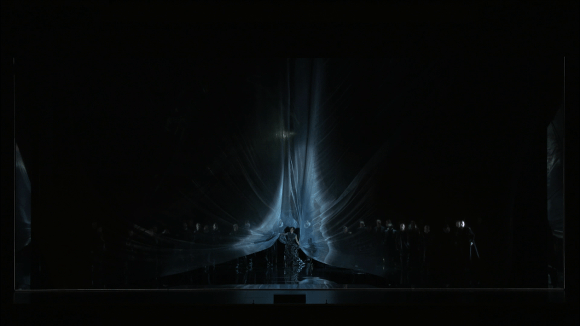
Last night the COC began its run of Götterdämmerung, the last and longest opera in Wagner’s epic tetralogy at The Four Seasons Centre. It’s very different from Die Walküre and Siegfried. The visual elements that tied them together; tottering Valhalla, disintegrating world ash, gantries, dancers, heaps of corpses are mostly gone. In Tim Albery’s production the visuals are spare almost to abstraction. The Gibichung Hall is a CEO suite with computer monitors and red couches, both Brünnhilde’s rock and the Rhinemaidens’ hang out look improvised, almost like squatters’ camps. Costuming, apart from an occasional flashback, as in Waltraute’s scene, is severely modern business; grey suits, black dresses. Only Siegfried himself in tee shirt and leather jacket stands out from the corporate crowd. Dancing flames are replaced by red lights. Everything that can be understated is and the world ends not with an overflowing Rhine and collapsing Valhalla but a stately pas de quatre between Brünnhilde and the Rhinemaidens.

The Killing Flower
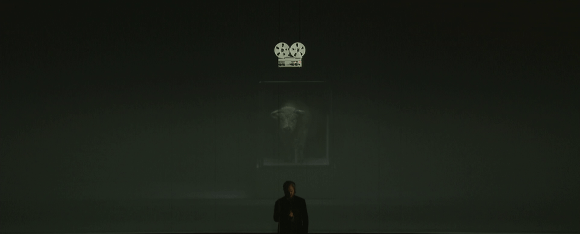
The Killing Flower is an opera by Salvatore Sciarrino. Both Italian and English versions exist and it was the latter that was given, in semistaged form, at Walter Hall as part of the Toronto New Music Festival last night. It’s a very distinctive work and not easy to form a full appreciation of on a single hearing. The plot is straightforward enough. There’s a duke and duchess. She falls in love with a guest. They are betrayed by a servant. He kills the guest and then her. But all this happens in a highly abstracted way (made even more abstract by not being fully staged). As the composer puts it:
My theatre is ‘post cinema’ theatre, beginning with the way the scenes are laid out – they proceed by dry blocks that ‘subtract’ in order to get the point across.
Got that? Nor me but what I saw was a succession of scenes in which two characters exchanged fragments of text repeated multiple times. This was actually quite useful as there were no surtitles and it made it easier to grasp what the (very few) words actually were.