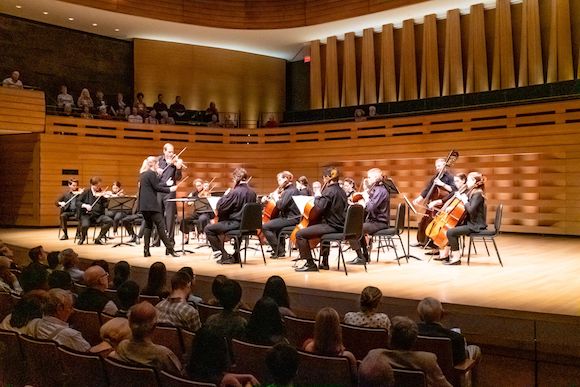
Last night’s final Koerner Hall event in Toronto Summer Music started off with Mozart’s Violin Concerto No. 5 in A Major. It’s a tuneful, well constructed piece which in places riffs off Romany music, hence its nickname “Turkish”. Jonathan Crow was the soloist with a small orchestra drawn from all the area’s major orchestras plus TSM Fellows. Gemma New conducted. It was very satisfying. The orchestra was excellent and the interplay between solist and orchestra worked very well. It’s quite a demanding piece for the soloist and I really enjoyed the sound that Jonathan produced. He plays an instrument with a rather distinctive timbre which worked well here. I’m curious about the first movement cadenza. I don’t know the work well enough to knoew what the options are but this one was very virtuosic though sounding distinctly post-Mozartian.


 It’s been rumoured for weeks but now it’s confirmed. Alexander Neef will leave the COC at the end of the 2020/21 season to head up L’Opéra de Paris. I don’t think anybody should be surprised. He’s a relatively young guy with a lot of working years ahead of him. He’s been in Toronto eleven years. It’s probably for the best for everybody that he moves onwards and upwards. Toronto will miss him. He’s been, in my view, a force for good here but, realistically, could he have continued to be transformational? I doubt anybody could. Has he solved, or would he solved, all the challenges facing the COC? No he hasn’t. Would anybody have done better? I doubt it.
 I swear this image is the most random opera related thing that has dropped into my lap in an age.
 As regular readers know I review a fair number of video recordings of opera on DVD and Blu-ray. I know how I watch and listen to them but I know little about how readers experience them. I think it might be useful to know a little more so that I can think about different segments of readers when I’m reviewing. To that end I’ve created a short survey on Survey Monkey. It should only take a couple of minutes to complete and I would appreciate it if you could take the time to do so. Assuming there’s a non embarrassing response I’ll summarize the results here in a couple of weeks time.