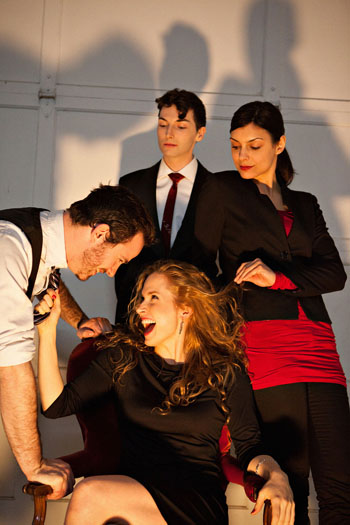
Last night I attended Soup Can Theatre’s double bill of Barber’s A Hand of Bridge followed by Jean-Paul Sartre’s No Exit; an English translation by Stuart Gilbert, of his 1944 play Huis Clos. The latter is a piece I’ve seen before and read in both English and French and I would never have imagined it could be presented as it was last night. It’s a play about three people who find themselves in a room in Hell together. They will be there for eternity, an eternal triangle I suppose, for they have been especially selected to get on each others’ nerves by continually reminding each character of that aspect of their former lives that they find least admirable. I have always seen it as an incredibly bleak play as befits one that premiered in Paris in the last months of the German occupation. I would never have imagined it as a comedy; albeit a dark one, but that’s what director Sarah Thorpe gave us. Continue reading
Category Archives: Performance review – miscellaneous
Smart and sexy Don Giovanni
Last night saw the first of two performances of Don Giovanni by the students of the Glenn Gould School at Koerner Hall. Koerner Hall isn’t the easiest venue to do fully staged opera since it is basically a concert hall with very limited lighting and stage facilities. Ashlie Corcoran and Camellia Coo pulled off perhaps the most inventive staging I have seen there by using a giant staircase to link the part of the gallery that wraps around the stage to the stage itself. Within this basic configuration they deployed a few bits and pieces of furniture, mostly couches. It made a very serviceable unit set for the various scenes. The production was set in the 1960s and seemed to revolve around the basic idea of Don Giovanni as a “chick magnet”. All the usual suspects are clearly attracted to him. There’s no hint of coercion in the opening scene with Donna Anna and Zerlina is a very willing seductee. The idea is reinforced in “Deh vieni” when, as Don Giovanni is serenading Donna Elvira’s maid, five or six women make their way to the staircase and down to the man himself.
Don Giovanni at Koerner Hall
Last night I saw the Glenn Gould School’s production of Don Giovanni at Koerner Hall. I’ll do a proper review later but for now let’s just say that the staging is the best use of the Koerner Hall space I’ve seen and that the production is witty, sexy and well sung. There’s only one more performance, on Friday night. Well worth seeing if you are in the Toronto area.
Kurtág and Janáček at the Extension Room
Against the Grain Theatre have another hit on their hands. Joel Ivany once again successfully combines young talent, unusual repertoire and a funky performance space to create a brilliant evening of song and story. This time the space was a yoga studio on Eastern Avenue and the works on offer were the Kafka-Fragments op. 24 by György Kurtág and The Diary of One Who Disappeared by Leoš Janáček. Neither work was written for the stage but both were well suited to Ivany’s sensitive direction and Michael Gianfrancesco’s minimalist “sets”. Continue reading
Death, the Universe and Everything
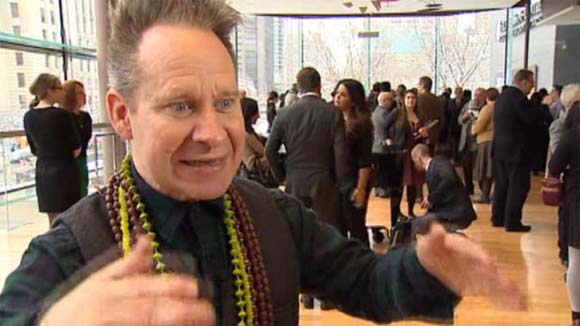
Last night Peter Sellars, in town directing Tristan und Isolde at the COC, made an appearance at the Toronto Reference Library. It was billed as an interview with The Star‘s Richard Ouzounian but bar a couple of questions at the end and a brief set up by Ouzounian it was pretty much a 75 minute monologue by Sellars. Like the man himself it was fascinating but very hard to pin down.
Fifty shades of Braun
This afternoon’s Off Centre concert at the Glenn Gould Studio was structured around three pairs of composer friends; Mozart/Haydn, Schumann/Brahms and Wolf/Mahler. It was a mix of lieder, opera excerpts and piano pieces and was pleasantly varied.
Things kicked off with Russell Braun singing a number of songs from Schumann’s Liederkreis accompanied by his partner, Carolyn Maule on the piano. This was maybe the third time that I’ve heard Russell in recital and he really is impressive. He has a really good command of a wide range of dynamics and tone colour and lovely floaty high notes. If I was being hyper critical I’d say I think there’s a point in the middle voice though that can’t quite sustain the volume he sometimes tries to get. He has quite an operatic approach to lieder (compared to, say, DFD) but that’s quite fun in its own way.
The Brothers Grimm hits 500
Dean Burry’s opera for children The Brothers Grimm had its 500th performance last night at the shiny new Ada Slaight Hall at the Daniels Spectrum in the revitalised Regent’s Park neighbourhood. It’s a work that premiered in 2001 and has been a staple of the COC Ensemble Studio School Tour ever since. It’s played an important role in developing young Canadian singers as performers as evidenced by the fact that the original cast brothers were Joseph Kaiser and David Pomeroy. 500 performances!
Feeding all the senses
Opera Five’s schtick is that they satisfy all five senses. In their current show that means matching a food offering with each of the three short operas on display. It’s a neat idea. In the current show a palindromic skewer of sausage, pickle and cheese is matched with the palindromic Hindemith work Hin und Zurück, assorted Russian pasty like objects are paired with Rachmaninov’s Aleko and some sort of chocolate on a stick thing with Milton Granger’s 1999 piece Talk Opera.
Fairest Isle
Toronto Masque Theatre’s latest effort is a Purcell show called Fairest Isle. It’s semi-staged performance of excerpts from Purcell works, mainly the four stage works; Dido and Aeneas, The Fairy Queen, The Indian Queen and King Arthur (Wot! No Diocletian you cry) interspersed with readings from the plays and a narrative about Purcell’s life performed by actors Derek Boyes and Arlene Mazerolle. The staging involves frequent short dance pieces, in a recognisably period style (heels, long skirts, arms never above the shoulder) by Marie-Nathalie Lacoursière. The six singers, costumed throughout in dark suits or dresses, mostly sang from music stands though some pieces were blocked. There was an eight piece ensemble; two violins (Larry Beckwith/Kathleen Kajioka), viola (Karen Moffat), two oboes (John Abberger/Gillian Howard), cello (Margaret Gay), lute/guitar (Lucas Harris) and keyboards (Christopher Bagan) directed by Beckwith. Continue reading
Cheap enough for beggars
Last night I went to see Essential Opera’s cheap and cheerful production of Brecht and Weill’s The Threepenny Opera. It was a semi staged production in the relatively small Heliconian Hall. Semi-staged in this case meant sung in costume from music stands with very basic blocking. Accompaniment was by Cathy Nosaty on piano and accordion which actually suited the music pretty well.
The singing was good, sometimes very good. Probably the stand out was Laura McAlpine’s Jenny. Of all the singers on display she was the one who seemed most immersed in the sound world of the piece and could vary style and technique appropriately. Erin Bardua’s Lucy Brown was really quite idiomatic too. The others were more consistently operatic which sounded a bit odd in places but worked surprisingly well in, for example David Roth and Heather Jewson’s rather refined refined and bourgeois Peachums. Obviously this approach also worked for the character who are usually sung operatically; Macheath, Brown and Polly for example. The ensembles were all also very effective.