Forge a magic bullet and your lifestyle will improve

There’s a lot to like in Opera Atelier’s current production of Weber’s Der Freischütz but also some things that are just plain puzzling.  I enjoyed it but certain aesthetic choices made no sense at all to me.

Let’s start with the good stuff.  The OA template was relaxed quite a bit, particularly in the dance department.  Allowing the women to dance in point shoes allowed for a degree of choreographic flexibility that was most welcome to me.  This, from a dance point of view, was the best OA production I have seen.  The singing, though stylistically inconsistent, was also uniformly excellent.  Meghan Lindsay’s Agathe was superb.  She had much the most dramatic voice on display and, to me, was the truest to the real sensibility of the piece.  Carla Huhtanen, as Aanchen, was also excellent though in such a different way that wondered whether they were in the same production.  Solid singing from the men too especially Krešimir Špicer as Max who was very stylish, if not especially heroic.  The design and lighting elements were also not too constrained by baroque considerations and worked pretty well.

Meghan Lindsay and Krešimir Špicer in Opera Atelier’s production of Der Freischütz (Bruce Zinger photo).

Continue reading →

Chasing an opera around the Gladstone

Theresa – Emily Atkinson

Last night we saw the preview of A Synonym for Love at the Gladstone Hotel.  The Gladstone has a long and eventful history. Nowadays it’s a boutique “artist” hotel which serves as a performance space and gallery for various indie projects like the one we saw.  The work itself is, I suppose, a pastiche.  The music is Handel’s long lost cantata Clori, Tirsi e Fileno.  It was written when Handel was 21 and isn’t maybe his greatest work but there’s a lot of really good music in it.  The libretto is an English text by Deborah Pearson that takes the basic idea of a love triangle and gives it a modern twist.  In Ms. Pearson’s story Clori, sung by soprano Traxy Smith Bessette, is a bisexual woman from Calgary in town for a fling with her male lover Phil (countertenor Scott Belluz) at, naturally, the Gladstone.  She is followed by her jealous long term partner Theresa (soprano Emily Atkinson).  Mayhem ensues.  There are also three non-singing roles who act as “guides” to the audience and participate in the drama as hotel employees.  Continue reading →

The Enslavement and Liberation of Oksana G.

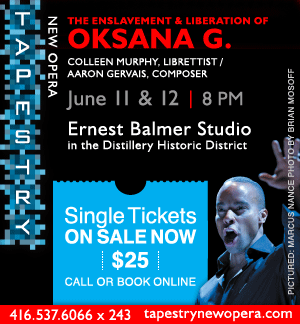
Last night saw the first of two workshop performances of Act 2 of The Enslavement and Liberation of Oksana G., a new full scale opera with music by Aaron Gervais and libretto by Colleen Murphy.  Act 1 was similarly workshopped last year.  It’s being produced by Tapestry New Opera in the Ernest Balmer Studio at The Distillery.  The second performance is tonight.

The piece is about sex trafficking.  Oksana is a Ukrainian girl tricked, raped and forced into an Italian  brothel controlled by Russian organized crime.  At the beginning of Act 2 she has escaped and is living at a refugee shelter run by a Canadian priest in Brindisi.  The story concerns her relationship with the priest, her desire to return to her family and her pimp’s determination to get his hands on her again.  It’s dramatic, emotionally charged and ends badly.  It’s neither overly melodramatic nor crushingly intellectual and it works very well as an opera libretto.  Somewhat oddly it’s written in four languages; English, Italian, Russian and Ukrainian, apparently for essentially “naturalistic” reasons.  I think the logic is off but it didn’t reduce my enjoyment of the piece. Continue reading →

Laura’s Cow

I had mixed feelings about attending something billed as a “children’s opera” but Laura’s Cow turned out to be quite a lot of fun. The piece was created for the Canadian Children’s Opera Company by composer Errol Gay and librettist Michael Patrick Albano.  It’s a 70 minute long, somewhat wry take on Laura Secord and the War of 1812.  It manages not to be too sentimental and pokes fun at the Tea Party, coyotes and Americans; which is a bit harsh on coyotes.  Writing for a children’s opera company obviously places some constraints on the composer.  There have to be simple choruses for the younger children.  There have to be not too demanding short solos for promising older singers and so on.  Within those limits Mr. Gay managed to create a score with quite a lot of musical interest especially in the orchestral writing.  The sets and stage direction were effective too especially given the logistics of handling a large cast in a fairly restricted stage area. Continue reading →

It is a curious story

Miriam Khalil

Last night was the first night of a four night run for Against the Grain Theatre‘s production of Britten’s The Turn of the Screw.  These are the folks who did La Bohème at the Tranzac and The Seven Deadly Sins in an art gallery.  Last night’s space was only marginally less unconventional.  We were in some upstairs space at the Helen Gardiner Phelan Playhouse reached via the back entrance and lots of stairs.  It was a sort of loft set up so that the performance space was a narrow strip bounded at each end by a door and at the sides by three banked rows of seats.  There was seating for maybe eighty people so it was intimate, even claustrophobic.  Add to the space a few simple props, lights and a fog machine and you have the raw materials for Joel Ivany’s production. Continue reading →

Amici Ensemble – Season close and new season announcement

Yesterday I attended the final concert of the 2011/12 season of the Amici Ensemble at the Glenn Gould Studio courtesy of Executive Director Lizzie Bowman.

It was my first time at the Glenn Gould and I was impressed by the space.  It’s pretty much ideal for chamber music.  They also have Glenn Gould’s childhood piano on display which is another addition to Toronto’s collection of secular relics.  There is a book or thesis at least in that topic.

The concert was a varied mix of pieces from the first third of the 20th century.  That’s pretty much a sweet spot for me as it’s pretty much where I discovered classical music.  My first classical LP purchase was of the Janáček string quartets.  Some of the music I was very familiar with.  Some was quite unknown to me.  Also, the ensemble was different for each piece.  It made for an interesting afternoon.  Continue reading →

Cavalli’s La Calisto

Last night was the first performance of this year’s production by the Glenn Gould Opera School at the Royal Conservatory.; the piece being Cavalli’s 1651 work La Calisto.  It’s one of those mythologically based pieces with a rather convoluted plot.  It starts with a prologue where various allegorical figures explain why Calisto, a nymph, should be immortalised as a constellation and then we flashback to the main action.  Jove (natch) fancies Calisto who is a chaste (and chased) devotee of the virgin huntress Diana.  With the help of Mercury Jove disguises himself as Diana and seduces Calisto.  This makes Diana and Juno (inevitably) very unhappy and Calisto is turned into a bear by the Furies though Jove reassures her that she will end up as a star.  Meanwhile there’s also sorts of stuff going on with Diana and a shepherd, Pan, assorted nymphs and a satyr.  Various permutations of women playing men pretending to be women etc allow for all sorts of broad sexual humour plus goat on goat action.  So it’s an odd blend of serious classical myth and pastoral farce that  works better when it doesn’t try to be too intellectual.

Continue reading →

Against the Grain’s Seven Deadly Sins

Last night we headed out to that part of the formerly industrial west end much beloved by tiny arts organizations to see a thoroughly eclectic series of performances by Against the Grain Theatre. This is the company that previously brought us a genuinely Bohemian La Bohème at the Tranzac club. Last night’s show cunningly built on that success by using the undoubted crowd pleaser, Lindsay Boa-Sutherland, to headline a performance of Weill’s Die sieben Todsüngen. Since the orchestra was replaced by two superbly virtuosic pianists in Daniel Pesca and AtG music director Christopher Mokrzewski it made sense to include two fiendish pieces for two pianos; Steve Reich’s Piano Phase and John Adams’ Hallelujah Junction. The program was balanced up for “virtue” with Britten’s Abraham and Isaac. So, a thoroughly eclectic but oddly coherent line up.

Continue reading →

Terry Gilliam’s The Damnation of Faust

Last Friday the BBC broadcast the English National Opera production of Berlioz’ The Damnation of Faust directed by former Python Terry Gilliam. This was filmed back in May at the Coliseum and got positive to glowing reviews for its visual inventiveness. So how well did it come over as a TV broadcast?

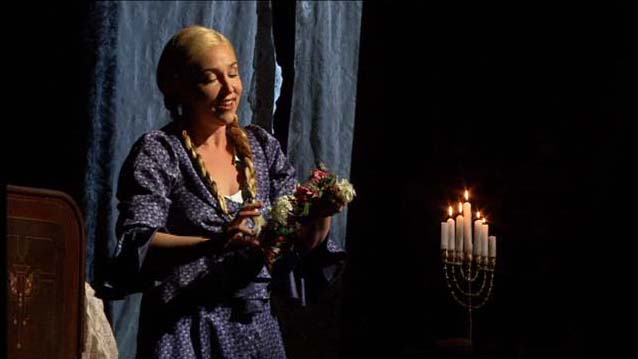
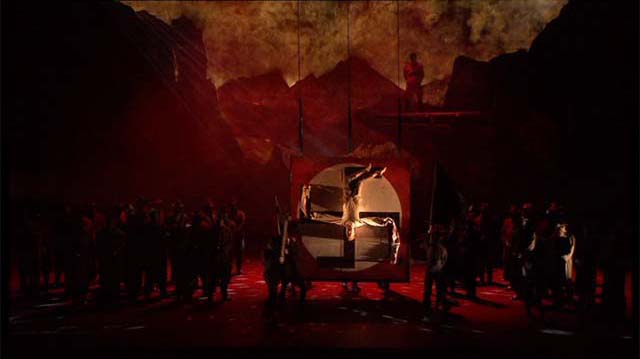
The bottom line is “probably less well than in the theatre”. Gilliam’s approach to staging this almost unstageable “opera” is to treat us to a visual romp through German history from the late 19th century through WW1 to Auschwitz and in between we get lots of Nazis and Jews. There is heavy use of projection, film and special effects and one imagines it must have been incredibly spectacular in the theatre. Unfortunately much of this is lost in the filming for TV. There are certainly some arresting moments but not enough to keep one locked into the action and the director’s vision. And, once when starts to ‘lose the plot’ the more inconsistent and incongruous much of it seems. It doesn’t help that there are long passages where the orchestra is playing and action is going on on stage and it all feels a bit more like a movie soundtrack than an opera. Also, of course it being the ENO, it’s in English. The broadcast subtitled the chorus but not the soloists which was a bit odd and certainly made things harder to follow. The biggest dramatic problem I had was with the treatment of Marguerite. She’s Jewish but seems to have a serious “Aryan wannabee” complex. There’s a bizarre scene where she comes home, lights a menorah, puts on a blonde, pigtailed wig and swoons over a giant poster of a ideally beautiful Hitler Youth on the wall of the building opposite. She then takes Faust, who looks more like George Bernard Shaw on an off day, as her lover, apparently as some sort of substitute. Marguerite is then carted off to Auschwitz and death but there’s no sin here. She’s killed because she’s Jewish along with hordes of others. So there is nothing to redeem which makes the final scene really weird. Marguerite ascends to (Christian) heaven to words that are overtly Christian sung by a chorus of gassed Jewish corpses. So spectacular but a bit incoherent and on TV the incoherence tends to overwhelm the spectacular. I really would pay to see this in the theatre though.

Pretty good performances on the whole. Peter Hoare is Faust and he is convincing though somewhat overchallenged by some of his higher passages. Christopher Purves is near perfect as Mephistopheles (though surely the Prince of Darkness would not be caught wearing a clip-on tie!). He’s sardonic, funny and vocally and dramatically assured. Christine Rice is vocally excellent and does her best with the odd Marguerite she has to project. I wish Edward Gardner in the pit had managed a bit more drama in the orchestral passages. With Nazis on stage executing Communists, smashing Jewish shops and staging the odd Nuremberg rally it was far too easy to forget there was any music going on.

Here’s Marguerite with her pigtails and menorah

And, to emphasise the subtlety of it all, here’s Faust crucified on a swastika with Adolph going nuts in the background.


Svadba-Wedding

Last night was the world premiere of Montreal composer Ana Sokolovic’s Svadba-Wedding performed by Queen of Puddings Music Theatre at the Berkeley Street Theatre. The 400 or so seat theatre was packed and I had the splendid company of lemurcatta and sabotabby.

Svadba is an interesting work. I guess one can call it an opera. It lasts about an hour and is sung a cappella in Serbian by six singers. The seven scenes take place the night before Milica’s wedding as her best friends prepare her. There isn’t really a linear narrative but the scenes do unfold with a certain coherence. Similarly, although all the characters are named, only the bride to be Milica has any definable identity. The other five sing mostly ensemble and to someone who hasn’t seen the score seem essentially interchangeable.

The music draws on Serbian folk motifs but also has a lot of play with pure sound elements. That much it had in common with the other Sokolovic piece I’ve seen which was a short opera about mobile telephones. It’s not the sort of music one comes away humming but it is quite accessible and very interesting

The production, by Dairine Ni Mheadhra and John Hess, was quite spare but effective. Fabric drapes at the back of the stage are lit for various effects, a flexible piece of mirror serves multiple roles , most notably as Milica’s bath, and long strios of translucent material unroll to represent water. On occasion some Klieg lights make an onstage appearance and there is a ladder that serves as a sort of throne for Milica in the final scene. It’s all quite unfussy and interesting.

The highlight of the show though is the performers themselves. We got to see and hear six of Toronto’s best young singers and they were excellent. Jacqueline Woodley sang Milica and was wonderful. She seems to improve every time I hear her sing. The “friends” consisted of sopranos Laura Albino (last seen as Mimi at the Tranzac), Carla Huhtanen and Shannon Mercer with mezzos Andrea Ludwig and Krisztina Szabo. The nature of the piece makes it impossible to single out individual performances. What we got was crisp, rapid fire ensemble work covering some pretty challenging material nicely held together by Dairine Ni Mheadhra who conducted.

All in all, it’s a really good piece beautifully performed. It runs until July 2 and there five more performances.