Cavalli’s La Calisto

Last night was the first performance of this year’s production by the Glenn Gould Opera School at the Royal Conservatory.; the piece being Cavalli’s 1651 work La Calisto.  It’s one of those mythologically based pieces with a rather convoluted plot.  It starts with a prologue where various allegorical figures explain why Calisto, a nymph, should be immortalised as a constellation and then we flashback to the main action.  Jove (natch) fancies Calisto who is a chaste (and chased) devotee of the virgin huntress Diana.  With the help of Mercury Jove disguises himself as Diana and seduces Calisto.  This makes Diana and Juno (inevitably) very unhappy and Calisto is turned into a bear by the Furies though Jove reassures her that she will end up as a star.  Meanwhile there’s also sorts of stuff going on with Diana and a shepherd, Pan, assorted nymphs and a satyr.  Various permutations of women playing men pretending to be women etc allow for all sorts of broad sexual humour plus goat on goat action.  So it’s an odd blend of serious classical myth and pastoral farce that  works better when it doesn’t try to be too intellectual.

Continue reading

Against the Grain’s Seven Deadly Sins

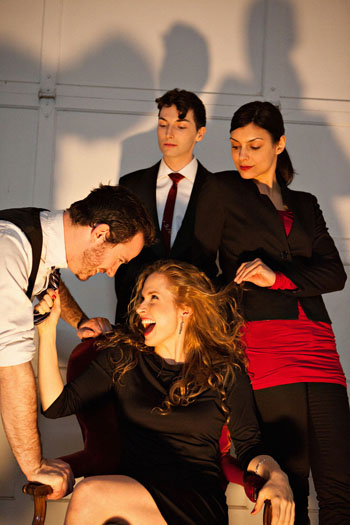
Last night we headed out to that part of the formerly industrial west end much beloved by tiny arts organizations to see a thoroughly eclectic series of performances by Against the Grain Theatre. This is the company that previously brought us a genuinely Bohemian La Bohème at the Tranzac club. Last night’s show cunningly built on that success by using the undoubted crowd pleaser, Lindsay Boa-Sutherland, to headline a performance of Weill’s Die sieben Todsüngen. Since the orchestra was replaced by two superbly virtuosic pianists in Daniel Pesca and AtG music director Christopher Mokrzewski it made sense to include two fiendish pieces for two pianos; Steve Reich’s Piano Phase and John Adams’ Hallelujah Junction. The program was balanced up for “virtue” with Britten’s Abraham and Isaac. So, a thoroughly eclectic but oddly coherent line up.

Continue reading

Terry Gilliam’s The Damnation of Faust

Last Friday the BBC broadcast the English National Opera production of Berlioz’ The Damnation of Faust directed by former Python Terry Gilliam. This was filmed back in May at the Coliseum and got positive to glowing reviews for its visual inventiveness. So how well did it come over as a TV broadcast?

The bottom line is “probably less well than in the theatre”. Gilliam’s approach to staging this almost unstageable “opera” is to treat us to a visual romp through German history from the late 19th century through WW1 to Auschwitz and in between we get lots of Nazis and Jews. There is heavy use of projection, film and special effects and one imagines it must have been incredibly spectacular in the theatre. Unfortunately much of this is lost in the filming for TV. There are certainly some arresting moments but not enough to keep one locked into the action and the director’s vision. And, once when starts to ‘lose the plot’ the more inconsistent and incongruous much of it seems. It doesn’t help that there are long passages where the orchestra is playing and action is going on on stage and it all feels a bit more like a movie soundtrack than an opera. Also, of course it being the ENO, it’s in English. The broadcast subtitled the chorus but not the soloists which was a bit odd and certainly made things harder to follow. The biggest dramatic problem I had was with the treatment of Marguerite. She’s Jewish but seems to have a serious “Aryan wannabee” complex. There’s a bizarre scene where she comes home, lights a menorah, puts on a blonde, pigtailed wig and swoons over a giant poster of a ideally beautiful Hitler Youth on the wall of the building opposite. She then takes Faust, who looks more like George Bernard Shaw on an off day, as her lover, apparently as some sort of substitute. Marguerite is then carted off to Auschwitz and death but there’s no sin here. She’s killed because she’s Jewish along with hordes of others. So there is nothing to redeem which makes the final scene really weird. Marguerite ascends to (Christian) heaven to words that are overtly Christian sung by a chorus of gassed Jewish corpses. So spectacular but a bit incoherent and on TV the incoherence tends to overwhelm the spectacular. I really would pay to see this in the theatre though.

Pretty good performances on the whole. Peter Hoare is Faust and he is convincing though somewhat overchallenged by some of his higher passages. Christopher Purves is near perfect as Mephistopheles (though surely the Prince of Darkness would not be caught wearing a clip-on tie!). He’s sardonic, funny and vocally and dramatically assured. Christine Rice is vocally excellent and does her best with the odd Marguerite she has to project. I wish Edward Gardner in the pit had managed a bit more drama in the orchestral passages. With Nazis on stage executing Communists, smashing Jewish shops and staging the odd Nuremberg rally it was far too easy to forget there was any music going on.

Here’s Marguerite with her pigtails and menorah

And, to emphasise the subtlety of it all, here’s Faust crucified on a swastika with Adolph going nuts in the background.


Svadba-Wedding

Last night was the world premiere of Montreal composer Ana Sokolovic’s Svadba-Wedding performed by Queen of Puddings Music Theatre at the Berkeley Street Theatre. The 400 or so seat theatre was packed and I had the splendid company of lemurcatta and sabotabby.

Svadba is an interesting work. I guess one can call it an opera. It lasts about an hour and is sung a cappella in Serbian by six singers. The seven scenes take place the night before Milica’s wedding as her best friends prepare her. There isn’t really a linear narrative but the scenes do unfold with a certain coherence. Similarly, although all the characters are named, only the bride to be Milica has any definable identity. The other five sing mostly ensemble and to someone who hasn’t seen the score seem essentially interchangeable.

The music draws on Serbian folk motifs but also has a lot of play with pure sound elements. That much it had in common with the other Sokolovic piece I’ve seen which was a short opera about mobile telephones. It’s not the sort of music one comes away humming but it is quite accessible and very interesting

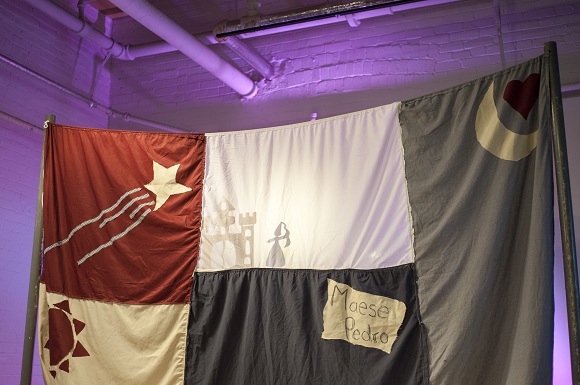
The production, by Dairine Ni Mheadhra and John Hess, was quite spare but effective. Fabric drapes at the back of the stage are lit for various effects, a flexible piece of mirror serves multiple roles , most notably as Milica’s bath, and long strios of translucent material unroll to represent water. On occasion some Klieg lights make an onstage appearance and there is a ladder that serves as a sort of throne for Milica in the final scene. It’s all quite unfussy and interesting.

The highlight of the show though is the performers themselves. We got to see and hear six of Toronto’s best young singers and they were excellent. Jacqueline Woodley sang Milica and was wonderful. She seems to improve every time I hear her sing. The “friends” consisted of sopranos Laura Albino (last seen as Mimi at the Tranzac), Carla Huhtanen and Shannon Mercer with mezzos Andrea Ludwig and Krisztina Szabo. The nature of the piece makes it impossible to single out individual performances. What we got was crisp, rapid fire ensemble work covering some pretty challenging material nicely held together by Dairine Ni Mheadhra who conducted.

All in all, it’s a really good piece beautifully performed. It runs until July 2 and there five more performances.

Against the Grain’s Bohème

Last night we were as far removed from the elegant sophistication of the Four Seasons Centre as one can get. We were in the back room of the Tranzac for Against the Grain Theatre Company’s updated, Toronto version of Puccini’s much played La Bohème. The Tranzac is a club. It’s quite scruffy and for many years the Nomads hung out there. I have spent many a riotous evening there involving beer slides and too much booze. It also hosts music events; mostly folk and jazz. Last night’s show was in the big room at the back which, set up with tables as it was, holds maybe a hundred or so people. The bar was open throughout. The beer selection has improved markedly since I was last at the Tranzac with a good range of products from McAuslan’s and Mill Street.

Against the Grain is a newly formed company of youngish performers. Many of them are products of the COC’s Ensemble Studio. This was not an amateur show! What we got was a somewhat abridged version of La Bohème in a new English translation by Joel Ivany (who also directed) adapted to include the translation in place and time to contemporary Toronto sung with piano accompaniment and staged in and around the audience. The piece opens with Rudolfo and Marcello squatting at the Tranzac where, the libretto informs us, it is “fucking cold”. It rolls on from there in a similar vein and it’s very effective.

The singing was excellent. Adam Luther sang Rudolfo and showed that it was well within his compass, high notes and all. Laura Albino sang a serious Mimi capable of great and beautiful passion in her set pieces. Opera turned cabaret singer Lindsay Sutherland Boal was a thoroughly engaging Musetta. She pretty much stole the show in Act II when she worked the room in black corset and tight pants during her big aria. Christopher Mokrzewski was at the piano throughout and did a fine job.

All in all it was an enjoyable and worthwhile evening without the rather jarring aspect of displaying grinding poverty to the rich in their opera house finery. I really like that alongside the increasingly excellent offerings from the COC Toronto can offer opera in settings like the Tranzac.

There are two more performances; tonight and tomorrow.

A horse goes into a bar

Yesterday lemur_catta and I flogged out to the wastelands of North York to watch Carmen in 3D at the Empress Walk multiplex. It was a very different experience from a crowded Theatre 1 at the Scotiabank for the Met HD broadcasts as there were only about 20 people in the theatre. This is understandable enough as this one wasn’t live and is playing twice per day for a week.

The performance was recorded earlier this season at the Royal Opera House. It’s the Zambello production that was released on DVD and BluRay by Opus Arte with Anna-Catharina Antonacci and Jonas Kaufmann in the leading roles. This recording uses a much younger and less well known cast. Christine Rice plays Carmen, Bryan Hymel is Don Jose, Maija Kovalevska sings Micaela and Aris Argiris is Escamillo. The conductor is Constantinos Carydis. So, very much a repertoire revival cast and thus perhaps an odd choice for a high risk venture such as ROH’s first foray into 3D but see general comments about opera films below.

The production is very conventional; period costumes, animals (including a horse in a bar) and so on but it’s directed in some detail and by no means a repertoire “park and bark” performance. It’s fine if unexceptional. So what does 3D do for it? When it’s used with restraint it definitely adds a sense of depth. It’s never “realistic” as it gives more depth than would ever get sitting in the house. Even up in the nosebleeds there is more foreshortening than in the broadcast. The real trouble is it isn’t used with restraint. Give an opera video director a gimmick and they will go nuts. They are bad enough without gimmicks. We had acrobats tumbling into the audience, confetti apparently falling on the first few rows of the stalls and, weirdest of all, close up disembodied head, or head and torso, shots of singers apparently floating over the orchestra pit. This peaked during Micaela’s final aria where she got a sort of Joan of Arc like treatment made weirder by the fact that as they faded back to a more realistic shot there was “real” Micaela clearly on stage and “radiant” Micaela floating around in the ether in front of her. The technology also seems to cause a few focus problems in unexpected places. In contrast to the visual exaggerations the sound stage was quite flat. It might almost have been a good stereo recording from the 1960s and it was much more restrained than the close miking used in the MetHD broadcasts. I think that’s a plus but it was somewhat at odds with the visuals. There was generally less distortion than on recent Met shows too. I’m not sure whether that’s a function of the theatre or the recording or the fact that Carmen isn’t an especially noisy opera.

So with the usual caveats about reviewing singing on a recording here are my thoughts on the performances. Christine Rice was very good indeed. She is a genuine mezzo which I think is preferable in this role and she sang with a lot of passion. She also has the looks and the acting ability for the role. There were definite echoes of Maria Ewing there. Bryan Hymel was fine as Don Jose. He is very much a lyric rather than a dramatic tenor so musically it was quite different from hearing Kaufmann in the role but quite appropriate. He, too, acted well and looked the part. Chemistry between the two was pretty good though not perhaps as smoky as Kaufmann and Antonacci. Maija Kovalevska made a very appealing Micaela. She manages to look and sound like a young girl which few singers in the role manage. She sang sweetly and accurately and it made for an interesting dramatic point. This Micaela is no match at all for Carmen as a woman, as an object of desire (though she is certainly pretty). She really does represent the respectable life that Don Jose rejects. She’s totally believable as the little girl from the village that his mother wants him to marry. That’s an aspect of the plot that rather gets lost with a more obviously mature Micaela. Watching parts of the Antonacci version again points this up. A soprano Carmen opposite a more mature and powerful Micaela (Norah Amsellem) doesn’t have nearly the dramatic contrast. The one disappointment in the casting was Aris Argyris’ Escamillo. He sings well enough but there’s no swagger. He just doesn’t convince as the toreador who Carmen falls head over heels in love with. Ildebrando d’Arcangelo on disk shows how it should be done! Orchestra and chorus and the minor roles were all fine. Overall, I’d say it was a good but not a great Carmen. There are better versions available on disk (Ewing for example or Garanca (my review of the HD broadcast) if you buy into the “Carmen in love with Death” vibe of that production) but it’s worth seeing or, of course, the Antonacci/Kaufmann version of this production.

So, another opera house gets on the cinema bandwagon with “3D” rather than “Live in HD” as the USP. What are they trying to do and are they succeeding? Is it supposed to increase the audience for live opera? Is it just an additional revenue stream? I don’t think there is any evidence that the former is happening and we are told that the Met is just now breaking even (in season 5) on its broadcasts. No consumer goods company would willingly launch a product that took five years to reach break even. I don’t think they know what they are trying to achieve. They seem to me to be like IT firms who have management consulting arms and can’t make up their minds whether they are a profit centre or a loss leader for integration work. Strategic clarity is rare!

This lack of clarity has practical consequences. If the aim is to bring more people into the theatre then, clearly, the product should represent the live experience as faithfully as possible. Close ups of the principals’ tonsils are only going to mislead the person who does show up to the opera house and is looking at the stage from the Upper Circle. The sound values too are going to create a false impression of what an opera house sounds like. Anyone who has been following my reviews of opera in cinemas will know what I think they need to do; faff about less and give us more of a “best seat in the house” view of the show. One wonders in fact whether opera company GMs bother to check out what their product looks and sounds like in a movie theatre.

Conversely, if the product is a stand alone film for a new audience I don’t really see the need to record live productions. There have been plenty of films of operas and they have used a variety of “tricks”. One can film on location (and have the singers recorded in the studio and lip synched too if one like). One can use actors who look the part and dub in the voices. One can use singers who are visually the part but too lightweight for the role in the opera house. All of these things have been done more or less successfully in the past. Perhaps, ultimately, the big thing about just documenting a live performance is that relatively little extra expense is involved.

I guess, bottom line, I’m not totally convinced by the whole “opera in cinema” thing. I think it could be very good if they put the video directors on a tighter leash but right now I think one is better off going to see a live show, even if it’s a bunch of young enthusiasts with a few video projections in a disused warehouse. I’ve got at least as much pleasure and insight out of shows by Opera Erratica and the Royal Conservatory as out of 9/10 star studded, multi million dollar production broadcasts.

For reference, here’s the annoying Blu-ray trailer:

Anna Nicole

Last night I lasted about thirty minutes in to Mark-Anthony Turnage’s much hyped Anna Nicole. I quite liked the orchestral writing and Eva-Marie Westbroek was acting up a storm but in the end I just felt “meh”. Watching Tony Pappano’s doco on “fallen women” in opera that was meant to contextualize Anna Nicole I think I understand why. Turnage and his librettist are trying to do to “us” what Verdi did with La Traviata; challenge our hypocrisy at colluding in the creation of Anna-Nicole Smith while deploring her life. Doesn’t work for me. Until the opera came along I scarcely knew who she was. I hate the “cult of celebrity”. I despise everything about it and the people who feed off it so trying to guilt trip me over voyeuristic fascination in this particular specimen was doomed to fall flat. It did.

Also, not nearly so edgy as Turnage and company seem to think. The painfully fake Texas accents underlie what is, essentially, an assertion of British cultural superiority over the crass Americans. If the Royal Opera House wanted to make an opera about the cult of mindless celebrity and they had any balls they’d make it about the vacuity of Princess Diana and her family. Not much chance of that!

Le Docteur Miracle and L’Heure Espagnole

Last night lemur_catta and I braved the blizzard to see students from the Glenn Gould School and the Royal Conservatory Orchestra perform at Koerner Hall. The bill was two French one act comic operas; Bizet’s Le docteur Miracle and Ravel’s L’heure espagnole. Both have extremely silly plots but rather lovely music.

The Bizet piece concerns an officer who is in love with the mayor’s daughter (or maybe his wife, or maybe both. This is French opera) and wins her hand by disguising himself as “Docteur Miracle” and “curing” the mayor who thinks he has been poisoned by an omelette. The omelette gets a lot of air time. In last night’s version heavy use is made of three ballet dancers with omelette making headgear. I have no idea if this idea is original or in the libretto but it was very funny. It’s a pretty conventional early classical piece musically; arias for the soprano, tenor and baritone leads and a lot of ensemble numbers. The dialogue is spoken. It was generally well sung with the stand out being the daughter, a coloratura soprano part, played by Jennifer Taverner. The ensembles worked well except that the very young looking tenor, Zachary Finkelstein, was somewhat underpowered and tended to disappear. Solo, his voice was pleasant enough, if light. Pretty decent performances from baritone Maciej Bujnowicz and mezzo Danielle MacMillan as the mayor and his wife. Excellent work from the orchestra and conductor Uri Mayer.

After the interval we had the much more modern sounding L’heure espagnole by Ravel. In this piece the clockmaker’s wife takes advantage of her husband’s day out fixing the municipal clocks to find a lover. This is complicated by the arrival of a muleteer who needs his watch mending. She gets him out of the way by having him haul clock cases from the shop to her bedroom and back. At various points her two would be lovers; a dull grandee and a verbose poet are concealed in the clock cases and a lot of singing takes place through windows in the front of the clocks. Finally she decides that someone who can tirelessly haul loaded clock cases up and down stairs may have more of what she is after than the other two and takes the muleteer off to bed, sans clock. The work concludes with a quintet confirming that it is, indeed, the muleteer’s day. The work is heavier in tone; through sung and fewer set piece numbers. Bujnowica and Finkelstein appeared again as the lovers but the stars were the bluff, strong baritone of Todd Delaney as the muleteer and Leigh_Anne Martin’s strong soprano as Concepcion. It’s the sort of role that one could easily imagine Anna Netrebko singing and Martin managed the same sense of sly, sexy fun that Trebs brings to roles like Norina. Tenor Andrew Byerlay played the clockmaker. This is a much more musically complex work than the Bizet and uses a pretty large orchestra. I didn’t think the orchestral work was as crisp as in the Bizet but it was fine really.

Koerner Hall is a visually lovely venue with acoustics that help everyone. It’s really pleasant to hear and watch opera in a venue that size, 1100 seats, where every seat, pretty much, is a good one and the sound is excellent. All in all, a fun evening. I’m more and more convinced that I would rather see young artists having fun and really trying to put on a show than watch rather bored experienced professionals do their 200th performance of a work in a routine production in a big opera house. There’s another show on Friday night and decent seats are only $30 so think about it!

The COC crowd were out in force and I spotted Alexander Neef, Simone Osborne and Ambur Braid among others in the audience. One has to give credit to Mr. Neef. He spends a lot of time talent spotting young singers. I guess, given his background in casting in Paris, it’s not so surprising.

Der Rosenkavalier

Back in 1961 Paul Czinner decided to experiment with filming a live opera performance. He chose the 1961 Salzburg Festival production of Richard Strauss’ Der Rosenkavalier. I guess it got a theatrical release in the day then more or less disappeared, popping up up from time to time in a rather poor quality ‘Pan and Scan’ VHS version. Now it’s been digitally restored from a 35mm print and released on DVD and Blu-Ray by Kultur. It’s spectacular. It looks like early 1960s 35mm colour and it sounds like early 1960s analogue stereo. Very impressive. Like watching Il Gattopardo while listening to a recording by John Culshaw or Walter Legge.

1.bedroom Continue reading