
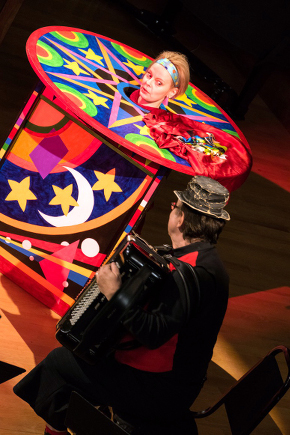
 A concert of contemporary works for accordion? Why not! Well it was more of a concert of contemporary works for fixed reed instruments with, ironically, Trinity St. Paul’s most impressive fixed reed instrument forming an unused but imposing backdrop to the proceedings. Things started off conventionally enough with Soundstreams’ Artistic Director Lawrence Cherney on stage with three players of different instruments describing their histories and properties and then mild Hell broke loose as a curiously clad Joseph Macerollo burst into the auditorium, ejected Lawrence and friends and launched into R. Murray Schafer’s performance piece La Testa d’Adriane; the tale of a head mystically preserved between life and death. At this point the purpose of the rather bizarre contraption on stage was unclear but soon enough the cloth was pulled back to reveal Carla Huhtanen, or her head at least. More accordion and speech from Macerollo and a bizarre collection of grunts, squeaks, shrieks and gurning from Carla followed. Madness or genius? It’s Schafer. The question is unanswerable.
Bring me the head of Carla Huhtanen
Reply
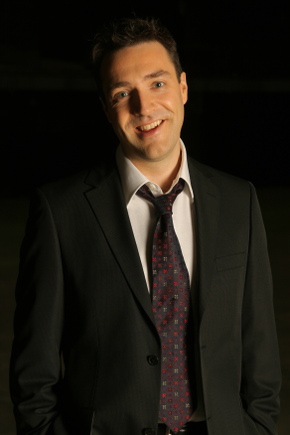 Most people in the Toronto opera world know Dean Burry principally as a composer of operas for children. He’s written several and a couple have been mainstays of COC school tours. It’s perhaps understandable then if his music is seen as approachable and maybe, even (sotto voce), a little unsophisticated. Last night, a recital of Dean’s works in Victoria College Chapel; part of his DMA program at UoT, provided a chance to hear a number of works in a much broader range of styles.
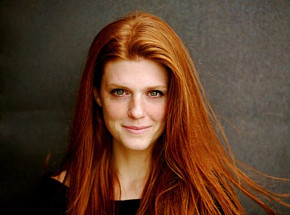 This concert was the culmination of several days of workshops involving Wallis Giunta, Jordan de Souza and eighteen emerging artists; both singers and pianists. It’s a comparatively unusual opportunity to focus on contemporary repertoire for a while and the results were fun. As usual with these multi-participant efforts I’m not going to attempt to be exhaustive but just concentrate on my personal highlights.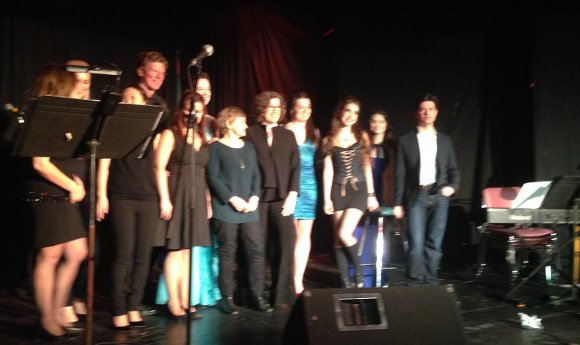
 The Glenn Gould School Vocal Showcase at Mazzoleni Hall last night was a chance to see twenty of the school’s singers in action. It was a curious mix actually; one bass, one baritone, a handful of tenors and mezzos and a lot of sopranos. There was a huge range of age and experience too from 18 year old first years to quite seasoned post-grads. As usual with these things I’m not going to attempt to be comprehensive but instead focus on the highlights as I saw them.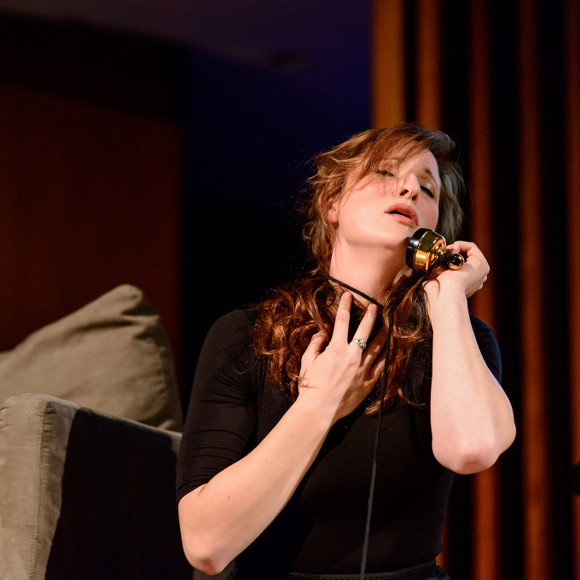
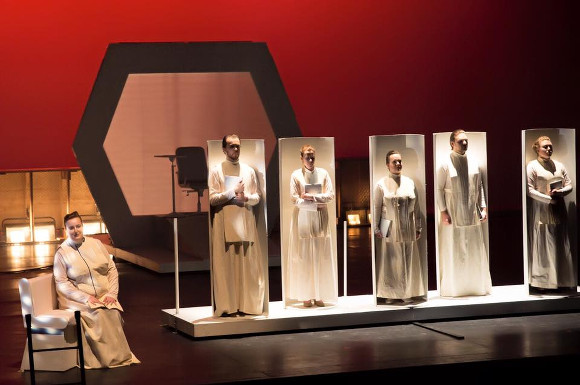
 FAWN Chamber Creative’s latest project is an opera called The Harvester. The libretto is adapted by Paul van Dyck from his own play of the same name and the music is by Aaron Gervais. The genesis (and we’ll come back to that) of the piece lies in the mind of soprano Stacie Dunlop who wanted a reduced orchestration version of Schoenberg’s Erwartung and a one acter that could be performed with the same band to form a double bill with it. Van Dyck’s play seemed to have the right stuff and Aaron was up for both parts of the project. Co-opting Kevin Mallon and his Aradia Ensemble and Amanda Smith to direct rounded out the project.
 I’ve spent a fair chunk of time this week following Barbara Hannigan’s stint as Stratton Visiting Artist in Music at the University of Toronto. I went to a lecture on Tuesday, a masterclass on Thursday and a concert yesterday. Twice already I have sat at the keyboard to try and document my impressions and failed miserably. It’s rare that I’m lost for words but Ms. Hannigan is really hard to describe. This time I shall apply myself with the sort of iron will that she exudes.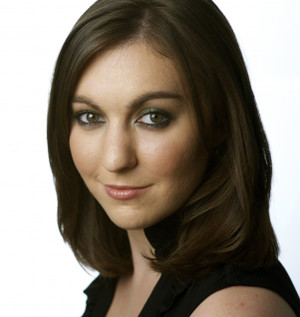
 operaramblings