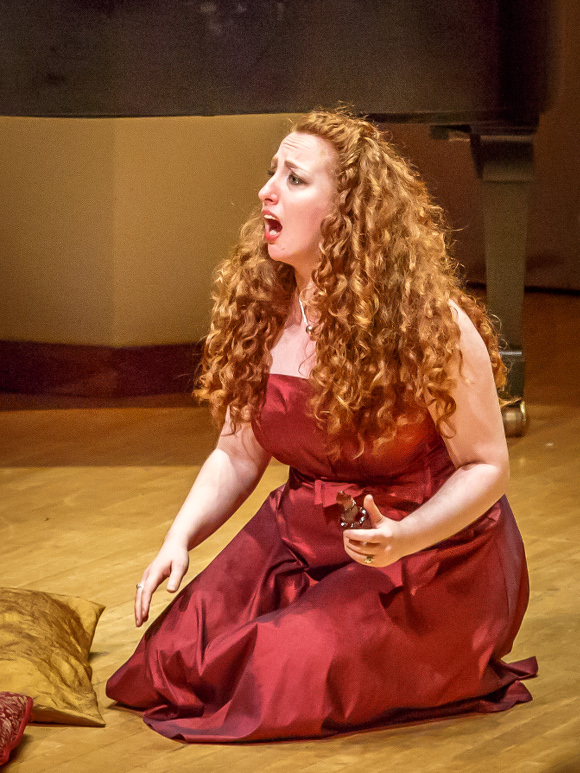
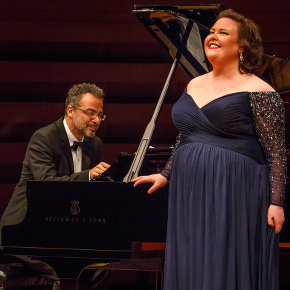
 American mezzo-soprano Jamie Barton, 2013 winner of Cardiff Singer of the Year, sang at Koerner Hall last night with veteran Bradley Moore at the piano. Her first set; Joaquin Turina’s Homenaje a Lope de Vega gave us a pretty good idea of the basic value proposition. She has a fantastic instrument. There is power to burn, a pleasing dark tone, accuracy and musicianship. She never sounded remotely strained even while pushing out a very impressive sound. The rest of her first half programme; Chausson’s Three Melodies and four of Schubert’s Goethe settings showed that there was more than just a big accurate voice. Basically, it’s all there. She can vary colours and scale vibrato up and down. There’s some agility. She can float quiet high notes and she can tell a story. Her diction was clear in all three languages. I would say at this point the only question mark I had was around her ability to engage the audience. If I were to judge by the very highest standards, and I’m think Bryn Terfel or Karita Mattila, there was something just the merest shade cold and technical. The second half would see whether she could, as it were , lighten up a bit.
Continue reading →

 Last night’s Soundstreams Koerner Hall presentation; Magic Flutes was an interesting experience. Aside from interesting (mostly) contemporary flute pieces it was very much an experiment in different ways of staging a concert. I’m all for breaking down the conventions of Mahlerian solemnity and I think experimentation is great. It’s in the nature of taking risks though that some things don’t quite work.
 Last night Christina Haldane gave her first DMA recital at Walter Hall. The inspiration was a painting by Manet and the programme was almost entirely made up of chansons from the late 19th and early 20th centuries; Offenbach, Charpentier, Duparc, Debussy and Berlioz. The exception was the cycle The Living Spectacle by Erik Ross which closed out the first half. I could have used more variation of mood and style.
 Evolving Symmetry is the first of a promised series of collaborations by soprano Adanya Dunn, clarinetist Brad Cherwin and pianist Alice Gi-Yong Hwang. The focus will be on “modern” chamber and vocal works (for some value of “modern”) and last night at Heliconian Hall they presented French works ranging from the 189os to the 1960s.