
 To the intimate (i.e. tiny) Array Space last night for a concert by the Happenstancers who, in this iteration, consisted of Brad Cherwin – clarinet, Madlen Breckbill – viola and Micah Behr – piano. and, in the first number, viola.
Part 1 of the programme was called Dream Images and was intended to evoke the discontinuous and illogical. It began with Du Yun’s dreams-bend for taped speech, two violas and clarinet as a sort of intro to the main event. This consisted of Schumann’s Fairy Tale Narrations and Kurtág’s Hommage à R. Schumann; these being two of the very few works for clarinet, viola and piano. Added to these was a new work; Abstractions by Nahre Sol. The pieces were played with the movements in the right order but with the composers mixed up so, for example, the first four movements went Kurtág, Sol, Schumann, Kurtág and so on. I like this approach. The styles contrast. The Kurtág is spikey and dissonant, the Schumann structured and Romantic and the Sol playful, tonal (mostly) and rhythmically varied. Listening to them interspersed somehow focusses attention on their particular qualities and has a kind of focus that the conventional way of doing things doesn’t.
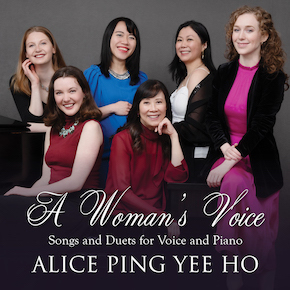 Confluence Concerts’ show last night at Heliconian Hall was titled A Woman’s Voice. It was, after a fashion, a CD release concert in two halves. The first half featured music by Alice Ping Yee Ho from the album A Woman’s Voice and featuring the same performers; Vania Chan, Katy Clark, Alex Hetherington, Maeve Palmer and Jialiang Zhu. I’ve already
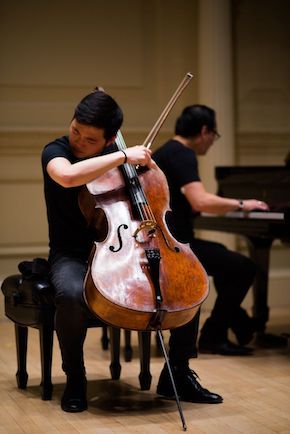 I found out quite late about OPUS Chamber Music and their current short concert series so I was only able to attend the last show on Sunday evening at Grace Church on-the-Hill. Pianist Kevin Ahfat is the driving force behind these concerts and he was able to marshal an impressive line up including recent Indianopolis Violin Competition gold medallist Serena Huang.
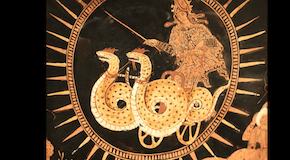 Cherubini’s Médée is a French opéra comique (i.e. with spoken dialogue) which premiered in March 1797. It’s based on Euripides by way of Corneille whose Médée of 1635 was written, as one might expect, in alexandrines. So its roots, and the work itself, are very much in the French classical tradition. The complication is that the work is much better known in its Italian version with sung recitatives (not authorised by Cherubini) and has developed as a “show off” vehicle for star sopranos; notably Maria Callas and, more recently, Sondra Radvanovsky. Along the way it’s lost a lot of its classicism and become almost verismo like. So I was intrigued to see how much Guillermo Silva-Marin, in presenting the work “in concert” at the St. Lawrence Centre, would try, and how much he would succeed, in reclaiming the Cherubini of a Paris tipping from revolution to Bonaparte.
 To 918 Bathurst last night to hear the Happenstancers’ latest offering Hypersuite. The concept was to take movements from Bach suites and partitas for solo instrument and combine them into sets with (mostly) contemporary music of like form. The one exception was some Telemann but we’ll come to that.
 The second set had a lot in common with it. Brad Cherwin on clarinet played Augusta R. Thomas’ d(i)agon(als) followed by the sarabande from Bach’s Partita BWV 1013 (usually played on flute). This segued into Telemann’s fantasie 8 played on English horn by Aleh Remezau. Completely different from the first set; more melodic and dance like, these three pieces also had much in common.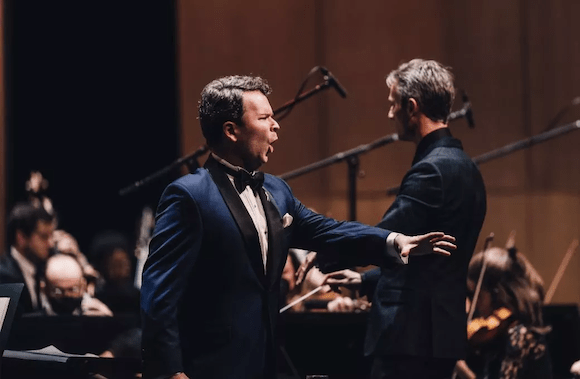
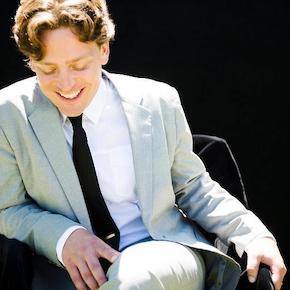 The 21C Afterhours concert in Temerty Theatre last night featured a candle lit performance by a varied ensemble of conservatory students conducted by Brian Current. Brian did a great job of introducing the music; contextualizing it and suggesting what the audience might listen for. That could maybe be done more often with complex contemporary music.
 operaramblings