OPUS II: Kaleidoscope

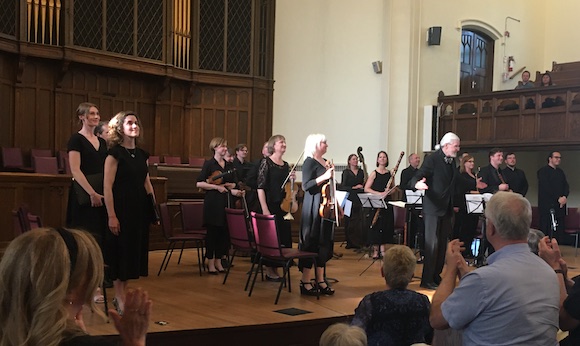
brannonchoI found out quite late about OPUS Chamber Music and their current short concert series so I was only able to attend the last show on Sunday evening at Grace Church on-the-Hill.  Pianist Kevin Ahfat is the driving force behind these concerts and he was able to marshal an impressive line up including recent Indianopolis Violin Competition gold medallist Serena Huang.

The first half of the programme was essentially French.  Brannon Cho joined Kevin for Poulenc’s Sonata for Cello and Piano.  It has a lively first movement with jazzy dance rhythms and lots of interaction between the players which showed excellent mutual understanding.  The second movement is more limpid and languorous and drew some rather elegantly beautiful sounds from both cello and piano.  The third movement is marked “Ballabile” which was new to me.  Apparently it refers to a dance by the corps de ballet.  I can see that.  It’s fast and intricate with lots of pizzicato from the cello.  The finale is almost like back to the beginning with more playful interaction between the instruments.  Lovely playing in both the livelier and the more lyrical passages with an appropriate sense of Frenchness. Continue reading

Médée

MédéeCherubini’s Médée is a French opéra comique (i.e. with spoken dialogue) which premiered in March 1797.  It’s based on Euripides by way of Corneille whose Médée of 1635 was written, as one might expect, in alexandrines.  So its roots, and the work itself, are very much in the French classical tradition.  The complication is that the work is much better known in its Italian version with sung recitatives (not authorised by Cherubini) and has developed as a “show off” vehicle for star sopranos; notably Maria Callas and, more recently, Sondra Radvanovsky.  Along the way it’s lost a lot of its classicism and become almost verismo like.  So I was intrigued to see how much Guillermo Silva-Marin, in presenting the work “in concert” at the St. Lawrence Centre, would try, and how much he would succeed, in reclaiming the Cherubini of a Paris tipping from revolution to Bonaparte.

Continue reading

Hypersuite

bachheadTo 918 Bathurst last night to hear the Happenstancers’ latest offering Hypersuite.  The concept was to take movements from Bach suites and partitas for solo instrument and combine them into sets with (mostly) contemporary music of like form.  The one exception was some Telemann but we’ll come to that.

So the first set consisted of cellist Sarah Gans playing Ana Sokolovic’s vez before a brief segue brought in Katya Poplanskaya on violin for the adagio from Bach’s Violin Sonata BWV 1005.  It’s really interesting as, although the Sokolovic piece uses a fair amount of extended technique there’s a definite sense that they belong to the same soundworld.  Both are spare and spiky and eschew anything that might conventionally be called melody.

textThe second set had a lot in common with it.  Brad Cherwin on clarinet played Augusta R. Thomas’ d(i)agon(als) followed by the sarabande from Bach’s Partita BWV 1013 (usually played on flute).  This segued into Telemann’s fantasie 8 played on English horn by Aleh Remezau.  Completely different from the first set; more melodic and dance like, these three pieces also had much in common.

The second half kicked off with The allemande from BWV 1013 on clarinet, followed by Sokolovic’s cinq danze, II on violin and the gigue from from BWV 1008 on cello.  Here there is more contrast with the Sokolovic exploring a more complex sound world though still with clear affinities to the Bach.  This was followed by Elliott Carter’s a 6 letter letter on English horn.  It’s a quite long and complex piece which clearly places serious physical demands on the player. Continue reading

Hymns to Night

bcurrentThe 21C Afterhours concert in Temerty Theatre last night featured a candle lit performance by a varied ensemble of conservatory students conducted by Brian Current.  Brian did a great job of introducing the music; contextualizing it and suggesting what the audience might listen for.  That could maybe be done more often with complex contemporary music.

The first piece was Bekah Simms’ Foreverdark.  It’s a ten minute concertino for amplified cello, ensemble and electronics playing homage to heavy metal.  It’s scored for a quite a large group including strings, brass, woodwinds and lots of percussion including a drum kit.  It starts out very abrasively then becomes somewhat more lyrical and the then the texture lightens up but it’s still pretty complex.  David Liam Roberts was the soloist and did an excellent job.

Continue reading

Silent Tears CD release

I went to the Toronto release concert for Payadora Tango Ensemble’s Silent Tears: The Last Yiddish Tango last night at Heliconian Hall.  Nearly all the music played was on the CD which I described in some detail here. There were a few “extras”.  There was a song from Lenka Lichtenberg’s new Album Thieves of Dreams.  There was also an upbeat Argentinian tango to finish which I was rather in need of.

payadora Continue reading

After the Fires

Lembit BeecherSaturday evening’s Cinq à SeptLiza Balkan for program book concert in the 21C Festival at the Royal Conservatory was intriguing.  The first half of the programme was a new song cycle, After the Fires, with words by Liza Balkan and music by Lembit Beecher.  It set seven pieces about the 2020 fires on the central California coast and their aftermath based on interviews with local residents.  It’s a really interesting piece scored for piano, clarinet, soprano, mezzo-soprano and baritone.  It’s very “text first”.  Although the accompaniment is often intricate it never overpowers the words and there’s a real harmony between words and music.  The mood varies but, given it’s about really awful events, it’s more elegiac and lyrical and even funny than angry or sad.  It got a fine, nuanced performance from Henry From (piano), Zachary Gassenheimer (clarinet), Xin Wang (soprano), Andrea Ludwig (mezzo-soprano) and Korin Thomas-Smith (baritone). Continue reading

Die Fledermaus revived at TOT

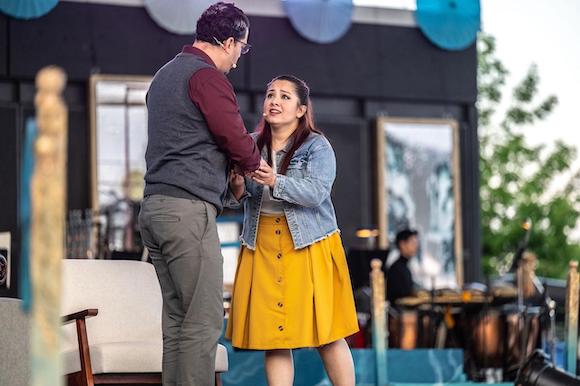
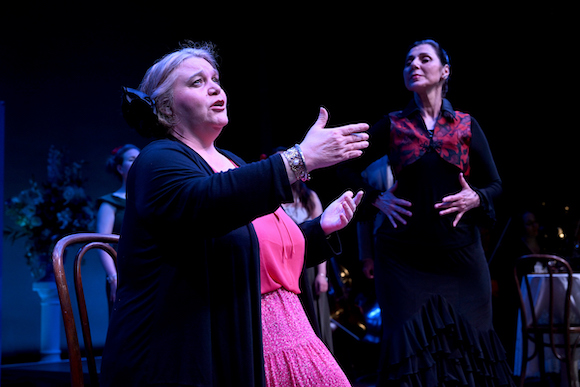
Toronto Operetta Theatre opened a run of Johann Strauss’ Die Fledermaus at the St. Lawrence Centre yesterday.  It’s a revival of their 2018 production and I don’t think my opinion of the production has really changed.  The jokes have been updated a bit; mostly to reflect the anticipated imprisonment of a certain former US president (I wish!).  But basically the schtick is the same.

Scott Rumble as Alfred, Kirsten LeBlanc as Rosalinda

Continue reading

Electric Messiah – 2022 edition

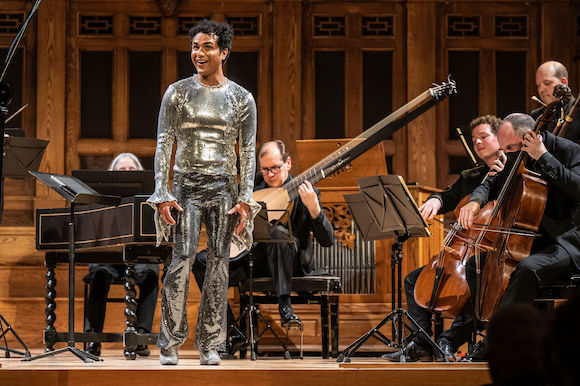
This was the seventh time I’ve seen Soundstream’s Electric Messiah.  It’s different every time of course but some things stay, more or less, as features.  The biggest change this year is the shift from the Drake Underground to Crow’s Theatre.  It’s staged as a conventional proscenium arch type show with the audience sitting in tiered rows facing the stage rather than being set up night club style.  There’s no bar in the actual performance space but you can still take a drink to your seat.  The drinks are cheaper than at the Drake too!

Electric Messiah

Continue reading