Last night saw the annual main stage performance by the COC’s young artist programme, the Ensemble Studio. This year it was Handel’s Semele in the production which I saw a couple of weeks ago. The main roles were cast from the Ensemble Studio with the the exception of the countertenor role of Athamas which was played by Ryan Belongie, an Adler Fellow. The title role was split with Mireille Asselin singing the first two acts and Ambur Braid coming in for the third act. This seemed like a sensible solution given the size of the role and the two singers’ strengths. Continue reading
Category Archives: Performance review – COC
Very satisfying double bill
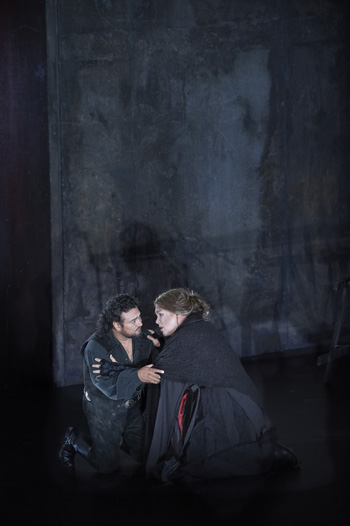
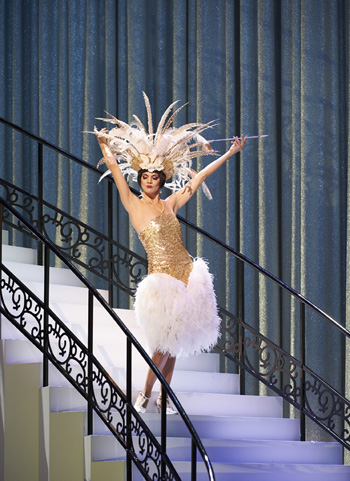
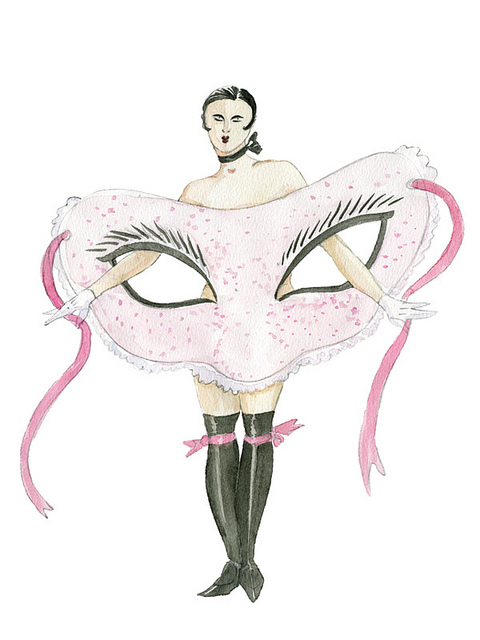
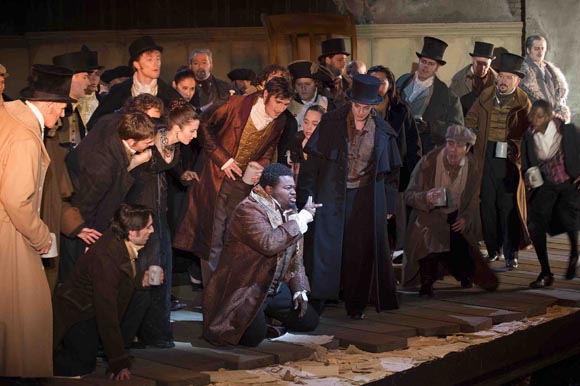
Last night I saw the Canadian Opera Company’s double bill of Zemlinsky’s A Florentine Tragedy and Puccini’s Gianni Schicchi. I had a pretty good idea what to expect having attended the dress rehearsal a couple of weeks ago. I said then that I thought that there was something in this show for everyone, even the most traditionalist, and I would still hold to that view if I hadn’t read the very silly review by Arthur Kaptainis in the National Post. Apparently there are people who can’t cope with a simple change of time setting and there are editors who let them write for real newspapers. It’s very puzzling. So let’s just say something for anyone with a smidgeon of imagination or dramatic instinct. Continue reading
Deconstructing Semele
When a director’s note in an opera programme contains in its first paragraph the following one has, I think, cause for concern.
there are very few people who understand opera, and even fewer artists who understand it. I too do not understand opera, but I like doing things out of the ordinary.
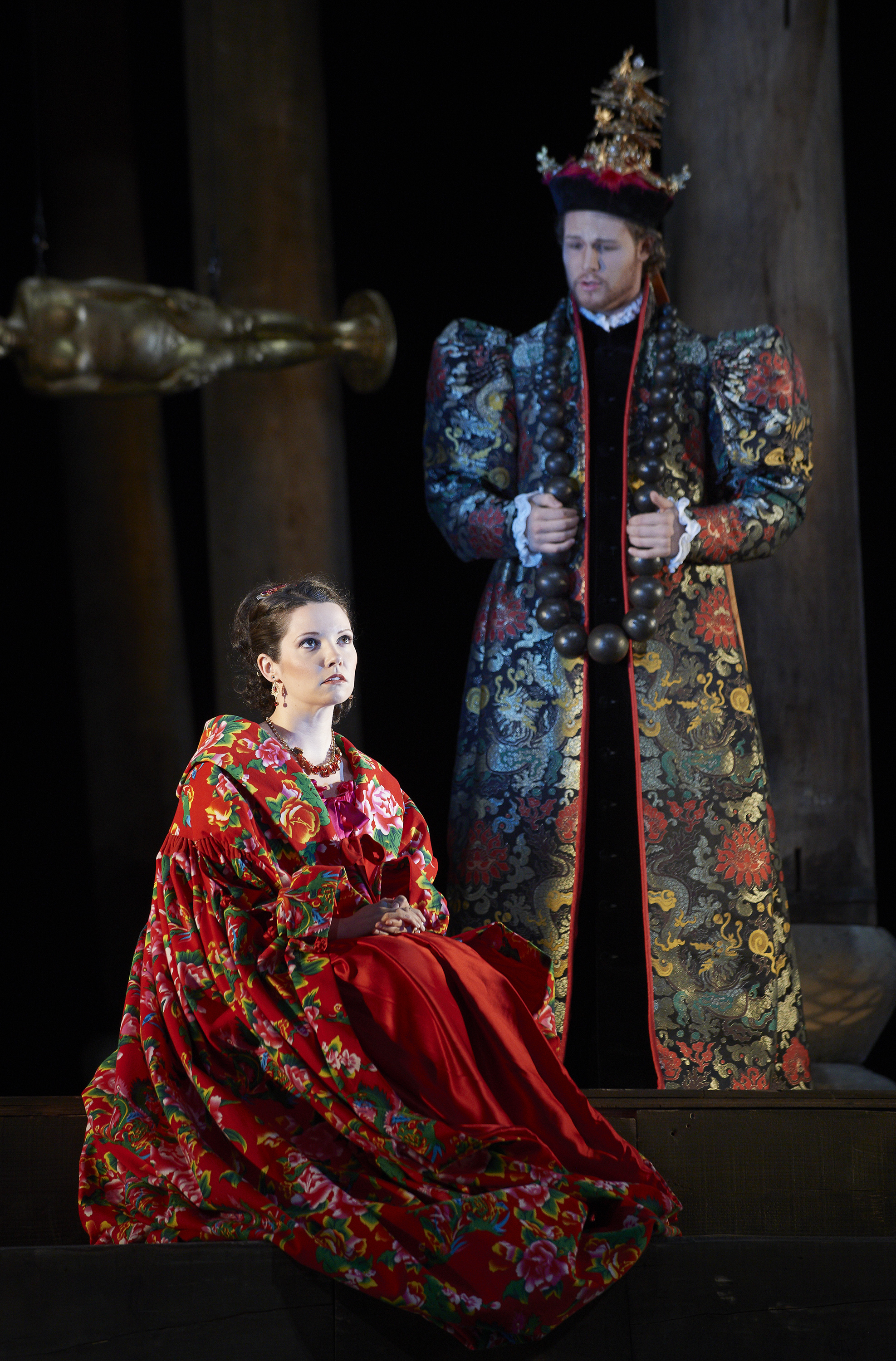
Zhang Huan’s production of Handel’s Semele for the Canadian Opera Company, first seen at the Théâtre Royale de la Monnaie in 2009, is certainly “out of the ordinary” but it doesn’t show much understanding of opera. Continue reading
Tales of Hoffmann at Canadian Opera Company
Last night saw the third performance in the current run of Offenbach’s Les Contes d’Hoffmann at the Canadian Opera Company.
It’s a peculiar work. It was Offenbach’s first and only foray into grand opera and he didn’t live to complete it. This leaves all sorts of performance issues regarding orchestration, sequence of the acts and spoken dialogue vs accompanied recitatives among others. The COC version uses the conventional act order; Olympia, Antonia, Giulietta, and recitatives with orchestral accompaniment which makes for a long night but is probably the best fit with director Lee Blakeley’s take on the piece, previously seen at Vlaamse Opera in 2000.
Kaija Saariaho’s L’Amour du Loin at Canadian Opera
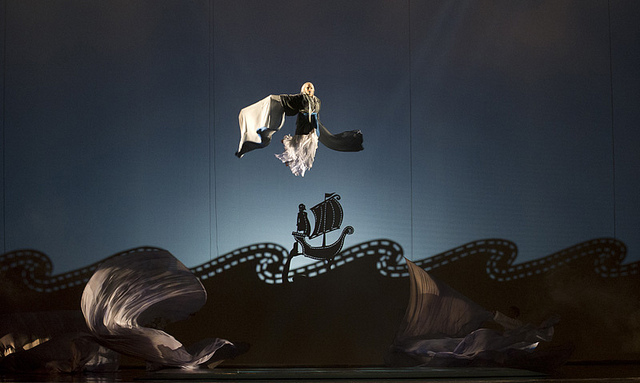
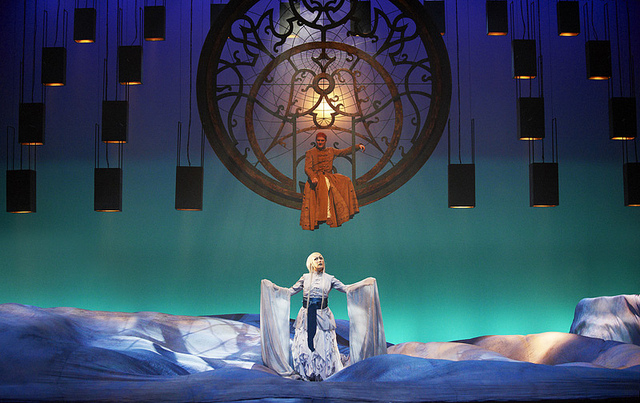
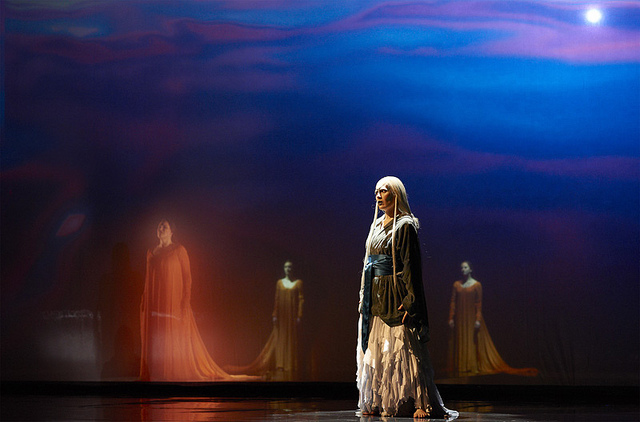
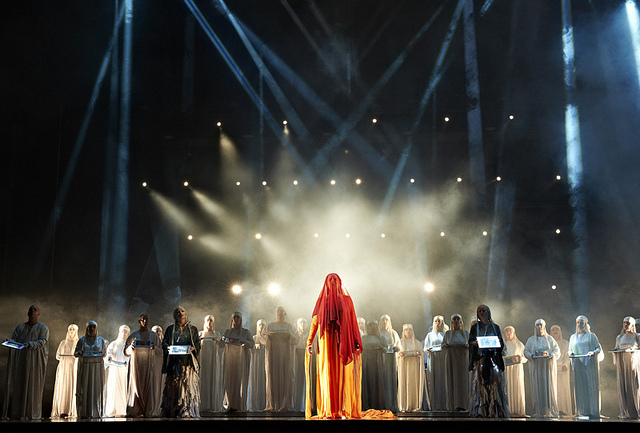
Last night we saw Kaija Saariaho’s L’Amour du Loin at the Four Seasons Centre. It was really, really good. It’s a very unusual piece. There’s not a lot of action in the libretto, despite, or perhaps because of, which Daniele Finzi Pasca devised a most spectacular production (more below). It’s an opera about ideas; love, duty, honour, death, faith, God. The characters spend far more time debating what to do and why than doing it. The plot is very simple. Jaufré Rudel, prince of Blaye, tired of a life of meaningless pleasure, yearns for real love. The Pilgrim tells him of an ideal woman, a countess in Tripoli. devotes Jaufré devotes his life to writing love songs to his “Love from Afar”. The Pilgrim tells Clémence of Jaufré and she falls under his spell. Jaufré decides he must cross the sea and meet Clémence but in doing so falls mortally ill. They meet and throw caution to the winds but Jaufré dies. Clémence decides to take the veil but her attitude to God is ambiguous at best. To who is her finally ecstatically beautiful prayer directed; the deity or her “Love from Afar”? It’s not the easiest piece to engage with. It has something in common with other meditative operas like Dialogues of the Carmélites and Pelléas et Mélisande and it’s rewarding in the same sort of way.
The music really impressed me. It haunted my dreams last night. It is an extraordinary score. In the last couple of weeks I’ve heard quite a few smaller scale works by Saariaho but this was the first time I had heard what she could do with a full orchestra. Her tachnique here seems influenced bu European minimalists like Górecki but the end result is utterly individual. She create waves of sound, often with one section of te orchestra picking a phrase up from another. The effect is almost architectural as textures interplay to create a thing of real beauty. Often, despite the wealth of visuals i found myself wanting to close my eyes and just listen. The solo vocal writing is more straightforward than in some of her chamber works. Each character has a distinct musical signature. The Pilgrim for example has any number of the trills common to medieval vocal music (which I think of as moorish but that’s just my association). The choral writing combines elements of the orchestral and solo vocal styles. It’s all really quite compelling.
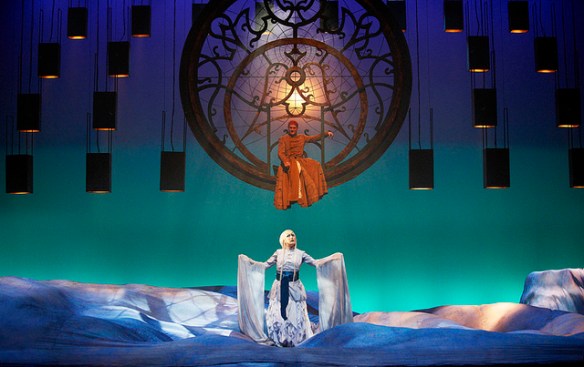
The performances were terrific. All three solo parts are long difficult sings and all three soloists were quite excellent. Russell Braun as Jaufré is on stage for four out of five acts. He was not as smoothly lyrical as he can be but his tougher, more muscular tone suited his line. Kristzina Szabó, as the Pilgrim, also has a lot to do. In many ways her acting must hold the piece together. This she said while sounding very idiomatic in the most ‘medieval’ sounding of the roles. Erin Wall almost stole the show at the end. Much of her part lies cruelly high and includes the sustained f and ff high notes that Saariaho likes to give sopranos. She coped admirably with those to close out the piece with a hauntingly beautiful rendering of the final, despairing prayer. The COC Orchestra and Chorus, were as ever, wonderful and conductor Johannes debus seemed to be right inside the music. Super stuff all round.
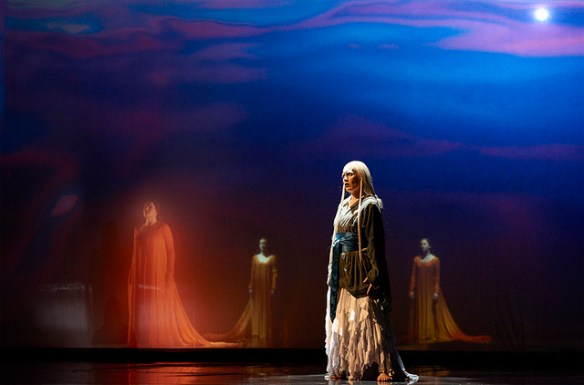
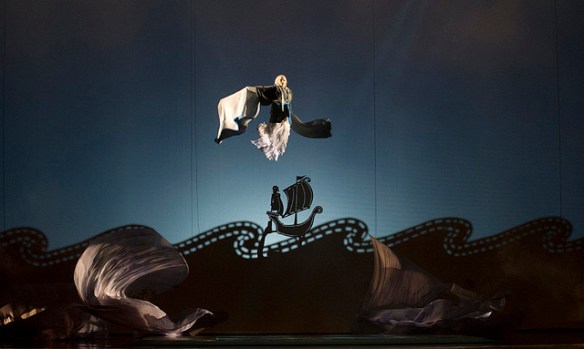
The production is very interesting. Gabriele Finzi pasca and his design team; Jean Rabasse – sets, Kevin Pollard – costumes and especially, Alexis Bowles – lighting and Roberto Vitalini – video, evoke the various settings of the piece extraordinarily vividly using cloth, light and video projections. The evocation of the sea in Act 4 is breathtaking and the ambiguous use of light shone into the auditorium at the beginning and end of the piece ask questions about the stage world and that f the audience. The story telling is embellished with shadow puppets, body doubles, acrobats and aerialists. It’s spectacular in the manner of a rather cerebral Cirque du Soleil performance. It might even be a little over the top to the point of distraction but there’s no denying the beauty of it.
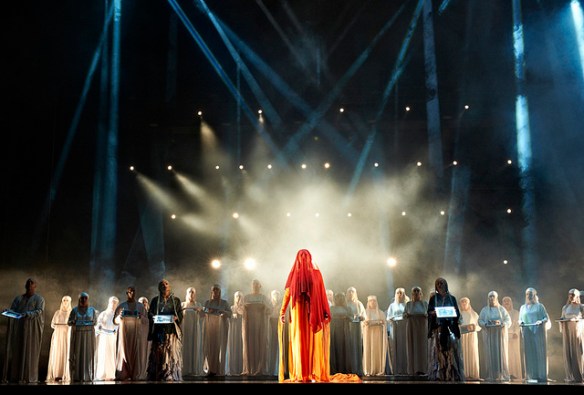
I thought it was a terrific modern opera, beautifully performed and I’d go see this in preference to traditional warhorse productions any time but what I saw last night suggests I may still be a bit unusual in that regard. The house wasn’t full and seats which I’m pretty sure are subscription seats were empty. A significant number of people, young and old, left at the interval. This disturbs me on all sorts of levels. This is quite an accessible piece and it was presented in a production that emphasised that and despite that some people obviously didn’t get it. This worries me far more than people who get offended by blood or nudity in a new production of some over performed Puccini piece. There’s a catch 22 here. A new audience is put off by the idea of opera as a boring museum piece and a section of the traditional audience boycotts anything that isn’t stuffed and mounted. Anyway, if anyone at COC is listening my vote is for innovation, risk and life.
There are four more performances ending on February 22nd. Go see it!
All photos © All rights reserved by Canadian Opera
Reflections on Tosca

The only known photograph from this production as featured in every other print or internet review I've seen.
Puccini’s Tosca is on at the Canadian Opera Company right now. It’s this years “bums on seats” production. There are fourteen performances scheduled; compared to eight for most shows. It’s double casted. It’s a conservative friendly, traditionalist production seen before just four years ago and it features hone town diva, Adrienne Pieczonka. We saw it last night and were a bit disappointed. It wasn’t the sort of show one comes out of spluttering “travesty” or “disgrace” but it wasn’t the sort of performance that gets a standing ovation and excited deconstruction on the subway home either. It felt like a revival of a traditional production. It has to be said that my reaction, while more positive than some reviews I’ve read, wasn’t shared by a large chunk of the audience who switched from their customary coughing to an extended standing ovation. From the chatter I could hear in seats around me that was largely the reaction of the “once a year” crowd so, in a very important sense, this production accomplishes what it needs to do.
Still it’s sad to come out of a performance of Tosca relatively unmoved so let me try and dissect why. Paul Curran’s production is very traditional so there’s no gimmickry to either offend or help overcome shortcomings in the singing or acting department and, of course, there’s no sense of novelty. A reasonably seasoned opera goer is, inevitably, comparing it with other Toscas. Mr. Curran’s programme notes are quite explicit about the success criteria for an enterprise of this type.
The joy and challenge of directing Tosca is not only in the glorious music and razor-sharp libretto, but ideally in workingclosely with the talents of the singers playing and fleshing out their roles. As the curtain rises it is the characters and relationships we must believe in. Characters are built bar by bar, phrase by phrase and discussion by discussion. No word is too small that it might not be the trigger for a singer to find a new angle into their character’s life or psyche, and the job of the director, I believe, is in part to help the cast explore and discover just these subtleties.
The trouble is that not much of this happened. The three principals; Adrienne Pieczonka (Floria Tosca), Carlo Ventre (Cavaradossi) and Mark Delavan (Scarpia), are all established ‘A’ list singers and sang as well as one would expect but neither their characters nor the relationships between them came fully alight. I can take my Tosca somewhat overblown but lukewarm doesn’t really cut it. Delavan is a big man with lots of physical presence but here he struck (rather odd) poses and never really exuded any sense of menace. He didn’t even seem to be that into Tosca. His physical encounters with her in Act 2 suggested that their mutual priority was not upsetting the costume shop. You could find steamier scenes in any high school parking lot. This just reinforced the aloofness of Pieczonka’s very “in control” Tosca. Vissi d’arte, though beautifully sung, came out of nowhere. This wasn’t a woman on the edge of breakdown and when she stabs Scarpia our surprise isn’t that she’s done so but that she didn’t rip his balls off with her bare hands ten minutes earlier. The less said about Ventre’s acting the better though he too sang very well indeed and E luceva qualche stella was probably the emotional highlight of the evening.
Besides fine singing there was quite a lot to like in the production. The orchestra under Paolo Carignani sounded great. I really like the atmospheric lighting plot which used light level and tone to create a variety of effects, especially in Act 1 and in Act 3, where it managed to suggest night time without being so dark one couldn’t see. The chorus both adults and children were excellent and curran creates some pleasing visual arrangements in Act 1 (nice touch where Scarpia barges out past the bishop celebrant). Unfortunately none of this really overcomes the emotional hole at the centre of the production.
I’ve heard it said, from various quarters, that the second cast of Julie Makerov in the title role and Brendan Jovanovich as Cavaradossi (Delavan sings Scarpia in all performances) may up the EQ a bit so they may actually be a better bet. Sheer curiosity may even get me to go find out.
I’m sure what I’ve written above sounds really negative. It needs context. Expectations for COC productions have been raised very high by some truly excellent efforts in recent years and so a “pretty adequate” production that would have received rave reviews ten years ago barely cuts it today. That’s the price of success.
Beautiful simplicity
I don’t think I’ve ever been to an opera with higher expectations than last night. The show was a piece I love; Gluck’s Iphigénie en Tauride. My favourite director, Robert Carsen, was directing. The cast; Susan Graham (Iphigénie), Russell Braun (Oreste), Joseph Kaiser (Pylade), Mark Doss (Thoas) with solid young singers in the minor roles, was as starry as I have seen at the Four Seasons Centre. How could it live up to my expectations? All I can say is that it did.
The stage design for Carsen’s production is about as minimalist as it gets. The raked stage is enclosed by three plain grey walls in the form of a regular trapezoid. Occasionally a rectangular slab (altar) appears centre stage. The chorus chalk the words AGAMEMNON, IPHIGENIE, KLYTEMNESTRE on the walls and later Iphigénie erases them. The rest is done with lighting (Peter van Praet). Even the lighting plot is spare. The palette is predominantly blue-grey with orange/red appearing to symbolise the Furies and the violence of the history of the house of Atreus. Only at the very end does the gloom and claustrophobia lift. Within the gloom though van Praet creates ominous giant shadows of the characters which enormously enhance key scenes.
To play out the drama in this gloomy space Carsen uses dancers and places the chorus in the orchestra pit. Occasionally this leads to minor balance issues between the soloists and chorus but it is a small price to pay for the action on stage. In one particularly effective scene, the Furies carry Oreste and force him to walk sideways across the text of KLYTEMNESTRE. In another they turn into writhing serpents who back Oreste into a corner. In the final scene the “dea ex machina” element is handled about as well as I have ever seen it done. Diana (Lauren Segal) sings, unlit, from what sounded like Ring 4 stage left. The characters on stage are frozen. She resolves the drama and the stage walls rise about six feet to flood the stage with very white light. Unfussy and effective. All in all one feels that Gluck’s ideal of a “beautiful simplicity” is achieved. The one place where the minimalism is a bit of an issue is that all the characters pretty much look the same to the point where it isn’t always obvious who is singing. A good pair of opera glasses, a decent seat and knowing what the main singers look like helps here. I think the approach works in part because the drama moves ahead at a breathless pace. Wagner would need about fifteen hours to get through a story that Gluck manages in less than two hours.
Musically the evening was about as good as it gets. Pablo Heras-Casado pushed things along at a pretty fair pace but didn’t lose the drama. He was helped by some gorgeous woodwinds. The soloists were all quite excellent. Susan Graham owns this part, her rather bright mezzo suits the role and she sounded utterly in command. Joseph Kaiser and Russell Braun worked really well together in a reading that wasn’t as obviously homoerotic as some I’ve seen. Kaiser has a lovely Mozartian tenor and Braun has power and beauty of tone to spare. Mark Doss was appropriately violent as Thoas and I’d really like to see what he could do with something more lyrical. The minor roles were all more than adequately covered by local singers who will be familiar to anyone who frequents the Four Seasons Centre.
So, my unrealistic expectations were met and I thoroughly enjoyed one of the best evenings I’ve spent in an opera house. I’m late to the party though. If you want to catch this show Susuan Graham is singing just one more time on October 12th and there is a final performance with Katherine Whyte in the title role on October 15th.
Rigoletto revisited
Last night I went back to the Four Seasons Centre to take another look at Christopher Alden’s Rigoletto. I was up in Ring 5 this time so quite a different viewpoint and it was the opening night cast singing. I now have a better understanding, I think, of what Alden is driving at and some of the stage action that was just puzzling first time around made more sense. Certainly the role played by Giovanna (Megan Latham) makes much more sense seen as the count’s procuress. The interpretation of Sparafucile is also interesting; part commedia perhaps and reminiscent of the quack in L’Elisir d’Amore with a sinister twist. If we take as valid Alden’s assertion that Rigoletto’s separation of personal and public life is a delusion then having all the action played out in “public” makes a certain kind of sense, though then I have to ask why, uniquely, the scene where Gilda confesses to her father what we (and he) already know, that she has been debauched by the duke, has to be between the two of them is a bit of a mystery. So, all in all, I still think it’s an interesting and very beautiful but not quite “of a whole” production. I much prefer that the COC take some chances even if not everything comes off 100% and I shall look forward to Mr. Alden’s next production here.
Musically there wasn’t a lot to choose between this cast and the one I saw on Friday. Quinn Kelsey is a very powerful Rigoletto and he was a little more restrained in the acting department than Lester Lynch. All in all a very fine performance. Dmitri Pittas was solid as the duke but I think David Lomeli has a more Italianate sound. Ekaterina Sadovnikova is a rather different Gilda to Simone Osborne. Her voice is lighter coloured and perhaps more classically suited to this role and there were none of the top end insecurities that some commented on on opening night. She did seem a bit underpowered in the duets with Kelsey but was fine singing solo. Once again I was pleased/surprised by how good the sound is up in the nosebleeds.
Bottom line, I still think this is a production worth seeing. The house wasn’t full either night I went and, in particular, there were plenty of seats last night in Ring 5. I got a second row dead centre seat as a “rush” ($22) and there were still OK seats available for that price half an hour before curtain.
Lynch, Lomeli and Osborne rock Rigoletto
Last night was the second performance of the COC’s new Rigoletto and the first featuring the alternate leading role trio of Lester Lynch (Rigoletto), David Lomeli (Duke of Mantua) and Simone Osborne (Gilda). The rest of the cast was as on opening night.
Musically this was a really splendid evening. Everybody sang really well. I like Lester Lynch’s idiomatic playing of the title role and he managed to combine a not inappropriate amount of scenery chewing with being thoroughly musical. Lomeli lived up to the “dragged from obscurity by Placido Domingo” hype. I think there is a true Italian tenor emerging here. He nailed his arias with lovely ringing high notes and plenty of swagger. Osborne, on role debut, was lovely. Caro nome was one of the highlights of the evening and ,in general, she sounded very secure across some pretty tough music. The chemistry between the three was pretty good although the production maybe put more emotional distance between Gilda and Rigoletto than is sometimes the case. In any event the voices blended well and seemed well balanced. Among the other roles I was particularly impressed by Kendall Gladden’s Maddalena. She has a really smoky mezzo that created a pleasing contrast with the brighter voices. She’s a pretty fine actor too so it’s easy to see why she gets cast as Carmen! I also liked Philip Ens’ Sparafucile. He was a sinister presence and a genuine bass with a thoroughly solid lower register. All in all, the casting managed to combine very good individual singers into an ensemble that had a really good balance of tone/timbre. The orchestra and chorus were at their usual high standard and Johannes Debus kept things together very nicely and didn’t distract from the singing and I do think this is very much a singers opera.
The production and design (Christopher Alden and Michael Levine) was very decorative. All the action plays out in a lavishly panelled and furnished “gaming room” looking something like the smoking room at one of the better London clubs in the mid/late 19th century. It does duty for the duke’s court, Rigoletto’s home and Sparafucile’s inn. In a sense this creates a kind of unity; all of these spaces are misogynistic theatres of corrupt power and delusion. On the other hand it requires the audience to suspend disbelief more often and more willingly than usual. It’s an odd kind of secret that can be sung mezzoforte in front of the people it’s supposed to be secret from! The male dominated Victorian aesthetic seems to produce a kind of emotional coolness too. We never quite get enough emotional charge in the Gilda/Rigoletto dynamic to fully feel his loss (i.e. I didn’t cry at the end). The final scene though is splendidly and very effectively done.(*)
So summing up, I enjoyed the show. Musically it is first rate. The production was interesting but I don’t think the concept was quite able to carry the piece emotionally. It’s not a disaster and there’s nothing to shock the traditionalist. Maybe if I had seen Rigoletto a million times before I’d be more positive. Go see the show and judge for yourself!
The production runs until October 22nd and there is a choice of the cast we saw or Quinn Kelsey, Dmitri Pittas and Ekaterina Sadovnikova as Rigoletto, the duke and Gilda.
(*)Spoiler follows… Continue reading
The 2010/11 Canadian Opera Company season in review
On paper this looked like the strongest season the COC has ever staged. Every production featured a judicious balance of international stars and local talent. Most of the casting would not have looked shabby in any opera house in the world. In execution it didn’t disappoint. All seven shows were better than competent and the best were very good indeed. The critics were mostly positive though La Cenerentola was less enthusiastically received. Despite all that ticket sales don’t seem to have been all that great. There’s been a fair amount of discounting and definitely more empty seats than one expects at the Four Seasons Centre. The grapevine also tells me worrying things like that the most positive feedback came for a pretty mundane production of The Magic Flute.
So what’s up? I really don’t know but I’d love to see the full stats on ticket sales and see what demographic is growing and which shrinking. I’d hazard a guess that we are seeing a typical Toronto phenomenon; not quite daring to be first rate. The good people of Toronto love to think of themselves as “a world class city” but faced with the awful prospect that they might actually have something that is first class they get scared and, for example, elect a buffoon as mayor. It happened with straight theatre about twenty five years ago. There was a brief flurry of innovative, edgy productions of classic plays but it all sputtered out as audiences couldn’t quite engage and the major theatres were rapidly recolonised by Broadway shows for tourists and straight theatre slunk back into the ghetto of producing plays nobody had heard of in tiny scruffy theatres. Hopefully it’s just a generational thing and a new audience that appreciates what’s on offer will be created. Next season is, if anything, even more exciting than 2010/11 so we will see.
(ETA: There’s also a section of the audience I just don’t understand. More specifically I don’t understand why they are there; they cough, they snore, they whisper, they come in late, they leave the second the curtain falls etc. Why do they come? Do they not realise how rude they are? Is it an entitlement thing?)
So back to the season; the good, the bad and the controversial. Highlights for me were, unexpectedly, Tim Albery’s gritty production of Aida which opened the season. This probably generated more hate mail than any production in COC history but I thought it was bold and effective, though like most bold statements not flawless. Certainly nothing else matched it for raw emotion. Less controversial but just as satisfying was Ariadne auf Naxos. Nothing better exemplified the COC’s ability to blend international stars with local talent (though as three out of five of the international stars were Canadian the categories are not exclusive).
Robert Carsen’s Orpheo was an aesthetic masterpiece entirely in keeping with Gluck’s ideas about simplicity. Beautifully performed, it was enjoyable but in an entirely celebral way. Much the same could be said for Death in Venice; design, direction, singing all beyond criticism but somehow failing to engage at the gut level. The problem lying, I think, with the libretto and its source, rather than anything the COC did to it.
La Cenerentola got a lukewarm reception from the critics who didn’t like the production or the conducting much though all praised the singing. I thought they were harsh. It’s not my favourite opera but I liked the production. The much criticised mice were rather fetching, the production design was a caricature but then so is the work, and the singing was splendid. It would have been a great one to have taken kids to as their introduction to opera.
Nixon in China compared very well with the Met’s version, directed by Sellars and conducted by the composer, which is perhaps all we need to say about it.
That leaves The Magic Flute, apparently the vox populi favourite of the season. Well colour me “blah”. It was OK, even rather good. The production was OK if lacking any real imagination. The singing was extremely stylish but lacked gut punch. Maybe I’d have felt different if it was my first Flute rather than my umpteenth. All in all, I enjoyed the Ensemble Studio performance better. What it lacked in polish it more than made up for in spontaneity.
So, a very high standard over all with a raft of star singers and conductors. Why wasn’t the company playing to packed houses? It’s a mystery.
Next season; more Adrienne Pieczonka, Jane Archibald, Robert Carsen and Sir Andrew Davis plus appearances by Susan Graham, Russell Braun, Christopher Alden, John Relyea, Catherine Malfitano and Alan Held among others.