Paedophilia di Lammermoor

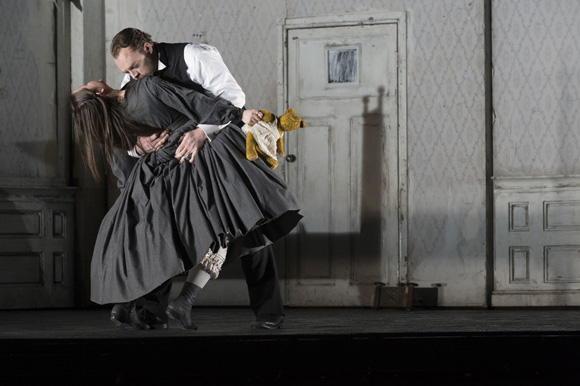
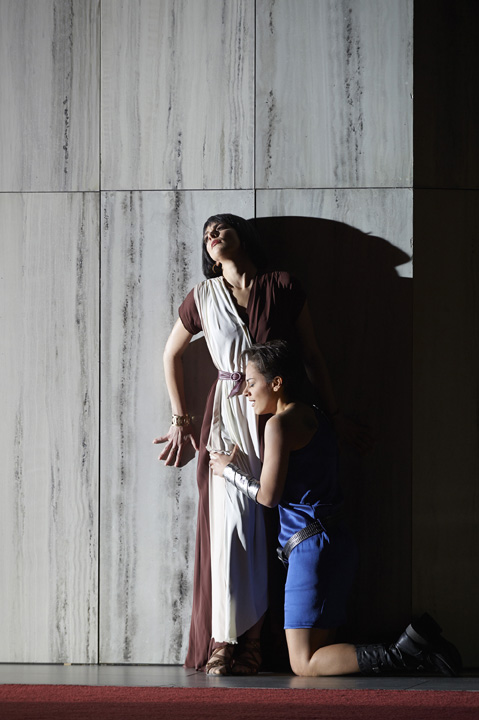
David Alden chooses to set his production of Donizetti’s Lucia di Lammermoor, currently playing at Canadian Opera, in Victorian Scotland in a rather decayed country house.  It’s all set up as classic Gothic schtick.  The angle is that Lucia herself is very young and is being sexually abused by her brother Enrico.  OK, I don’t have a problem with that.  It’s a better solution than the idea that women are all just inherently unstable and liable to go from shrinking violet to shrieking murderess at the drop of a forged letter.  So, it’s an interesting idea but it poses real problems about the nature of her relationship with her “fiance” Edgardo.  If he’s the hero of this thing what is he doing having a clandestine relationship with a girl who’s not yet out of the schoolroom?  (We can tell this by how she’s dressed).  This is a major Victorian taboo.  Respectable men don’t go after girls until they are “out”.  Are we then to see Edgardo as as a big a cad as Enrico?  Maybe.  The trouble with that concept is then why do we care what happens to him?  Edgardo kills himself.  Goodbye paedophile creep.  So what!  So bottom line, I can take the groping and the creepiness that some critics have complained about but I wonder what Alden is really trying to tell us about the piece.

67 – Anna Christy as Lucia and Brian Mulligan as Enrico in the

Photo credit: Chris Hutcheson

Continue reading

Cinematic Salome

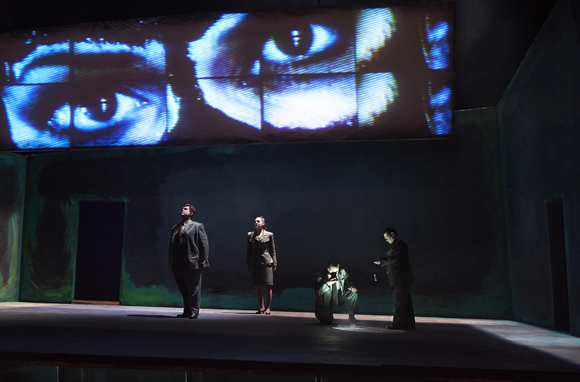
It comes as no surprise that an opera by Atom Egoyan comes across as somewhat cinematic but it’s hard not to use the term of his production of Richard Strauss’ Salome at Canadian Opera Company.  It’s quite a spare production.  There’s a raked stage; the raised end providing a sort of dungeon for Jochanaan and the back and side walls used for projections, especially of a giant mouth prophesying (shades of Big Brother here) and shadow puppets.  Costumes are simple and in shades of red, white and green.  The concept is based on the idea that Salome is a very young girl who has a history of sexual abuse at the hands of Herod that explains her “monstrousness”.  It’s most vividly explored during the dance of the seven veils where Salome rises above the stage on a swing and her robes form a scrim on which a video is projected.  It starts with a very young girl in a garden and gets progressively darker until it finishes up with today’s Salome being raped by her stepfather’s entourage.  Fittingly, the opera ends with Herod himself strangling Salome, perhaps more to silence her than out of disgust.

12-13-06-MC-D-081 Continue reading

Ex Alden semper aliquot novis

12-13-04-MC-D-814Last night saw the final performance of the COC’s run of La clemenza di Tito.  I had seen the Ensemble Studio performance a couple of weeks ago and really enjoyed it but had some questions and reservations about the production.  Last night many of those issues were resolved. It seemed more closely directed and the characterizations were more fully rehearsed.  A good example of this would be Michael Schade’s intensely neurotic Tito which was central to the concept.  Many things make sense if one sees Tito as being in love with an idea of himself.  In this context his betrayal by Sesto is particularly hurtful because it implies that his closest confidante isn’t buying it and his “clemency” is necessary to restore his faith in his own self-projection.  This Tito gives Robert Gleadow’s Publio space and reason to be more than the dutiful, rather thick plod.  He’s the one who has seen through Tito but must “play the game”.  His final, rather sharp, exchanges with Vitellia suggest a genuine capacity for malevolence.  This is, after all, an Imperial Court, where by definition life is dangerous and nothing what it seems.

Continue reading

Back to Tristan

Last night the lemur and I braved the biggest snow storm in several years to catch Tristan und Isolde at the Four Seasons Centre.  It was the same production I saw last Tuesday but with Michael Baba and Margaret Jane Wray replacing Ben Heppner and Melanie Diener in the title roles.  I was also sitting at the front of the Orchestra Ring which is a very different sight line than the back of Ring 3.  There’s no way to avoid saying this, it was hugely disappointing and especially so as it was the first time the lemur had seen the show and I had been talking it up excitedly since Tuesday.  Baba and Wray sounded underpowered and under-rehearsed.  The big Act 2 duet, O sink’ hernieder, Nacht der Liebe, that had left me literally shaking on Tuesday merely left me shaking my head.  What had been a glorious, transcendent, hypnotic wave of sound had turned to mush.  It was a relief when Franz-Josef Selig, King Marke, took over.  At last we got some Wagnerian singing of style and class.  Act 3 wasn’t much better.  To be fair, the rest of the cast was just as good as on opening night and the orchestra deservedly got the loudest and longest applause of the night.  But Tristan und Isolde needs, as Isolde points out, Tristan and Isolde.

Tristan und Isolde - 0013 - Credit Chris Hutcheson

Continue reading

Sic Semper Tyrannis

12-13-E-04-MC-D-0071 Last night saw the COC Ensemble Studio’s annual main stage performance.  This year it was Mozart’s La Clemenza di Tito in a Christopher Alden production.  It’s a somewhat quirky production that I haven’t fully digested yet and may need to wait until after seeing the main cast on the 22nd to come to a more considered view.  My initial reaction is that it has a lot of interesting ideas, maybe one or two misguided ones and that the whole thing, while interesting, isn’t completely coherent.  That said, Alden productions often seem more coherent second time around.  And whatever I might think of the production, it didn’t distract from some very fine performances.

Continue reading

Highest, purest joy

12-13-03-MC-D-0022-21After seeing Peter Sellars on Monday night I decided that (a) I had to see Ben Heppner as Tristan and (b) I couldn’t wait until next Friday when I have tickets to see Michael Baba in the role.  So, I skipped out of the office yesterday morning and with a little help (thanks Sergey!) scored a standing room ticket for last night’s opening.  (At $12 for nearly five hours music this was a remarkable bargain!).  I’m back at my desk on five hours sleep and I’m still in shock.  This will go down in legend.

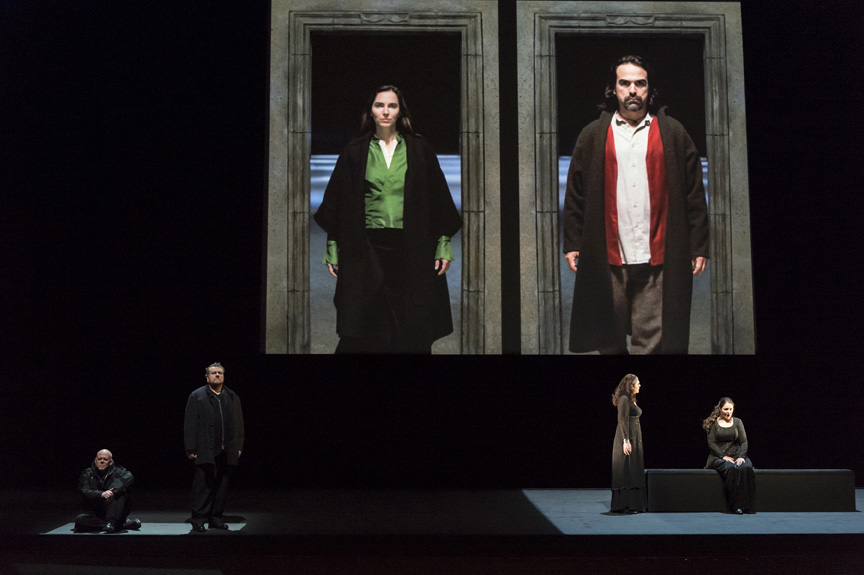
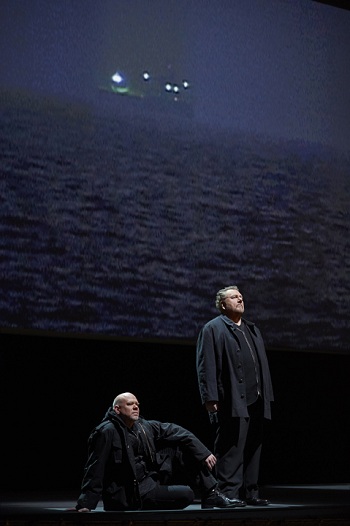
I’d only seen Tristan und Isolde once before, in a disastrous MetHD broadcast, which had been so irritating that the music left little impression.  Other times I’d attempted it on DVD I couldn’t get past the nothinghappensness of it.  Last night I finally got it.  In Sellars’ production not much happens on stage.  The singers, in non descript monochrome outfits, come and go or stand around in square light spots.  They gesture in characteristically Sellarian fashion but it’s almost classic “park and bark”.  But, and it’s a huge but, behind them there is a giant screen on which videos by Bill Viola play more or less continuously and through them he evokes time and place and we see the inner journeys of the characters.  It’s really hard to describe but it works brilliantly.  To counterpoint the long meditative sections, when there is action it often happens off stage.  The chorus sing off stage from various parts of the house and characters, too, appear on the orchestra apron or high up in the Rings.  These action moments are often accompanied by lighting that encompasses the auditorium and implicates us in the action (but not the dark inner journey of Tristan and Isolde).  It’s great.  (1)

Continue reading

Die Fledermaus redux

Mireille Asselin as Adele – Photo: Michael Cooper

I was back at the Four Seasons Centre last night for another look at the new Die Fledermaus; this time with Mireille Asselin as Adele.  There were a number of things about the production that I noticed more on a second look.  The most notable was the lighting (by Paul Palazzo).  It’s superb.  It’s atmospheric without falling into the trap of being so dark one can’t see anything.  Obviously too I saw the kind of prefiguring that goes on throughout the production differently knowing where things were going to go.  It’s clever and insightful without being too intrusive.  I also noticed one or two bits of comic business that either passed over me on opening night or have been added since.  Was the Fidelio joke there on opening night?  My overall verdict hasn’t changed.  It’s a funny, sexy production that can be enjoyed on many levels and one of the best things I’ve seen in ages.

So how was Mireille?  She was very good and very different from Ambur Braid.  Mireille is pretty much your classic soubrette; what I guess we are now calling an -ina voice.  It’s not a particularly big voice but she’s accurate and musical.  She’s also a very decent actress.  One feels that she’d be an ideal Adele in a perfectly conventional Fledermaus.  For this rather spikey, edgy version though I’d go with Ambur.  Her bigger, almost abrasive, voice and her more flamboyant acting (considerably helped by her rather striking appearance) really fit this production.  I’m glad I got a chance to see both of them.

Full review of the opening night with Ambur Braid as Adele

Fifty shades of grey

Verdi’s Il Trovatore notoriously has an episodic and highly improbable plot.  It’s also famously difficult to cast.  Creating a compelling production and staffing it with capable singers therefore presents a formidable double challenge.  The current Canadian Opera Company production gets it half right.  The problem is Charles Roubaud’s much travelled production.  There’s not an idea in it.  It’s not surprising that the director’s programme notes run to three short paragraphs.  Roubaud sets each scene in a sort of grey box of towering walls.  Unfortunately each grey box is just different enough that that the curtain comes down at the end of each scene and the stage crew spend what seems like an interminable amount of time setting up the next grey box.  We just aren’t used anymore to sitting quietly through interminable scene changes.  We expect slicker stagecraft and in a modern opera house there’s really no excuse for this 19th century approach.  Within in each grey box the grey clad cast come and go and in between mostly stand around.  Blocking is perfunctory, acting superfluous and old fashioned “park and bark” the order of the day.  It’s the sort of production that might have passed muster thirty years ago but really doesn’t cut it in 2012.
Continue reading

COC’s Fledermaus succeeds on several levels

Christopher Alden’s recent productions in Toronto; Rigoletto and Der Fliegender Holländer, were controversial, rather cerebral affairs that delighted his fans but tended to puzzle, and even infuriate, the more conservative critics and opera goers.  His Die Fledermaus, which opened last night at the Four Seasons Centre, has something for everybody.  There are two main threads uniting the three acts.  The first is the piece as an allegory of Austrian bourgeois society from an insecure pre WW1 period through a period of unbridled hedonism in the 1920s to the beginnings of Fascism.  The second is a much more explicit depiction of Falke as the ringmaster of the whole circus.  He goes from manipulative Freudian psychiatrist in Act 1 to Orlofsky’s confidante in Act 2 to, bat costumed, sitting astride the giant watch that hangs above the stage; the only character aloof from the takeover of the drama by the sinisterly Fascistic Frosch. All this is strung together by prefiguring later elements in earlier scenes.  In Act 1 the party goers from Act 2 invade the scene via the fractured wall of Rosalinde’s bedroom as Gabriel imagines the delights to come.  A silent but frenetic Frosch appears on stage at various points in the first two acts although his identity isn’t apparent until the coup de theâtre that carries us into Act 3.  Additionally Alden does not shy away from bat imagery, including it’s darker overtones.  There are bat shadows on the backdrop during the overture, Falke first appears as a Dracula look alike, the ‘ballet’ are batgirls and we close out with Falke, again dressed as a bat, overseeing the denouement.  There’s a lot going on  and I shall be very happy to see this again and delve deeper (a recurrent theme with Alden productions).  Continue reading

Sneak preview of Die Fledermaus

Female chorus member – Sketch: Constance Hoffman

There’s an event on in Toronto this weekend called “CultureDays”.  The COC’s contribution last night was an open orchestra dress rehearsal of Christopher Alden’s new production of Die Fledermaus preceded by a talk in the Richard Bradshaw Auditorium by set designer Allen Moyer and costume designer Constance Hoffman moderated by the CBC’s Brent Bambury.  The event was “first come, first served” and restricted to 500 tickets so we decided to be early.  Doors opened at 1815 for a 1830 talk so the plan was to meet the lemur at the opera house at 1700, grab a bite to eat and then join the line-up.  I got there early as I was through at work and preferred to sit in the sunshine at the Four Seasons Centre rather than at my desk so I got there around 1615.  There was already a line up!  By the time the lemur showed up just before 1700 there was quite a line up so we changed plan and the lemur went off to fetch burritos to eat in the line.  Just as well as they ended up turning people away.  Continue reading