Joan Sutherland on form

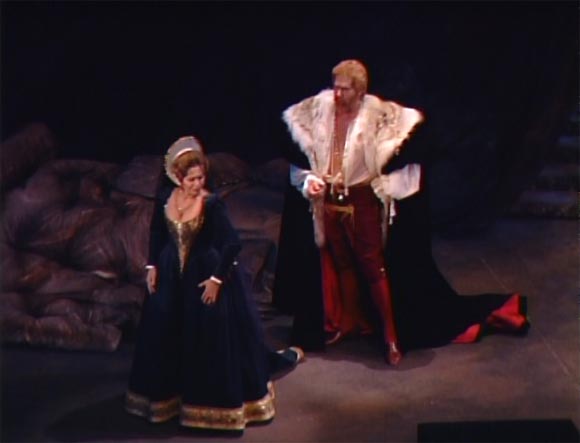
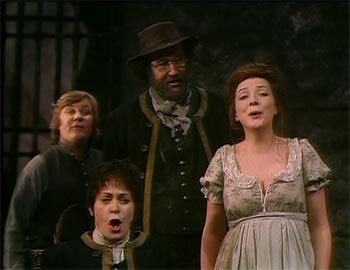
A while back I reviewed the train wreck that is the CBC recording of Joan Sutherland in Norma. Three years later the Canadian Opera Company and the CBC tried again with a recording of Donizetti’s Anna Bolena. As a recording and a production it has its limitations but it’s not a disaster and is enjoyable in many ways.

Continue reading

Kathleen Battle steals the show again

In this next episode of our wallow in Met nostalgia we  are looking at the 1988 production of Richard Strauss’ Ariadne auf Naxos.  It’s a starry affair with James Levine conducting, Jessye Norman in the title role, James King as Bacchus, Kathleen Battle as Zerbinetta and Tatiana Troyanos as the Komponist.  There’s even a bit of luxury casting in the minor roles with Barbara Bonney and Dawn Upshaw among the nymphs.  It’s also as old fashioned as one could possibly imagine, being a revival of a production that premiered in 1962. Continue reading

Hockney’s Flute

It seems to be “looking back at older Metropolitan Opera productions” week here in the blogosphere.  Over at The Earworm there’s a series of posts on a 1980 production of Don Carlos.  Our subject will be the 1991 Die Zauberflöte.

The production was designed by David Hockney and the look varies from the whimsical; the opening scene, to the grandiose; the final scene, with bits of Egyptiana in between.  It’s very handsome.  The direction is described as “original direction” by John Cox and “direction” by Guus Mostart.  I’m not entirely sure what this means as there doesn’t really seem to be a production concept and the Personeregie is pretty basic.  Basically it looks like acting is considered to be an optional extra.  Some of the singers are good actors and some don’t even try.  There’s no consistency.  The impression is that the “production” is just a backdrop for the singers to do their thing. Continue reading

There’s the Moral to Draw

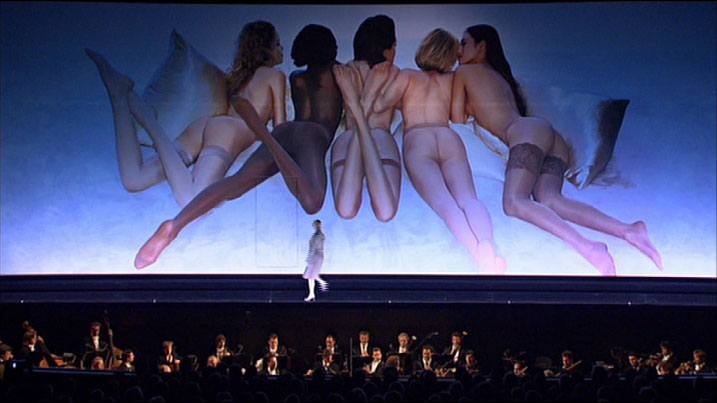
Robert Lepage’s 2007 Brussels production of The Rake’s Progress is fascinating on many levels.  I think all good opera productions start with the music and this is no exception.  Lepage sees a crucial relationship between Stravinsky at the time the work was written (1948) and film and television.  It was an era when insubstantial visual imagery was being supported emotionally by pretty impressive music.  Lepage works with that idea; setting the work in the 40s and incorporating film and film making imagery extensively.  I think this decision also frees up the music.  By taking the piece out of the 18th century it becomes possible to take the 18th century out of the piece.  For instance, there are elements in the libretto that mimic 18th century street ballads but Stravinsky absolutely avoids writing the kind of phrasing one might expect and quite deliberately breaks up the line.  That phrasing is respected here whereas I have often heard a false legato imposed on some of those phrases. In a way, the production is helping the viewer to hear the music differently which is perhaps the highest compliment one can pay an opera production.  There are other intriguing relationships between Lepage’s vision and Stravinsky’s.  Lepage sees Stravinsky as playing with time in a cinematic way i.e. rendering it non-linear.  Lepage seeks to mirror this in the spatial dimension by using some odd perspectives and some cinema devices; notably Anne driving her car in front of a moving backdrop just like a studio movie of the period.  There’s a lot going on and it would be tedious to describe it in detail.

Continue reading

La Fille de Laurent Pelly

Laurent Pelly’s 2007 production of Donizetti’s La Fille du Régiment was a coproduction of the Royal Opera House, The Metropolitan Opera and the Wiener Staatsoper which one make expect to produce a stodgy snoozefest.  It’s not.  It’s a fast paced, energetic and funny production.  There’s nothing especially cleverly conceptual about it but its well designed, well directed and well played.  If one were to be hyper critical it would be that the humour in Act 2 is rather laid on with a trowel but it’s not too seriously overdone.  The setting is updated from the wars of the first Napoleon to something vaguely WW1 like.  In some ways this doesn’t make a whole lot of sense but it does provide a visual “Frenchness” that’s probably easier for modern audiences and, anyway, the libretto as originally written is about as historically accurate as the average piece of bel canto fluff.  Best not get into serious military history buff territory and get on and enjoy the show.

Continue reading

You should have hoped us

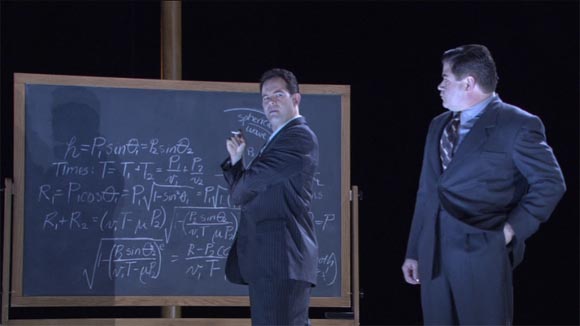
I’ve watched John Adams’ Doctor Atomic three times now. The first time; a MetHD broadcast, I wasn’t impressed at all.  The second time; an AVI rip of the Dutch television broadcast, I started to come around.  Having now watched the Opus Arte DVD based on the Dutch TV broadcasts I’m converted.  This piece is every bit as good as Nixon in China and probably surpasses it in emotional impact due to the more visceral nature of the material.  The orchestral writing is classic Adams.  The musical argument is swept along on a strong rhythmic pulse and overlapping waves of colour.  In contrast the vocal line often seems duller though there are passages of great lyricism, notably Oppenheimer’s big Act 1 aria Batter my heart, three personed God.  Kitty Oppenheimer and the native woman, Pasqualita, also get some good singing.  I also found myself warming to the libretto.  Some rather self conscious passages of Donne and Baudelaire aside, it lacks the poetry of Goodman’s libretti for Adams but Peter Sellars’ selection of words taken from the documentary record is, in its way, quite compelling; reflecting the mix of high and banal concerns that people under great tension express.  It’s particularly interesting to see the relatively high level of respect for and confidence in the moral judgement of politicians displayed by the scientists.  One doubts whether that would be the case today.  In total, it’s a strong additiion to the repertoire of 21st century operas.

Gerald Finley (Oppenheimer) and Richard Fink (Teller) do physics

Continue reading

Fidelio at Glyndebourne 1979

Southern Television’s 1979 Glyndebourne broadcast was Beethoven’s Fidelio. The production by Peter Hall with designs by John Bury is conventional enough though tendencies to exaggerate are clearly creeping in. The chorus of prisoners is almost zombie like and Florestan looks disconcertingly like the legless sea captain from Blackadder II. Apart from that it’s a conventional 1800ish setting where the prison’s a prison, the dungeon’s a dungeon etc. It’s also very literal in that the dungeon is so dark it’s almost impossible to see anything.  Continue reading

Hockney’s Rake

Having watched quite a few opera recordings from the 70s and 80s recently I can well see why David Hockney’s designs for Stravinsky’s The Rake’s Progress at Glyndebourne were such a big deal back in the day. They look they were designed by an artist rather than being lifted from an expensive department store furniture catalogue. And, of course, they are still in use. Beyond the design issues, this has a kind of transitional feel as a production. Occasionally some acting breaks out and quite imaginative use is made of the chorus but there is a lot of “park and bark”; perhaps somewhat inevitable on the old, small Glyndebourne stage but very noticeable. It’s hard not to feel that director John Cox could have done a lot more with a neat staging and a talented cast.  Continue reading

Normal service will be resumed shortly

On a bit of a hiatus here caused in part by bad luck with some library DVDs; a couple of which turned out to be pretty much unwatchable and certainly not worth a full blown review.  For the record:

Shannon Mercer - Extremely Silly

Le Nozze di Figaro; Glyndebourne 1973.  Dates from the era before acting or stage direction made it into opera.  eg: Susanna “this is the hat that I made”. Stops, grins, points to hat…

Not the Messiah (He’s a Very Naughty Boy); RAH 2009.  I was searching the library catalogue for Claus Guth’s staged Messiah.  Not a chance of course but I did find this.  How bad could a Monty Python oratorio be I thought?  That bad!  How did the lovely Shannon Mercer and a trouper like Rosalind Plowright get mixed up with this pile of dreck?

Hopefully the “to watch” pile will turn up something better soon.

Robert Carsen’s Eugene Onegin

One of the early Metropolitan Opera Live in HD broadcasts was a 2007 showing of Robert Carsen’s 1997 production of Tchaikovsky’s Eugene Onegin with Dmitri Hvorostovsky and Renée Fleming.  It was subsequently released on DVD and Blu-ray by Decca and remains one of the most successful disk releases spawned by the broadcasts.

1.leaves Continue reading